

-
×
 Semaglutide 15mg
1 × $200.00
Semaglutide 15mg
1 × $200.00 -
×
 Creatine + BCAA Gummies 5g
1 × $30.00
Creatine + BCAA Gummies 5g
1 × $30.00 -
×
 Thymalin 20mg
1 × $50.00
Thymalin 20mg
1 × $50.00 -
×
 Pinealon 50mg
1 × $100.00
Pinealon 50mg
1 × $100.00
Weight Management & Metabolic Health
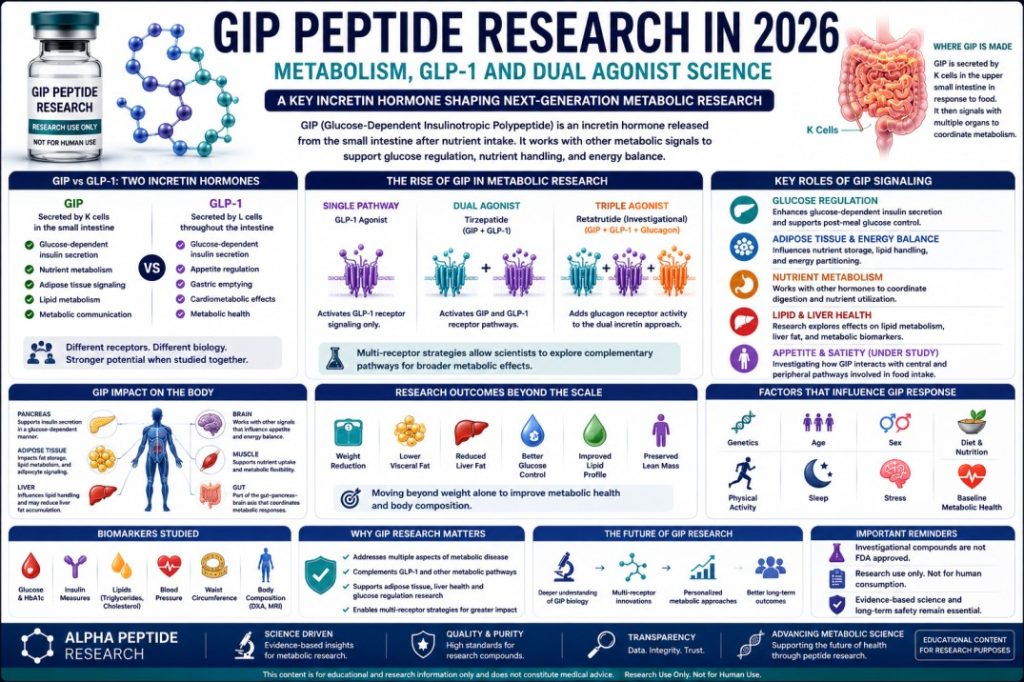
GIP Peptide Research in 2026: Why This Incretin Matters Beyond GLP-1
27
Jul
Jul
GLP-1 receives enormous attention in modern metabolic science. However, another incretin hormone has become increasingly important.
That hormone is GIP.
GIP stands for glucose-dependent insulinotropic polypeptide. Scientists have studied it for decades, especially because of its role in nutrient-dependent insulin secretion.
Today, however, the research landscape is much broader.
Current studies examine GIP in relation to glucose metabolism, adipose tissue, energy balance, body composition, and other metabolic pathways.
Furthermore, dual and triple receptor agonists have changed how scientists view GIP.
Tirzepatide combines GIP and GLP-1 receptor agonism. Meanwhile, investigational compounds such as retatrutide extend the concept by adding glucagon receptor activity.
Consequently, GIP peptide research has moved from a specialized field into a central area of next-generation metabolic science.
What Is GIP?
GIP is an incretin hormone released primarily from K cells in the small intestine.
Nutrient intake stimulates its secretion. Subsequently, GIP participates in communication between the digestive system and other metabolic tissues.
Several biological processes are connected with this pathway.
For example, scientists study GIP in relation to:
Glucose-dependent insulin secretion
Nutrient metabolism
Adipose tissue signaling
Energy balance
Lipid metabolism
Metabolic communication
Therefore, GIP should not be viewed simply as another version of GLP-1.
Instead, it represents a distinct biological pathway with its own research questions.
What Does Incretin Mean?
Incretins are gastrointestinal hormones released after nutrient intake.
Essentially, they help coordinate the body’s metabolic response to food.
Two major incretin hormones dominate current research:
GIP
GLP-1
Both can enhance glucose-dependent insulin secretion. Nevertheless, they act through different receptors and have distinct physiological characteristics.
Because of these differences, scientists can investigate each pathway independently. More importantly, they can examine what happens when both pathways are activated together.
Ultimately, that question helped drive the development of dual agonist research.
GIP vs GLP-1: What Is the Difference?
GIP and GLP-1 belong to the incretin system. However, they are not interchangeable.
GIP
GIP is secreted primarily by K cells in the small intestine.
Among other areas, its research landscape includes insulin secretion, nutrient handling, adipose tissue, and energy metabolism.
GLP-1
GLP-1 is another incretin hormone produced mainly by intestinal L cells.
In contrast, much GLP-1 research focuses on glucose-dependent insulin secretion, appetite regulation, gastric emptying, and broader metabolic effects.
Therefore, both hormones participate in nutrient-related signaling. Yet their receptors and physiological actions differ.
This distinction provides the foundation for combined GIP and GLP-1 research.
Why GIP Research Has Gained New Attention
GIP biology is not new. In fact, scientists have investigated the hormone for decades.
Modern multi-receptor compounds, however, have renewed interest in the pathway.
Tirzepatide played an important role in this shift.
Rather than activating only GLP-1 receptors, tirzepatide targets GIP and GLP-1 receptors.
As a result, scientists gained a new model for investigating coordinated incretin signaling.
Since then, the field has expanded further.
Triple agonist research now allows GIP to be studied alongside GLP-1 and glucagon signaling.
Consequently, GIP has become central to the evolution of metabolic peptide research.
GIP and Glucose Regulation
Glucose metabolism remains one of the most established areas of GIP research.
After nutrient intake, GIP can contribute to glucose-dependent insulin secretion.
Importantly, the phrase “glucose-dependent” describes a key part of the biology.
The response depends partly on glucose conditions rather than operating independently of nutrient status.
Therefore, this mechanism helps scientists examine how digestion and glucose regulation are coordinated.
Furthermore, GIP does not act alone.
Insulin, glucagon, GLP-1, amylin, and other signals also contribute to post-meal metabolic regulation.
For this reason, GIP is increasingly studied as part of a larger hormonal network.
GIP and Insulin Research
Pancreatic beta cells play a central role in insulin secretion.
Because GIP receptors are present on beta cells, GIP signaling can influence insulin release under appropriate glucose conditions.
Several research questions arise from this relationship.
For example, studies may examine:
Insulin secretion
Beta-cell response
Post-meal glucose
Incretin signaling
Glucose tolerance
Metabolic dysfunction
However, metabolic disease can alter normal physiology.
Consequently, scientists investigate how GIP responses differ across populations and metabolic states.
GIP and Adipose Tissue Research
Another major area of GIP research involves adipose tissue.
Fat tissue is not simply a passive energy reserve. Instead, it functions as an active metabolic organ.
Among its many roles, adipose tissue participates in:
Energy storage
Lipid handling
Hormonal signaling
Inflammatory signaling
Nutrient partitioning
Metabolic regulation
Accordingly, GIP receptors have attracted substantial attention in adipose tissue research.
One major question involves how GIP signaling affects nutrient storage and energy balance.
Moreover, these questions become increasingly relevant when GIP activity is combined with other metabolic pathways.
Why GIP Biology Can Seem Complicated
At first glance, GIP research can appear contradictory.
For instance, scientists have investigated both GIP receptor activation and approaches involving reduced GIP receptor signaling.
How can apparently different strategies both attract scientific interest?
The answer lies in biological complexity.
A receptor pathway can behave differently depending on tissue, metabolic state, duration of exposure, and interaction with other pathways.
Therefore, simple conclusions such as “GIP is good” or “GIP is bad” do not accurately describe the science.
Instead, modern research focuses on mechanism.
Ultimately, scientists want to understand when, where, and how GIP signaling influences metabolic outcomes.
What Is a GIP Receptor Agonist?
A GIP receptor agonist activates the GIP receptor.
Through this approach, scientists can study the physiological consequences of GIP receptor signaling.
However, agonism becomes especially interesting when combined with another pathway.
Tirzepatide provides a prominent example because it activates GIP and GLP-1 receptors.
Consequently, coordinated signaling can be investigated alongside GLP-1 receptor agonism alone.
This comparison has helped expand modern incretin research.
Tirzepatide and Dual Agonist Research
Tirzepatide played a major role in bringing GIP into mainstream metabolic science.
Its receptor profile combines GIP and GLP-1 receptor agonism.
Therefore, the approach is commonly described as dual incretin agonism.
Studies can examine glucose regulation and body weight. In addition, scientists may evaluate body composition, waist circumference, lipid markers, and other cardiometabolic outcomes.
However, the scientific significance extends beyond any single measurement.
Tirzepatide demonstrates how two incretin pathways can be investigated within one pharmacological strategy.
As a result, dual agonism helped influence the next generation of metabolic research.
Why Combine GIP and GLP-1?
Both GIP and GLP-1 participate in nutrient-dependent metabolic signaling.
Nevertheless, their biological actions are not identical.
Combining them therefore gives scientists an opportunity to investigate complementary mechanisms.
For instance, research can examine insulin response and appetite. In addition, studies may evaluate adipose tissue, body composition, and metabolic biomarkers.
Individual response also matters.
Consequently, dual agonism creates research opportunities that extend beyond studying either pathway in isolation.
GIP and Appetite Research
GLP-1 is widely associated with appetite research. GIP, however, presents a more complex picture.
Scientists are investigating how GIP receptor signaling interacts with central and peripheral pathways involved in energy regulation.
Furthermore, combining GIP with GLP-1 may create biological effects that cannot be explained by either pathway alone.
Therefore, studies may examine food intake, satiety, meal patterns, and energy balance within broader multi-receptor models.
Ultimately, this systems approach reflects the complexity of appetite regulation.
GIP and Body Composition
Total body weight cannot explain what happens to individual tissues.
Consequently, body composition has become an important endpoint in metabolic research.
Depending on the study, measurements may include:
Fat mass
Lean mass
Visceral adiposity
Waist circumference
Skeletal muscle
Regional fat distribution
Liver fat
Together, these measurements help show how different body compartments respond.
Moreover, body composition research can reveal changes that a standard scale may miss.
Therefore, it provides important context for modern metabolic studies.
GIP and Visceral Fat Research
Visceral adipose tissue surrounds internal organs within the abdominal cavity.
Excess visceral adiposity is associated with several markers of metabolic dysfunction. Therefore, this fat compartment receives significant attention in metabolic research.
GIP is particularly relevant because the pathway connects with nutrient handling and adipose tissue biology.
When GIP and GLP-1 signaling are studied together, scientists can examine whether total weight changes correspond with changes in abdominal fat distribution.
Furthermore, advanced imaging can provide additional information about specific fat compartments.
Consequently, visceral adiposity has become an important endpoint within broader incretin research.
GIP and Lipid Metabolism
GIP research also intersects with lipid biology.
After nutrient intake, the body must process incoming energy. Subsequently, some nutrients may be stored or used by different tissues.
Adipose tissue plays an important role in this process.
Therefore, scientists investigate how GIP signaling relates to lipid handling and nutrient partitioning.
Relevant measurements may include:
Triglycerides
Cholesterol markers
Fat mass
Adipose tissue response
Liver fat
Other metabolic biomarkers
However, these systems interact closely.
For this reason, individual lipid measurements are usually interpreted within a broader metabolic context.
GIP, GLP-1 and Glucagon Triple Agonism
Dual agonism was not the endpoint of multi-receptor research.
More recently, triple agonist models have expanded the field.
Retatrutide is an investigational example designed to activate GIP, GLP-1, and glucagon receptors.
By adding glucagon receptor activity, scientists can ask additional questions about energy expenditure, hepatic metabolism, glucose regulation, and lipid biology.
Therefore, triple agonism represents another stage in the evolution of GIP peptide research.
However, retatrutide remains investigational in 2026.
Accordingly, its research status should be clearly distinguished from approved medicines.
GIP Within the Multi-Receptor Research Landscape
Modern metabolic science now includes several major receptor strategies.
For example, GLP-1 receptor agonism focuses primarily on one receptor pathway.
By comparison, GIP and GLP-1 dual agonism combines two incretin systems.
Triple agonism goes further by adding another metabolic signal, such as glucagon receptor activity.
Meanwhile, amylin research explores a distinct pathway associated with satiety and nutrient regulation.
Consequently, metabolic peptide research has become increasingly diverse.
Rather than focusing exclusively on GLP-1, scientists can compare several biological strategies.
GIP vs Amylin Research
GIP and amylin both participate in metabolic regulation. However, they are different peptide hormones.
GIP is an incretin hormone released primarily from the small intestine.
Amylin, in contrast, is released from pancreatic beta cells alongside insulin.
GIP research often examines incretin signaling, insulin secretion, nutrient metabolism, and adipose tissue.
Meanwhile, amylin research frequently focuses on satiety, food intake, gastric emptying, glucagon regulation, and energy balance.
Therefore, each pathway creates distinct research opportunities.
In the future, scientists may increasingly investigate how these systems complement other metabolic signals.
GIP and Liver Health Research
The liver plays a central role in metabolic regulation.
For example, it participates in glucose storage, glucose production, and lipid metabolism.
Consequently, metabolic studies increasingly evaluate liver-related endpoints.
Depending on the research question, studies may measure:
Liver fat
Lipid markers
Glucose regulation
Insulin sensitivity
Visceral adiposity
Body composition
However, many interacting pathways influence liver biology.
Therefore, appropriate imaging and biomarkers are important when scientists evaluate hepatic outcomes.
Metabolic Biomarkers in GIP Research
Weight change alone cannot describe overall metabolic health.
For this reason, GIP-related studies often examine additional measurements.
Depending on the research question, these may include:
Fasting glucose
HbA1c
Insulin-related measures
Triglycerides
Cholesterol
Blood pressure
Waist circumference
Body composition
Liver-related markers
Together, these measurements create a more complete picture of metabolic response.
Furthermore, they allow scientists to study changes that may not be visible through body weight alone.
Why Individual Response Matters
Average study results provide useful information. Nevertheless, individual responses can vary.
Several biological and lifestyle factors may contribute to these differences.
For example, genetics, age, sex, and baseline body composition may influence response. In addition, metabolic status, diet, physical activity, sleep, hormonal signaling, and dose exposure can matter.
Consequently, researchers increasingly want to understand why individuals respond differently.
Ultimately, this work could contribute to more precise models of metabolic response.
Why Long-Term Research Is Important
Short-term metabolic changes can provide valuable information. Nevertheless, long-term outcomes are essential.
Scientists need to determine whether observed changes persist over months or years.
Furthermore, extended studies can examine weight maintenance, glucose regulation, body composition, cardiometabolic outcomes, tolerability, and safety.
Individual response may also change over time.
Therefore, long-term evidence can provide a deeper understanding of GIP within metabolic science.
Why Research Quality Matters
The rapid growth of incretin science has created enormous public interest.
However, online information varies greatly in quality.
Therefore, scientific evaluation should distinguish between peer-reviewed studies, registered clinical trials, regulatory information, company announcements, preclinical evidence, and unverified claims.
Laboratory quality matters as well.
For example, compound identity and purity can influence experimental reliability. Stability, storage, analytical documentation, and appropriate controls are also important.
Consequently, rigorous scientific standards remain essential throughout peptide research.
What Researchers May Study Next
GIP peptide research will likely continue expanding.
Future studies may examine GIP receptor signaling alongside GLP-1 combinations and triple receptor agonists.
Furthermore, scientists may investigate adipose tissue biology, visceral fat, liver fat, body composition, and energy balance.
Long-term metabolic outcomes will also remain important.
Meanwhile, researchers may explore why GIP activation produces different effects across tissues and metabolic states.
New receptor combinations could create additional research opportunities.
Consequently, GIP may remain a central pathway in next-generation metabolic peptide science.
Frequently Asked Questions
What is GIP?
GIP stands for glucose-dependent insulinotropic polypeptide. It is an incretin hormone released primarily from K cells in the small intestine after nutrient intake.
Is GIP a peptide hormone?
Yes. GIP is a peptide hormone involved in nutrient-related metabolic signaling.
What does GIP do?
GIP participates in several metabolic processes. For example, scientists study its roles in glucose-dependent insulin secretion, nutrient metabolism, adipose tissue signaling, and energy regulation.
Is GIP the same as GLP-1?
No. Both are incretin hormones, but they act through different receptors. Therefore, GIP and GLP-1 represent distinct metabolic pathways.
Why combine GIP with GLP-1?
The two pathways have overlapping but distinct biological actions. Consequently, combined signaling allows scientists to investigate glucose regulation, energy balance, body composition, and other metabolic outcomes.
What is a GIP and GLP-1 dual agonist?
A dual agonist activates both receptor pathways. Tirzepatide is a prominent example of GIP and GLP-1 receptor agonism.
What is tirzepatide?
Tirzepatide is a GIP and GLP-1 receptor agonist. Consequently, it has become important to research involving coordinated incretin signaling.
Is retatrutide related to GIP research?
Yes. Retatrutide is an investigational compound designed to activate GIP, GLP-1, and glucagon receptors.
Why do scientists study GIP and adipose tissue?
GIP signaling connects with nutrient handling and adipose tissue biology. Therefore, scientists investigate its relationship with energy storage, lipid metabolism, and broader metabolic regulation.
Is GIP involved in body composition research?
Yes. For example, modern multi-receptor studies may examine fat mass, visceral adiposity, lean tissue, waist circumference, and other body composition measurements.
Is GIP an appetite hormone?
GIP participates in metabolic signaling. However, appetite regulation involves many interacting biological systems. Scientists are therefore studying GIP within this larger network.
What is next for GIP peptide research?
Research continues to expand into multi-receptor agonism, adipose tissue biology, body composition, liver health, individual response, and long-term metabolic outcomes.
Conclusion
GIP has become an important pathway in modern metabolic peptide research.
Although scientists have studied this incretin hormone for decades, dual and triple agonist research has transformed its relevance.
Tirzepatide helped demonstrate the importance of combining GIP and GLP-1 receptor signaling. Meanwhile, investigational triple agonists have extended this model to include glucagon receptor activity.
Consequently, research questions have become increasingly sophisticated.
Scientists now investigate how GIP relates to glucose regulation and adipose tissue. Furthermore, body composition, lipid metabolism, energy balance, and other metabolic signals have become important areas of study.
The research landscape is also moving beyond total body weight. For example, studies can examine visceral fat, lean tissue, liver health, and metabolic biomarkers.
Ultimately, GIP research illustrates a larger shift in metabolic science.
The future may not depend on one peptide pathway alone. Instead, progress may come from understanding how several biological signals interact.
Alpha Peptide Research follows emerging peptide and metabolic science to provide research-focused educational information about developments shaping modern biotechnology.
Research Disclaimer: This article is provided for educational and research information only. Discussion of peptide pathways or investigational compounds does not imply regulatory approval, safety, efficacy, or suitability for human use. Materials labeled for research use only are not intended for human consumption.
