

Uncategorized
CJC-1295 Research in 2026: Growth Hormone, IGF-1 and GHRH Science
Jul
CJC-1295 research occupies an important place within experimental growth hormone and endocrine science.
Scientists developed CJC-1295 as a synthetic analogue related to growth hormone-releasing hormone, commonly called GHRH.
This connection gives researchers a way to investigate one of the body’s major regulatory pathways for pituitary growth hormone secretion.
Interest in CJC-1295 therefore extends beyond growth hormone alone.
Researchers may examine GH pulsatility, downstream IGF-1 signaling, endocrine feedback, metabolism, body composition, recovery biology, and the effects of altering GHRH-related signaling.
However, understanding CJC-1295 requires careful attention to compound identity.
The term sometimes appears alongside references to DAC, non-DAC compounds, Modified GRF 1-29, and other GHRH-related peptides. These terms do not necessarily describe pharmacologically identical molecules.
Consequently, researchers should verify the exact peptide before interpreting scientific evidence.
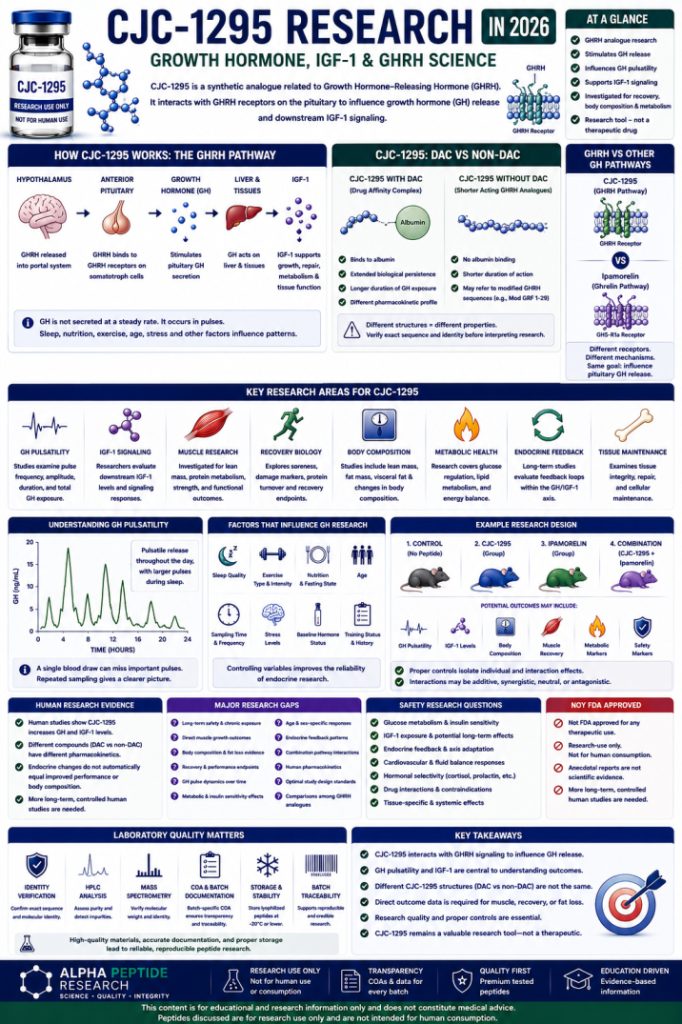
This guide explores CJC-1295 research in 2026, including GHRH biology, growth hormone, IGF-1, GH pulsatility, body composition research, evidence limitations, safety questions, and laboratory quality.
What Is CJC-1295?
CJC-1295 is a synthetic peptide associated with GHRH analogue research.
Growth hormone-releasing hormone normally participates in communication between the hypothalamus and pituitary gland.
When GHRH activates receptors on pituitary somatotroph cells, those cells can release growth hormone.
Scientists developed modified GHRH-related compounds to investigate how structural changes influence this endocrine pathway.
Therefore, CJC-1295 research can involve several areas:
GHRH receptor signaling
Growth hormone secretion
GH pulsatility
IGF-1 biology
Pituitary responses
Endocrine feedback
Metabolism
Body composition
Recovery-related physiology
Nevertheless, scientists need to identify the exact CJC-1295-related compound in each experiment.
What Is GHRH?
Growth hormone-releasing hormone is a peptide that the hypothalamus produces.
It plays a central role in regulating pituitary growth hormone release.
GHRH travels through the hypothalamic-pituitary portal circulation and interacts with GHRH receptors on somatotroph cells.
Receptor activation triggers intracellular signaling.
As a result, pituitary cells can increase growth hormone secretion.
However, GHRH does not act alone.
Other signals help regulate the GH axis.
Somatostatin can inhibit growth hormone release, while ghrelin-receptor signaling can stimulate the system through another pathway.
Therefore, GH regulation involves a coordinated endocrine network.
How Does CJC-1295 Relate to GHRH?
CJC-1295 research builds on GHRH biology.
Scientists modified GHRH-related sequences to investigate characteristics such as biological persistence and endocrine activity.
Structural changes can alter how long a peptide remains available, how it interacts with biological systems, and how researchers observe downstream hormone responses.
Consequently, CJC-1295 provides a useful research model for studying prolonged GHRH-related signaling.
Still, scientists should avoid treating every GHRH analogue as equivalent.
Sequence and molecular design matter.
Understanding the Growth Hormone Axis
The GH axis connects several organs and signaling molecules.
At the top of the system, the hypothalamus helps regulate pituitary activity.
GHRH provides a stimulatory signal.
Somatostatin contributes inhibitory signaling.
Meanwhile, ghrelin and growth hormone secretagogues can influence GH through GHS-R1a.
The anterior pituitary releases growth hormone.
GH then acts on tissues throughout the body and contributes to downstream IGF-1 signaling.
Feedback mechanisms help regulate the system.
Therefore, researchers studying CJC-1295 need to consider the entire endocrine network rather than one isolated hormone.
What Is Growth Hormone?
Growth hormone is a peptide hormone produced by somatotroph cells in the anterior pituitary.
GH contributes to growth, metabolism, tissue maintenance, and numerous physiological processes.
Importantly, GH levels do not remain constant.
The pituitary releases growth hormone in pulses.
Several factors can influence these patterns, including:
Sleep
Age
Exercise
Nutrition
Stress
Biological sex
Baseline endocrine status
Time of day
Consequently, researchers must account for natural variability when measuring GH responses.
Why GH Pulsatility Matters
Growth hormone pulsatility represents a major challenge in endocrine research.
A single blood sample provides only one moment in a dynamic hormonal pattern.
For example, one sample could occur near a GH peak.
Another could occur during a trough.
Researchers might therefore reach misleading conclusions if they compare isolated measurements without considering timing.
More detailed studies can examine pulse frequency, amplitude, duration, peak concentration, and integrated exposure.
This approach gives scientists a better understanding of how CJC-1295-related signaling affects GH dynamics.
CJC-1295 With DAC
DAC stands for Drug Affinity Complex.
Researchers designed the DAC approach to extend the biological persistence of certain peptide analogues.
CJC-1295 with DAC can interact with circulating albumin through this design.
Albumin is an abundant protein in blood.
By associating with albumin, the peptide can display different pharmacokinetic characteristics from shorter-acting GHRH-related sequences.
Therefore, DAC represents an important feature when interpreting CJC-1295 research.
A study involving a long-acting compound cannot automatically describe a structurally different short-acting analogue.
What Does “CJC-1295 Without DAC” Mean?
Commercial terminology creates confusion around this phrase.
Sources sometimes use “CJC-1295 without DAC” for shorter-acting GHRH-related peptides.
However, Modified GRF 1-29 terminology may describe a different molecular construct from CJC-1295 with DAC.
Therefore, researchers should not rely on product names alone.
Instead, they should verify:
Exact amino-acid sequence
Molecular formula
Expected molecular mass
Analytical identity
Presence or absence of relevant modifications
Batch documentation
This distinction can prevent researchers from applying evidence from one molecule to another.
Why Peptide Sequence Matters
Peptide structure determines biological properties.
Even relatively small structural modifications can influence receptor activity, stability, degradation, or pharmacokinetics.
Therefore, two peptides associated with the same biological pathway may behave differently.
CJC-1295 research illustrates this principle clearly.
Researchers should identify the exact sequence before connecting laboratory results with published evidence.
Otherwise, ambiguous terminology can weaken experimental interpretation.
CJC-1295 and Growth Hormone Research
One of the central questions in CJC-1295 research involves growth hormone secretion.
Because the peptide relates to GHRH signaling, scientists can investigate how modifying this pathway changes pituitary GH output.
Researchers may measure:
Baseline GH
Peak GH
Pulse amplitude
Pulse frequency
Duration
Integrated GH exposure
Time-course responses
Downstream IGF-1
However, changes in GH represent endocrine findings rather than proof of a specific physiological benefit.
Researchers need separate evidence for each downstream outcome.
CJC-1295 and IGF-1 Research
Growth hormone can stimulate downstream IGF-1 signaling.
The liver contributes substantially to circulating IGF-1, although tissues can also produce IGF-related signals locally.
Consequently, CJC-1295 research may measure both GH and IGF-1.
The two biomarkers provide different information.
GH can fluctuate quickly because of pulsatile secretion.
IGF-1 generally follows different dynamics and may provide information about downstream GH-axis activity.
Still, an increase in IGF-1 does not automatically demonstrate muscle growth, recovery, or improved performance.
Scientists must measure those endpoints directly.
What Is IGF-1?
IGF-1 stands for insulin-like growth factor 1.
It participates in growth, metabolism, tissue maintenance, and cellular signaling.
The GH/IGF-1 axis plays an important role across multiple tissues.
However, IGF-1 biology is complex.
Circulating concentrations represent only part of the system.
Binding proteins, receptor activity, local tissue production, nutritional status, age, and endocrine conditions can all influence biological effects.
Therefore, researchers should avoid interpreting IGF-1 as a simple “muscle growth marker.”
CJC-1295 and Muscle Research
CJC-1295 frequently appears in online discussions about muscle growth.
Scientifically, the connection begins with GH and IGF-1 signaling.
Both participate in tissue physiology.
Therefore, researchers can investigate whether altered GHRH signaling affects skeletal muscle-related outcomes.
Direct measurements could include:
Lean mass
Muscle cross-sectional area
Muscle protein metabolism
Strength
Functional outcomes
Recovery markers
Body composition
However, GH or IGF-1 changes alone cannot demonstrate muscle hypertrophy.
Direct muscle measurements remain necessary.
Does CJC-1295 Build Muscle?
Current evidence does not justify describing CJC-1295 as a proven muscle-building treatment.
Muscle hypertrophy depends on multiple interacting factors.
Resistance training provides an important mechanical stimulus.
Nutrition supplies energy and amino acids.
Meanwhile, protein synthesis, protein breakdown, genetics, sleep, age, and endocrine signals all contribute.
GH-axis signaling forms only part of this broader biological system.
Therefore, researchers should separate endocrine effects from demonstrated increases in muscle tissue.
CJC-1295 and Recovery Research
Recovery includes several processes that restore physiological function after stress.
Muscle tissue adapts after exercise.
Energy stores change.
Connective tissues respond to mechanical loading.
Sleep and endocrine regulation also contribute.
Because GH participates in tissue and metabolic biology, scientists may investigate GHRH-related signaling within recovery research.
CJC-1295 provides one experimental route into that system.
However, researchers must measure recovery directly.
Hormone changes cannot independently establish faster recovery.
Measuring Recovery
Researchers can define recovery in several ways.
Possible measurements include:
Strength restoration
Force production
Range of motion
Muscle soreness
Biochemical markers
Inflammatory markers
Functional performance
Sleep outcomes
Tissue-specific measures
The correct endpoint depends on the research question.
Consequently, broad claims about “recovery” provide less scientific value than clearly defined measurements.
CJC-1295 and Body Composition Research
Growth hormone biology intersects with body composition.
Therefore, CJC-1295 research can include measurements of lean tissue and adipose tissue.
Scientists may use validated methods to distinguish changes in different body compartments.
For example, researchers can evaluate:
Lean body mass
Fat mass
Visceral adipose tissue
Subcutaneous adipose tissue
Muscle measurements
Body weight
Metabolic biomarkers
Direct body composition measurements help determine whether endocrine changes translate into physiological outcomes.
CJC-1295 and Fat Metabolism
Growth hormone participates in lipid metabolism.
As a result, CJC-1295-related research can generate questions involving adipose tissue and energy metabolism.
Scientists may examine lipid mobilization, circulating fatty acids, metabolic markers, or body fat distribution.
However, GH pathway involvement does not establish CJC-1295 as a proven fat-loss treatment.
Body fat depends on energy balance, nutrition, activity, genetics, insulin signaling, sleep, and numerous other factors.
Therefore, researchers need controlled outcome studies.
CJC-1295 and Glucose Metabolism
Growth hormone also interacts with glucose regulation.
Consequently, metabolic research should examine more than lipid-related outcomes.
Scientists may monitor glucose and insulin-related markers when investigating prolonged GH-axis signaling.
This information can help researchers understand both intended experimental effects and broader physiological responses.
Safety studies should also consider metabolic changes over time.
CJC-1295 vs Ipamorelin
CJC-1295 and Ipamorelin influence the GH axis through different receptor pathways.
CJC-1295-related compounds interact with GHRH receptor signaling.
Ipamorelin acts through GHS-R1a, the growth hormone secretagogue receptor associated with ghrelin.
Therefore, the two peptides provide different experimental approaches to GH regulation.
Researchers may compare:
Receptor signaling
GH pulse characteristics
Duration of endocrine effects
IGF-1 responses
Metabolic outcomes
Body composition
Recovery-related endpoints
Endocrine feedback
Such comparisons can clarify how different upstream signals influence the same broader endocrine system.
Why Scientists Study CJC-1295 and Ipamorelin Together
GHRH signaling and ghrelin-receptor signaling can both influence pituitary growth hormone secretion.
Because they use different receptors, researchers may investigate how the pathways interact.
A controlled study could compare a control group, CJC-1295 group, Ipamorelin group, and combination group.
Scientists could then measure predefined endocrine or physiological outcomes.
However, researchers should not assume synergy.
The interaction could prove additive, synergistic, neutral, or antagonistic.
Direct experiments must determine the result.
CJC-1295 vs Growth Hormone
CJC-1295 is not growth hormone.
Instead, it belongs to research involving an upstream regulatory pathway.
Growth hormone itself comes from the anterior pituitary.
CJC-1295-related compounds interact with GHRH signaling, which can influence pituitary GH secretion.
This distinction matters scientifically.
Studying an upstream secretagogue pathway differs from directly studying the downstream hormone.
Feedback mechanisms and physiological regulation may also differ.
CJC-1295 vs Other GHRH Analogues
Not every GHRH analogue shares identical properties.
Sequence modifications can influence stability, receptor activity, degradation, and biological persistence.
Therefore, scientists should compare compounds based on molecular characteristics rather than category labels alone.
Research involving one GHRH analogue cannot automatically establish the behavior of another.
Compound-specific evidence remains essential.
Sleep and CJC-1295 Research
Sleep strongly interacts with natural GH physiology.
Characteristic GH pulses often occur during sleep.
Therefore, sleep quality, timing, and duration can influence endocrine measurements.
Researchers studying CJC-1295 should account for these variables.
Standardizing sleep conditions may reduce experimental variability.
Alternatively, scientists may investigate sleep as a specific research outcome.
However, endocrine effects alone cannot demonstrate improved sleep.
Researchers need direct sleep measurements.
Exercise and GH Signaling
Exercise can stimulate growth hormone secretion.
The response varies according to exercise intensity, duration, modality, training status, and other factors.
Consequently, exercise can act as an important confounding variable in CJC-1295 research.
Scientists may standardize activity before testing.
Alternatively, researchers can deliberately examine interactions between exercise and GHRH-related signaling.
Either approach requires clearly defined methods.
Nutrition and the GH Axis
Nutrition influences endocrine physiology.
Energy balance, glucose availability, protein intake, fasting state, and meal timing may affect hormone responses.
Therefore, nutritional conditions should remain consistent when relevant to the study.
This consideration becomes particularly important in metabolism and body composition research.
Without appropriate controls, dietary differences may obscure experimental effects.
Age and CJC-1295 Research
GH secretion changes across the lifespan.
Younger and older populations can display different endocrine patterns.
IGF-1 concentrations also vary with age.
Therefore, researchers should account for age when interpreting CJC-1295-related findings.
Results from one population may not translate directly to another.
Age-specific research can help clarify these differences.
Biological Sex and GH Research
Growth hormone patterns can differ according to biological sex and hormonal environment.
Pulse characteristics may vary.
Body composition and metabolic responses can also differ.
Therefore, researchers should consider these variables during study design and analysis.
Broader representation can improve understanding of biological variability.
Endocrine Feedback
Hormonal systems use feedback loops to maintain physiological regulation.
The GH/IGF-1 axis follows this principle.
Changes in downstream signaling can influence upstream hormone activity.
Consequently, prolonged GHRH-related stimulation may produce responses that differ from short-term effects.
Researchers need to examine feedback when interpreting CJC-1295 studies.
Otherwise, acute hormone changes may provide an incomplete picture.
Acute vs Long-Term CJC-1295 Research
Acute studies can examine immediate endocrine responses.
Researchers may measure GH changes, timing, peak concentrations, and short-term signaling.
Long-term studies address different questions.
They can investigate adaptation, sustained IGF-1 responses, body composition, metabolic effects, endocrine feedback, and safety.
Therefore, researchers should avoid using acute data to make long-term claims.
Both study types contribute valuable information when interpreted correctly.
Human CJC-1295 Research
CJC-1295 has attracted human research interest because scientists can measure endocrine responses relatively directly.
Human studies have examined GH and IGF-1-related outcomes with specific CJC compounds.
These investigations help characterize pharmacological and endocrine properties.
However, hormone changes do not establish every outcome commonly promoted online.
Researchers still need direct evidence for claims involving muscle growth, fat loss, athletic performance, recovery, or anti-aging effects.
Compound-specific interpretation also remains important.
Preclinical Research
Preclinical studies help scientists explore mechanisms before larger human investigations.
Researchers can examine receptor activity, signaling pathways, tissue responses, and pharmacological properties.
These models can generate hypotheses.
However, results from cells or animals cannot automatically establish human outcomes.
Human physiology introduces additional variables.
Therefore, translation requires controlled clinical research.
CJC-1295 Regulatory Status
Research interest does not equal regulatory approval.
CJC-1295 should not be marketed as an FDA-approved treatment for muscle growth, recovery, fat loss, anti-aging, or performance enhancement.
Researchers and suppliers should use accurate regulatory language.
Clear research-use labeling also matters.
Scientific credibility depends partly on distinguishing experimental compounds from approved therapies.
CJC-1295 Safety Research
Safety remains an important part of CJC-1295 research.
Because the GH axis influences many tissues, researchers need to examine broader physiological effects.
Important questions include:
Glucose regulation
Insulin sensitivity
IGF-1 exposure
Fluid balance
Cardiovascular responses
Endocrine feedback
Tissue-specific effects
Potential interactions
Long-term exposure
Individual variability
Safety research should accompany studies of endocrine activity.
Why Long-Term Evidence Matters
Short-term hormone responses cannot reveal every consequence of prolonged signaling.
Biological systems adapt.
Feedback loops may change endocrine responses.
Metabolic effects can also develop over time.
Therefore, long-term studies help researchers evaluate questions that acute experiments cannot answer.
This evidence becomes especially important when a compound has prolonged biological activity.
Why Laboratory Quality Matters
Endocrine research depends on reliable experimental material.
If scientists cannot confirm peptide identity, they cannot confidently attribute an observed response to CJC-1295.
Therefore, laboratories should evaluate:
Exact peptide identity
Sequence
Molecular mass
Purity
Batch number
Analytical methods
COA documentation
Storage conditions
Traceability
Research-use labeling
These factors create a stronger foundation for reproducible experiments.
HPLC Analysis
High-performance liquid chromatography helps researchers characterize peptide samples.
HPLC separates components according to their chromatographic behavior.
Scientists can then evaluate purity and impurity profiles.
However, HPLC alone cannot confirm molecular identity.
Therefore, researchers should combine chromatographic analysis with appropriate identity testing.
This approach provides greater analytical confidence.
Mass Spectrometry
Mass spectrometry provides information about molecular mass.
Scientists can compare measured characteristics with the expected peptide.
Therefore, mass spectrometry can support identity verification.
Combined with HPLC, it provides complementary analytical information.
Chromatography helps characterize purity.
Mass analysis helps researchers evaluate identity.
Together, these methods support stronger quality control.
Certificates of Analysis
A Certificate of Analysis can summarize analytical results for a peptide batch.
Useful information may include:
Compound name
Sequence
Batch number
Purity result
HPLC information
Mass data
Testing date
Specifications
Storage conditions
Laboratory details
Researchers should verify that the COA corresponds to the exact batch used in the experiment.
Batch-specific documentation improves traceability.
Batch Traceability
Traceability connects experimental outcomes with specific research material.
This connection supports reproducibility.
If researchers observe unexpected results, they can examine batch documentation.
Scientists can also compare analytical characteristics across batches.
Therefore, traceability contributes directly to laboratory quality.
Storage and Stability
Peptide stability depends on environmental conditions.
Temperature, moisture, light, formulation, and time may influence research material.
Therefore, laboratories should follow validated storage instructions for the exact compound.
Scientists should also document handling conditions.
Poor storage can introduce experimental variability.
Consequently, storage forms part of research quality rather than a simple logistical detail.
Why Purity Alone Is Not Enough
A high purity percentage can provide useful information.
However, purity does not independently establish identity.
Researchers also need to know whether the dominant material actually matches the intended CJC-1295-related molecule.
This issue becomes particularly important because CJC terminology can describe structurally different compounds.
Therefore, laboratories should combine purity data with sequence information, molecular mass, and other identity evidence.
Evaluating CJC-1295 Research Material
Researchers should begin with the scientific objective.
Next, they need to identify which CJC-related compound matches that question.
The evaluation should consider:
Exact sequence
DAC status
Expected molecular mass
HPLC analysis
Identity testing
Batch-specific COA
Storage information
Traceability
Research-use labeling
Scientific documentation
This process helps prevent terminology from becoming an uncontrolled experimental variable.
Major CJC-1295 Research Gaps
Important questions remain in 2026.
Future research needs stronger evidence involving:
Compound-specific pharmacokinetics
GH pulse dynamics
Long-term endocrine effects
IGF-1 responses
Body composition
Direct muscle outcomes
Recovery-related endpoints
Glucose metabolism
Insulin sensitivity
Endocrine feedback
Age-related responses
Sex-related differences
Combination effects
Long-term safety
Clear comparisons among GHRH analogues
These gaps provide substantial opportunities for controlled research.
Future of CJC-1295 Research
Future studies should connect molecular identity, endocrine mechanisms, and direct physiological outcomes.
Researchers can compare specific GHRH analogues rather than treating them as one category.
Detailed GH sampling may clarify pulse dynamics.
Meanwhile, longer studies can examine downstream IGF-1, metabolic responses, body composition, and feedback.
Scientists also need stronger long-term safety data.
Ultimately, precise terminology and better experimental design will make the research easier to interpret.
Why CJC-1295 Research Matters
CJC-1295 provides researchers with a way to investigate GHRH-related control of the growth hormone axis.
That pathway connects hypothalamic signaling with pituitary GH secretion and downstream endocrine responses.
Therefore, the research can contribute to broader questions involving endocrinology, metabolism, body composition, and tissue physiology.
However, scientific value does not depend on exaggerated performance claims.
Precise questions produce more useful evidence.
How does the receptor pathway respond?
How do GH patterns change?
What happens to IGF-1?
Do endocrine changes translate into measurable tissue outcomes?
How does prolonged signaling affect feedback and metabolism?
Those questions define the future of CJC-1295 research.
Frequently Asked Questions
What is CJC-1295?
CJC-1295 is a synthetic peptide associated with GHRH analogue research and growth hormone-axis signaling.
What is GHRH?
Growth hormone-releasing hormone is a hypothalamic peptide that stimulates pituitary growth hormone secretion through the GHRH receptor.
Is CJC-1295 growth hormone?
No. CJC-1295 relates to an upstream GHRH signaling pathway, while growth hormone comes from the anterior pituitary.
What does CJC-1295 research focus on?
Researchers study areas including GHRH signaling, GH secretion, GH pulsatility, IGF-1, endocrine feedback, metabolism, body composition, and recovery-related biology.
What is CJC-1295 with DAC?
CJC-1295 with DAC uses a Drug Affinity Complex design associated with extended biological persistence through interactions with circulating albumin.
Is CJC-1295 without DAC the same peptide?
Not necessarily. Commercial terminology can refer to shorter-acting GHRH-related compounds, so researchers should verify the exact sequence and molecular identity.
What is Modified GRF 1-29?
Modified GRF 1-29 refers to a modified GHRH-related sequence. Researchers should not automatically treat it as identical to CJC-1295 with DAC.
Does CJC-1295 increase growth hormone?
CJC-1295 research has examined effects on GH signaling and secretion. The exact response depends on the specific compound and experimental conditions.
What is the relationship between CJC-1295 and IGF-1?
Changes in GH signaling can influence downstream IGF-1 biology, which researchers may measure during CJC-1295 studies.
Does CJC-1295 build muscle?
Current evidence does not establish CJC-1295 as a proven direct muscle-building treatment.
Is CJC-1295 researched for recovery?
Scientists can investigate GHRH and GH-axis signaling in recovery-related research, but direct evidence must establish specific recovery outcomes.
What is the difference between CJC-1295 and Ipamorelin?
CJC-1295-related compounds act through GHRH signaling, whereas Ipamorelin interacts with GHS-R1a, the ghrelin receptor pathway.
Why does GH pulsatility matter?
Growth hormone naturally occurs in pulses. Therefore, repeated measurements can provide more information than a single hormone sample.
Is CJC-1295 FDA approved?
CJC-1295 should not be represented as an FDA-approved treatment for muscle growth, recovery, fat loss, anti-aging, or performance enhancement.
What testing matters for CJC-1295 research material?
Researchers may evaluate exact sequence, DAC status, HPLC purity, mass spectrometry, batch-specific COAs, traceability, and storage documentation.
Conclusion
CJC-1295 research provides scientists with an important experimental approach to GHRH signaling and growth hormone regulation.
Unlike Ipamorelin, which interacts with the ghrelin receptor pathway, CJC-1295-related compounds approach the GH axis through GHRH receptor biology.
That distinction allows researchers to investigate how different upstream signals influence pituitary growth hormone secretion.
GH pulsatility represents an important part of this research.
Researchers may also examine downstream IGF-1 signaling, metabolism, body composition, tissue physiology, endocrine feedback, and recovery-related outcomes.
However, changes in GH or IGF-1 do not independently establish muscle growth, fat loss, faster recovery, anti-aging effects, or enhanced performance.
Scientists need direct evidence for each outcome.
Compound identity creates another major consideration.
CJC-1295 with DAC, shorter-acting GHRH-related sequences, and Modified GRF terminology should not become interchangeable labels.
Researchers need to verify the exact molecule.
Analytical quality supports that process.
HPLC, mass spectrometry, sequence information, batch-specific COAs, traceability, and documented storage conditions help laboratories produce more reliable and reproducible research.
Ultimately, CJC-1295 remains scientifically interesting because it provides a window into the regulation of one of the body’s major endocrine systems.
Future studies that combine precise molecular identification with controlled human research will provide the clearest picture of its biological significance.
Alpha Peptide Research provides research-focused educational information about emerging peptide science, laboratory standards, and developments shaping modern biotechnology.
Research Disclaimer: This article provides educational and scientific research information only. CJC-1295 is discussed as an experimental research peptide. The content does not provide dosing, administration, treatment, or performance-enhancement instructions and does not establish safety, efficacy, or suitability for human use. Research-use materials are not intended for human consumption.
