

Muscle Growth & Recovery
BPC-157 Research in 2026: What Scientists Know About Tissue Repair and Recovery
Jul
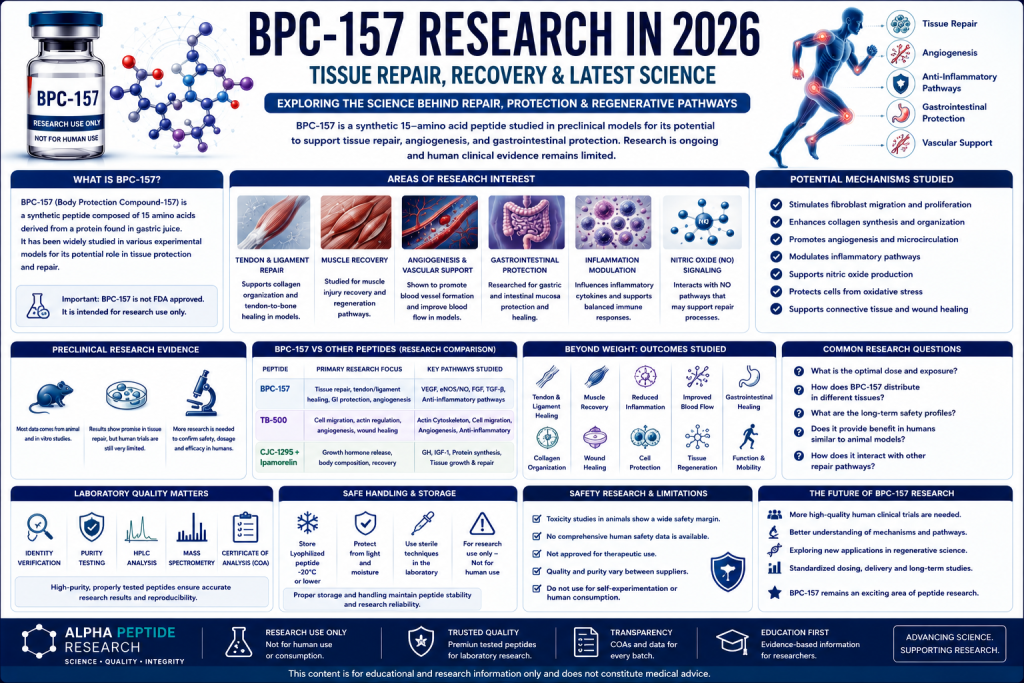
BPC-157 has become one of the most discussed experimental peptides in tissue repair and recovery research.
Interest is especially strong around tendons, ligaments, skeletal muscle, gastrointestinal tissues, blood vessels, and cellular responses involved in repair. However, online enthusiasm often moves much faster than the evidence.
So, what does BPC-157 research actually show?
Most published evidence comes from preclinical models rather than large, high-quality human clinical trials. Therefore, promising laboratory findings should not be interpreted as proof that BPC-157 safely treats injuries or medical conditions in people.
Nevertheless, the peptide remains scientifically interesting.
Researchers have investigated BPC-157 in relation to tissue repair pathways, angiogenesis, inflammatory signaling, nitric oxide biology, tendon-to-bone healing, muscle injury, and gastrointestinal protection.
Consequently, BPC-157 research offers a useful window into how peptide signaling may influence complex repair processes.
This guide examines the science, evidence, limitations, and major research questions surrounding BPC-157 in 2026.
What Is BPC-157?
BPC-157 is a synthetic peptide composed of 15 amino acids.
The name is commonly expanded as Body Protection Compound 157. Scientific literature often describes it as a peptide associated with research involving a gastric protein-derived sequence.
Researchers have studied BPC-157 primarily in experimental models.
Unlike established medicines with extensive clinical development programs, BPC-157 lacks the large body of controlled human evidence required to establish therapeutic safety and effectiveness.
Therefore, discussions about BPC-157 should clearly separate laboratory findings from demonstrated clinical outcomes.
That distinction becomes particularly important when discussing tissue repair.
Why Is BPC-157 Studied?
Tissue repair involves many biological processes.
After tissue damage, cells must communicate, inflammatory responses must be regulated, blood supply may need restoration, and extracellular structures must undergo remodeling.
Furthermore, different tissues heal differently.
Muscle has different structural requirements from tendon. Likewise, ligament repair differs from gastrointestinal tissue recovery.
Researchers have investigated BPC-157 because experimental studies suggest that it may interact with several processes involved in repair.
Research areas include:
Tendon healing
Ligament repair
Skeletal muscle injury
Angiogenesis
Nitric oxide signaling
Inflammatory responses
Gastrointestinal tissue integrity
Cell migration
Vascular responses
Tendon-to-bone healing
However, these research areas do not establish BPC-157 as a proven treatment.
Instead, they identify biological questions that require further investigation.
What Does BPC-157 Research Show?
The strongest way to understand BPC-157 is to separate evidence by type.
Preclinical Research
Much of the published BPC-157 literature involves animals, isolated tissues, or other experimental systems.
These studies can help scientists investigate mechanisms.
For example, researchers can examine how injured tissue responds under controlled conditions. They can also measure changes in cellular signaling, tissue organization, vascular responses, and mechanical properties.
However, animal results do not automatically translate to humans.
Differences in physiology, exposure, experimental design, and injury models can all affect outcomes.
Therefore, preclinical evidence should generate hypotheses rather than definitive clinical conclusions.
Human Research
Human evidence remains far more limited.
Compared with established therapeutic peptides and medicines, BPC-157 lacks extensive randomized controlled clinical trial data.
As a result, major questions remain regarding pharmacokinetics, effective exposure, safety, long-term effects, and whether preclinical observations translate meaningfully to humans.
Consequently, claims that BPC-157 has been proven to heal human injuries go beyond the available evidence.
BPC-157 and Tendon Research
Tendons connect muscle to bone.
Because tendons receive relatively limited blood supply compared with many other tissues, tendon injuries can create challenging research questions.
BPC-157 has attracted attention in experimental tendon models.
Researchers have examined tissue organization, functional recovery, cellular behavior, and other aspects of tendon healing.
Furthermore, some experimental work has explored interactions involving fibroblasts and pathways associated with repair.
These findings help researchers investigate mechanisms.
However, they do not demonstrate that BPC-157 can treat tendon injuries in humans.
Future controlled human research would be necessary to establish clinical relevance.
BPC-157 and Ligament Research
Ligaments connect bone to bone and contribute to joint stability.
Like tendons, they contain highly organized connective tissue.
Therefore, ligament repair depends on coordinated cellular activity and extracellular matrix remodeling.
Experimental BPC-157 research has contributed to broader interest in peptide-related connective tissue repair.
Scientists may investigate collagen organization, cellular migration, inflammatory signaling, vascular responses, and mechanical properties.
Nevertheless, human evidence remains insufficient to establish therapeutic benefits.
The distinction between an experimental signal and a clinical treatment is essential.
BPC-157 and Muscle Recovery Research
Skeletal muscle can repair itself after many forms of damage.
However, muscle regeneration involves several stages.
Initially, damaged tissue triggers biological responses. Subsequently, immune cells, satellite cells, vascular processes, and remodeling mechanisms contribute to recovery.
Researchers have studied BPC-157 in experimental muscle injury models.
This work creates questions involving:
Muscle fiber recovery
Vascular responses
Inflammatory signaling
Cellular repair
Functional recovery
Tissue remodeling
However, muscle recovery should not be confused with muscle growth.
Current evidence does not justify presenting BPC-157 as a proven muscle-building compound.
Instead, its scientific relevance lies primarily in experimental tissue repair research.
Does BPC-157 Build Muscle?
There is not strong clinical evidence establishing BPC-157 as a direct muscle-building agent in humans.
This distinction matters.
Muscle hypertrophy involves processes related to mechanical tension, muscle protein synthesis, nutrition, hormonal signaling, training status, and recovery.
BPC-157 research, by contrast, has focused heavily on experimental repair processes.
Therefore, describing it as a muscle growth peptide would oversimplify the evidence.
A more accurate research question is whether pathways associated with BPC-157 influence damaged muscle tissue under specific experimental conditions.
That question remains scientifically interesting without overstating what researchers know.
BPC-157 and Angiogenesis Research
Angiogenesis describes the formation of new blood vessels from existing vessels.
Blood supply is important during tissue repair because tissues require oxygen and nutrients.
Furthermore, vascular networks help support cellular activity during remodeling.
BPC-157 research has investigated pathways associated with angiogenic responses.
For example, experimental studies have explored interactions involving vascular signaling and endothelial function.
Consequently, angiogenesis has become one proposed mechanism through which BPC-157 may influence experimental repair.
However, biological mechanisms rarely operate independently.
Researchers must examine vascular responses alongside inflammation, cellular signaling, tissue organization, and other processes.
BPC-157 and Nitric Oxide Signaling
Nitric oxide participates in vascular regulation and numerous cellular processes.
Therefore, nitric oxide signaling has become another important area within BPC-157 research.
Experimental studies have suggested interactions between BPC-157 and nitric oxide-related pathways.
These findings may help researchers investigate vascular responses and tissue repair mechanisms.
Nevertheless, the relationship is complex.
Nitric oxide biology depends on tissue type, enzyme activity, physiological state, and many other factors.
Consequently, researchers should avoid reducing BPC-157’s proposed mechanisms to one pathway.
BPC-157 and Inflammation Research
Inflammation plays an essential role in tissue repair.
Immediately after injury, inflammatory processes help coordinate the response to damaged tissue.
However, excessive or poorly regulated inflammation can interfere with normal recovery.
Therefore, scientists study how inflammatory signaling changes throughout repair.
BPC-157 has been investigated in experimental models involving inflammatory processes.
Researchers may examine cytokines, cellular responses, oxidative stress, and tissue changes.
However, describing BPC-157 simply as an “anti-inflammatory peptide” would be too broad.
The scientific question involves how it may influence specific inflammatory pathways under defined experimental conditions.
BPC-157 and Fibroblast Research
Fibroblasts are important cells in connective tissue.
They contribute to extracellular matrix production and remodeling.
As a result, fibroblast behavior matters in tendon, ligament, skin, and other tissue repair processes.
Experimental BPC-157 research has examined cellular responses relevant to fibroblast activity.
Scientists may investigate migration, signaling, extracellular matrix organization, and interactions with repair pathways.
Consequently, fibroblast research provides another possible mechanism for studying BPC-157.
Still, cellular findings require careful interpretation before researchers can determine their relevance to whole organisms.
BPC-157 and Collagen Research
Collagen provides structural support throughout the body.
Tendons and ligaments, in particular, depend heavily on organized collagen fibers.
Therefore, connective tissue research often examines collagen synthesis, organization, and remodeling.
BPC-157 research intersects with these questions because of its investigation in experimental tendon and ligament models.
However, saying that BPC-157 “creates collagen” would be an oversimplification.
Instead, scientists study whether experimental exposure influences cellular and tissue processes associated with connective tissue repair.
This language more accurately reflects the evidence.
BPC-157 and Tendon-to-Bone Healing
Tendon-to-bone healing presents a specialized challenge.
The interface between tendon and bone contains distinct tissue structures.
After injury or surgical repair, restoring that interface requires coordinated remodeling.
Consequently, researchers have investigated experimental strategies that might influence tendon-to-bone healing.
BPC-157 has appeared within this broader research area.
Scientists may examine tissue organization, mechanical properties, cellular responses, and functional outcomes.
Nevertheless, preclinical findings require human validation before clinical conclusions can be made.
BPC-157 and Gastrointestinal Research
Although recovery discussions often focus on tendons and muscle, much of the historical BPC-157 research involves gastrointestinal biology.
Experimental studies have investigated gastric and intestinal tissue responses.
Researchers have explored mucosal integrity, vascular processes, inflammatory signaling, and injury models.
Therefore, gastrointestinal research remains important for understanding the broader scientific history of BPC-157.
However, these findings should not be turned into claims that BPC-157 treats gastrointestinal diseases.
Clinical efficacy requires appropriate human trials.
BPC-157 vs TB-500
BPC-157 and TB-500 frequently appear together in online discussions.
However, they represent different research areas.
BPC-157 is a synthetic 15-amino-acid peptide investigated across several experimental tissue repair models.
TB-500 is associated with thymosin beta-4-related research, which involves cellular migration, cytoskeletal biology, vascular processes, and tissue repair.
Therefore, the two should not be treated as interchangeable compounds.
Their mechanisms, evidence bases, and research histories differ.
Our next dedicated comparison article will examine BPC-157 vs TB-500 in greater detail.
BPC-157 vs Growth Hormone Secretagogues
BPC-157 also differs substantially from growth hormone secretagogues.
Compounds studied in GH-related research generally target pathways involved in growth hormone release or associated endocrine signaling.
BPC-157 does not belong to that same category.
Instead, its research literature focuses largely on experimental tissue protection and repair mechanisms.
Therefore, grouping all of these compounds under “muscle growth peptides” can create scientific confusion.
Researchers should classify compounds according to their actual biological pathways.
Is BPC-157 FDA Approved?
No.
BPC-157 is not an FDA-approved drug.
This fact is important because online discussions sometimes blur the distinction between experimental research and established medical treatment.
FDA approval requires evidence and regulatory review addressing quality, safety, and effectiveness for specific medical uses.
BPC-157 has not met that standard for an approved therapeutic indication.
Therefore, research content should never imply that BPC-157 has established medical approval simply because it is widely discussed online.
Is BPC-157 Still Experimental in 2026?
Yes.
BPC-157 remains an experimental research compound.
Scientific interest does not change regulatory status.
Likewise, widespread online discussion does not establish clinical effectiveness.
Instead, BPC-157 remains relevant because several biological questions surrounding tissue repair still require investigation.
These questions include mechanism, pharmacokinetics, safety, dose-response relationships, long-term effects, and human translation.
Consequently, future research will need stronger clinical evidence.
BPC-157 Safety Research
Safety represents one of the most important unanswered questions.
Preclinical studies can identify certain biological effects. However, they cannot establish comprehensive human safety.
Researchers need to understand:
Pharmacokinetics
Metabolism
Dose-response relationships
Short-term effects
Long-term effects
Tissue-specific effects
Potential interactions
Reproductive effects
Cardiovascular effects
Other systemic outcomes
Furthermore, compounds obtained outside controlled research environments may introduce additional uncertainties involving identity, purity, contamination, and concentration.
Therefore, safety conclusions require rigorous evidence.
Why Purity Matters in BPC-157 Research
Reliable laboratory research begins with accurately characterized material.
If a sample contains impurities or has the wrong identity, experimental results can become difficult to interpret.
Therefore, purity is not simply a marketing number.
It directly affects research quality.
Laboratories should consider analytical documentation, identity confirmation, batch information, storage conditions, and handling requirements.
Furthermore, purity percentage alone does not answer every quality question.
A strong research-quality assessment should examine the methods used to characterize the material.
Understanding HPLC in Peptide Research
High-performance liquid chromatography, commonly called HPLC, is widely used in peptide analysis.
Researchers can use chromatographic methods to separate components within a sample.
Consequently, HPLC can provide useful information about peptide purity and impurity profiles.
However, an HPLC percentage should not automatically be treated as complete proof of identity.
A sample could theoretically produce a strong purity result while additional analytical questions remain.
Therefore, researchers should interpret chromatography alongside appropriate identity testing.
Why Mass Spectrometry Matters
Mass spectrometry provides information related to molecular mass and can support compound identification.
When used alongside chromatography and other analytical methods, it can strengthen peptide characterization.
Therefore, researchers evaluating laboratory materials should look beyond a single purity claim.
Analytical documentation may include:
HPLC data
Mass spectrometry
Batch identification
Test dates
Specifications
Storage information
Laboratory documentation
Together, these records provide a stronger research foundation.
What Is a Certificate of Analysis?
A Certificate of Analysis, or COA, summarizes analytical information for a specific material or batch.
Depending on the laboratory and testing process, a COA may report identity, purity, appearance, or other specifications.
However, not all COAs provide the same level of information.
Researchers should examine whether documentation clearly identifies the batch and analytical methods.
Additionally, traceability matters.
A generic document that cannot be connected to a specific batch provides less useful information than properly matched analytical records.
How to Evaluate BPC-157 for Laboratory Research
Researchers evaluating BPC-157 material should focus on scientific quality rather than exaggerated marketing.
Important considerations include:
Clearly stated compound identity
Batch-specific documentation
Analytical purity data
Appropriate identity testing
Transparent labeling
Storage information
Traceability
Research-use labeling
Reliable supplier documentation
Furthermore, claims should remain scientifically realistic.
A supplier promising guaranteed injury healing or human performance outcomes is making a fundamentally different claim from a research supplier providing analytical information about laboratory material.
For research, documentation should come first.
BPC-157 Storage and Stability Research
Peptide stability can depend on environmental conditions.
Temperature, moisture, light, time, and physical state may influence degradation.
Therefore, laboratories should follow validated storage information for the specific material they obtain.
Lyophilized material and prepared laboratory solutions may also have different stability characteristics.
Consequently, researchers should not assume one universal storage rule applies to every formulation.
Proper documentation should define relevant handling conditions.
Why Batch Traceability Matters
Reproducibility is central to scientific research.
If two experiments use materials with unknown or inconsistent characteristics, comparing results becomes difficult.
Batch traceability helps laboratories document exactly which material was used.
Furthermore, batch-specific analytical records allow researchers to connect experimental results with the tested sample.
Therefore, traceability supports both quality control and reproducibility.
This becomes especially important in peptide research, where small differences in identity or purity can affect experiments.
BPC-157 Research and Scientific Reproducibility
Interesting findings become more valuable when independent researchers can reproduce them.
Therefore, future BPC-157 research needs robust experimental design.
Scientists should clearly report methods, materials, controls, outcome measurements, and statistical approaches.
Furthermore, research materials should be characterized adequately.
Without these standards, apparently conflicting findings can become difficult to interpret.
Consequently, reproducibility should remain a priority as BPC-157 research develops.
What Scientists Still Need to Learn About BPC-157
Despite substantial online attention, major scientific questions remain unanswered.
Researchers still need stronger evidence regarding:
Human pharmacokinetics
Bioavailability
Mechanisms of action
Dose-response relationships
Long-term safety
Clinical efficacy
Tissue-specific effects
Potential interactions
Human tendon outcomes
Human muscle recovery
Human ligament outcomes
Gastrointestinal effects
Vascular mechanisms
Furthermore, high-quality randomized controlled trials would be necessary before strong therapeutic conclusions could be justified.
Therefore, BPC-157 should still be viewed primarily as an experimental research subject.
Future of BPC-157 Research
Future studies could move the field in several directions.
First, researchers need stronger characterization of how BPC-157 behaves biologically.
Pharmacokinetic studies could clarify exposure and persistence.
Meanwhile, mechanistic studies could investigate interactions among vascular, inflammatory, cellular, and connective tissue pathways.
Human research would also be necessary to determine whether findings from experimental models translate into clinically meaningful effects.
Furthermore, standardized analytical methods could improve research consistency.
Ultimately, the future of BPC-157 depends on better evidence rather than greater online popularity.
Frequently Asked Questions
What is BPC-157?
BPC-157 is a synthetic 15-amino-acid peptide studied primarily in experimental models involving tissue repair and related biological processes.
What does BPC-157 stand for?
BPC is commonly expanded as Body Protection Compound, while 157 refers to the peptide sequence discussed in the research literature.
What is BPC-157 researched for?
Researchers have investigated BPC-157 in experimental models involving tendons, ligaments, skeletal muscle, gastrointestinal tissues, vascular responses, and other repair-related processes.
Does BPC-157 heal tendons?
Preclinical studies have investigated BPC-157 in tendon repair models. However, strong clinical evidence establishing it as a treatment for human tendon injuries is lacking.
Does BPC-157 help muscle recovery?
Experimental research has examined BPC-157 in muscle injury models. Nevertheless, controlled human evidence remains insufficient to establish a therapeutic recovery benefit.
Does BPC-157 build muscle?
Current evidence does not establish BPC-157 as a proven muscle-building compound. Its research literature focuses more heavily on experimental tissue repair.
Is BPC-157 the same as TB-500?
No. BPC-157 and TB-500 are different research compounds associated with different biological pathways and evidence bases.
Is BPC-157 FDA approved?
No. BPC-157 is not an FDA-approved drug.
Is BPC-157 still experimental?
Yes. BPC-157 remains an experimental research compound, and important questions about human safety and efficacy remain unresolved.
What is HPLC testing for BPC-157?
HPLC can help characterize the purity and impurity profile of a peptide sample. However, researchers should consider it alongside appropriate identity testing.
What should a BPC-157 COA show?
Useful documentation may include batch identification, analytical results, testing methods, specifications, and other information that connects the analysis to the specific material.
Why does peptide purity matter?
Impurities or incorrect compound identity can influence experimental results. Therefore, material characterization is important for reliable laboratory research.
How should BPC-157 be stored?
Storage requirements depend on the specific material and formulation. Researchers should follow validated supplier or laboratory documentation for temperature, light, moisture, and other conditions.
What are the biggest gaps in BPC-157 research?
Major gaps include human pharmacokinetics, long-term safety, dose-response relationships, clinical efficacy, and confirmation that preclinical tissue-repair findings translate to humans.
What is the future of BPC-157 research?
Future work may focus on mechanisms, pharmacokinetics, tissue-specific responses, safety, standardized analytical methods, and higher-quality human studies.
Conclusion
BPC-157 has become one of the most visible experimental peptides in modern recovery research.
However, popularity and scientific certainty are not the same thing.
Preclinical studies have created interesting questions involving tendon repair, muscle injury, connective tissue, angiogenesis, nitric oxide signaling, inflammatory responses, and gastrointestinal biology.
Nevertheless, human evidence remains limited.
Therefore, BPC-157 research in 2026 should focus on understanding mechanisms and evidence rather than repeating exaggerated claims.
Future studies need to clarify pharmacokinetics, safety, dose-response relationships, tissue-specific effects, and whether experimental findings translate meaningfully to humans.
Research quality matters as well.
Accurate compound identity, analytical purity, HPLC data, mass spectrometry, batch traceability, appropriate storage, and transparent documentation can help laboratories conduct more reproducible experiments.
Ultimately, BPC-157 remains scientifically interesting precisely because many important questions are still unanswered.
As research evolves, high-quality evidence will determine which proposed mechanisms survive scientific scrutiny and which do not.
Alpha Peptide Research provides research-focused educational information about emerging peptide science, laboratory standards, and developments shaping modern biotechnology.
Research Disclaimer: This article is provided for educational and scientific research information only. BPC-157 is not an FDA-approved drug. Discussion of experimental findings does not establish safety, efficacy, or suitability for human use. Materials labeled for research use only are not intended for human consumption.
