

Muscle Growth & Recovery
BPC-157 vs TB-500: Differences in Tissue Repair and Recovery Research
Jul
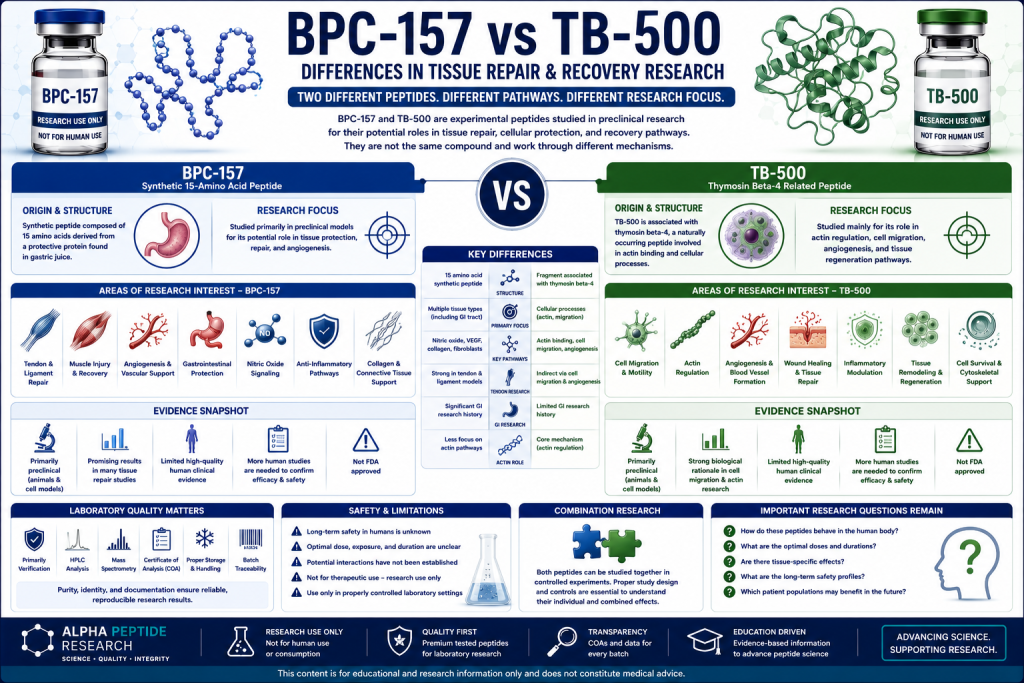
BPC-157 and TB-500 are two experimental peptides frequently discussed in tissue repair and recovery research.
Although they often appear together online, they are not the same peptide.
Their biological origins differ. In addition, researchers study different mechanisms and signaling pathways associated with each compound.
BPC-157 research has explored tendon and ligament models, skeletal muscle injury, gastrointestinal tissue, vascular responses, nitric oxide signaling, and other repair-related processes.
TB-500, meanwhile, is associated with thymosin beta-4 research. Scientists have studied thymosin beta-4 biology in relation to actin regulation, cellular migration, angiogenesis, wound repair, and tissue regeneration.
Consequently, comparing BPC-157 vs TB-500 requires more than asking which peptide is “better.”
A scientifically useful comparison should examine what each compound is, which mechanisms researchers study, the strength of the evidence, and the questions that remain unanswered.
BPC-157 vs TB-500 at a Glance
The biggest difference between BPC-157 and TB-500 begins with their biological background.
BPC-157 is a synthetic 15-amino-acid peptide associated with research derived from a gastric protein sequence.
TB-500, by contrast, is associated with thymosin beta-4-related peptide research.
Therefore, the compounds should not be treated as interchangeable.
Researchers investigate BPC-157 heavily within experimental tissue protection and repair models. Meanwhile, thymosin beta-4-related research has focused strongly on actin biology, cellular movement, vascular responses, and wound repair.
Both research areas can overlap around tissue recovery.
However, they approach that subject through different biological mechanisms.
What Is BPC-157?
BPC-157 is a synthetic peptide containing 15 amino acids.
Most published BPC-157 evidence comes from preclinical research.
Experimental studies have investigated areas such as:
Tendon repair
Ligament recovery
Muscle injury
Gastrointestinal tissue
Angiogenesis
Nitric oxide signaling
Inflammatory pathways
Fibroblast behavior
Collagen organization
Vascular responses
Consequently, BPC-157 has attracted significant interest within tissue repair research.
Nevertheless, promising experimental findings should not be interpreted as established therapeutic effects in humans.
Human evidence remains limited.
What Is TB-500?
TB-500 is commonly discussed in relation to thymosin beta-4, a naturally occurring peptide involved in several cellular processes.
Thymosin beta-4 has a much broader scientific history than many online discussions of TB-500 suggest.
One important area involves actin.
Actin is a structural protein that contributes to the cytoskeleton, cellular movement, tissue organization, and many other biological processes.
Therefore, thymosin beta-4-related research intersects with cellular migration and tissue repair.
Scientists have also investigated:
Angiogenesis
Cell migration
Wound repair
Inflammatory signaling
Tissue remodeling
Cell survival
Cytoskeletal regulation
However, TB-500 and full-length thymosin beta-4 should not automatically be treated as identical in every scientific context.
Precise compound identification matters when evaluating research.
BPC-157 vs TB-500: Are They the Same?
No.
BPC-157 and TB-500 differ in structure, biological origin, and research history.
BPC-157 is associated primarily with experimental research involving tissue protection and repair.
TB-500 is associated with thymosin beta-4-related biology, particularly mechanisms involving actin and cellular migration.
Nevertheless, both appear in discussions about recovery because tissue repair depends on multiple biological processes.
Cells need to migrate.
Blood vessels may need to form or reorganize.
Extracellular structures must remodel.
Inflammatory signals also change over time.
Therefore, different experimental pathways can converge on similar research outcomes without being biologically identical.
Why Are BPC-157 and TB-500 Compared?
The comparison largely comes from their association with tissue repair research.
Researchers investigating recovery may examine tendons, ligaments, muscle, skin, blood vessels, and other tissues.
Both BPC-157 and thymosin beta-4-related research intersect with some of these areas.
However, their proposed mechanisms differ.
Consequently, the more useful question is not simply which compound “repairs tissue faster.”
Instead, scientists should ask which biological pathways each compound influences under controlled experimental conditions.
That distinction creates a more accurate comparison.
BPC-157 and Tendon Research
Tendon research is one of the most prominent areas associated with BPC-157.
Tendons connect muscle to bone.
Their organized collagen structure allows them to transmit mechanical force. However, relatively limited vascularity can make tendon repair scientifically challenging.
Preclinical BPC-157 studies have investigated tendon healing and related repair processes.
Researchers may examine:
Tissue organization
Fibroblast activity
Collagen remodeling
Vascular responses
Mechanical properties
Functional recovery
Tendon-to-bone interfaces
These findings have generated considerable scientific interest.
However, controlled human evidence remains insufficient to establish BPC-157 as a tendon injury treatment.
TB-500 and Tissue Repair Research
Thymosin beta-4-related research provides a different perspective on tissue repair.
Rather than focusing on one tissue type, scientists have studied thymosin beta-4 across several cellular and regenerative processes.
Cell migration is especially important.
During repair, cells often need to move into damaged areas.
Actin dynamics contribute directly to cellular movement.
Therefore, the relationship between thymosin beta-4 and actin makes this pathway scientifically relevant to tissue remodeling.
Furthermore, researchers have investigated vascular and inflammatory responses.
Together, these areas explain why TB-500-related research appears frequently in recovery discussions.
BPC-157 vs TB-500 for Tendon Research
BPC-157 has a notable preclinical research history involving tendons.
Therefore, someone reviewing experimental tendon literature may encounter BPC-157 relatively quickly.
TB-500-related research approaches repair differently.
Its association with thymosin beta-4 connects it to cell migration, actin regulation, angiogenesis, and broader regenerative processes.
Consequently, the two research areas may overlap around tendon repair while emphasizing different mechanisms.
However, neither should be described as a clinically proven tendon-healing treatment based on current evidence.
BPC-157 vs TB-500 for Ligament Research
Ligaments connect bone to bone and help stabilize joints.
Repair involves cellular activity, collagen remodeling, vascular changes, and mechanical adaptation.
BPC-157 has appeared in experimental ligament and connective tissue research.
Meanwhile, thymosin beta-4-related pathways may be relevant because cellular migration and tissue remodeling contribute to repair.
Therefore, both compounds create scientifically interesting questions.
Nevertheless, direct high-quality human comparisons remain lacking.
As a result, claims that one is definitively superior for ligament recovery are not supported by strong clinical evidence.
BPC-157 vs TB-500 for Muscle Research
Muscle recovery involves several stages.
Following injury, inflammatory processes begin the response. Subsequently, cellular repair, vascular activity, regeneration, and tissue remodeling contribute to recovery.
BPC-157 has been investigated in experimental muscle injury models.
Meanwhile, thymosin beta-4 research has explored cellular processes that may influence tissue regeneration.
Therefore, both research areas can intersect with skeletal muscle biology.
However, neither peptide should automatically be described as a direct muscle-building compound.
Muscle recovery and muscle hypertrophy are different research topics.
Do BPC-157 or TB-500 Build Muscle?
Current evidence does not justify presenting either compound as a proven direct muscle-building peptide.
Muscle hypertrophy involves mechanical tension, resistance training, nutrition, protein synthesis, endocrine signaling, genetics, and other factors.
BPC-157 research focuses primarily on experimental tissue repair.
TB-500-related research, meanwhile, centers more heavily on thymosin beta-4 pathways involving cellular migration, actin biology, vascular processes, and regeneration.
Therefore, their relevance to muscle research is primarily connected with repair mechanisms rather than established hypertrophic effects.
BPC-157 and Fibroblast Research
Fibroblasts contribute to connective tissue structure.
During repair, they participate in extracellular matrix production and remodeling.
Therefore, fibroblast behavior is particularly relevant to tendon and ligament research.
Experimental BPC-157 studies have examined cellular responses associated with fibroblast migration and repair.
Consequently, researchers have proposed fibroblast-related activity as one area that may contribute to observed preclinical effects.
However, cellular mechanisms require further validation.
A laboratory finding does not automatically predict a meaningful human outcome.
TB-500 and Actin Regulation
Actin biology represents one of the most important distinctions in the BPC-157 vs TB-500 comparison.
Actin forms a major part of the cellular cytoskeleton.
Furthermore, actin dynamics allow cells to change shape and move.
Thymosin beta-4 interacts with actin biology.
Therefore, researchers study this pathway in relation to cellular migration and tissue remodeling.
This mechanism differs substantially from many pathways discussed in BPC-157 research.
Consequently, understanding actin helps explain why TB-500-related science occupies a distinct research category.
BPC-157 vs TB-500 and Angiogenesis
Angiogenesis describes the development of new blood vessels from existing vascular structures.
This process matters because repairing tissues require oxygen, nutrients, and cellular communication.
Both BPC-157 and thymosin beta-4-related research have intersected with angiogenesis.
However, the underlying biological pathways may differ.
BPC-157 studies have investigated vascular signaling and nitric oxide-related processes.
Meanwhile, thymosin beta-4 research includes endothelial cell migration and vascular responses.
Therefore, angiogenesis provides an area of overlap without making the two compounds equivalent.
Why Blood Vessel Research Matters for Recovery
Tissue repair requires adequate circulation.
Blood vessels deliver oxygen and nutrients while also supporting communication among cells.
After injury, vascular networks may need to reorganize.
Consequently, angiogenesis and microvascular responses are important areas of regenerative biology.
Peptide research can help scientists investigate these mechanisms.
However, angiogenesis is highly regulated.
Excessive or inappropriate vascular growth can also create biological problems.
Therefore, researchers need to understand when, where, and how vascular pathways change.
BPC-157 and Nitric Oxide Research
Nitric oxide contributes to vascular signaling and many other physiological processes.
Experimental BPC-157 research has investigated interactions involving nitric oxide pathways.
Therefore, scientists may examine whether these interactions influence blood flow, vascular responses, or tissue repair.
However, nitric oxide biology is complex.
Different nitric oxide synthase enzymes operate in different contexts.
Furthermore, tissue type and physiological conditions influence the response.
Consequently, researchers should avoid reducing BPC-157 biology to a single nitric oxide mechanism.
TB-500 and Cellular Migration
Cell migration is essential during many repair processes.
Cells must often move toward damaged tissue.
Thymosin beta-4-related research is particularly relevant because of its connection with actin regulation.
Actin rearrangement helps cells move and change shape.
Therefore, scientists study thymosin beta-4 in cellular migration models.
This mechanism is one reason TB-500-related research has attracted attention within regenerative science.
However, translating cellular mechanisms into human therapeutic outcomes requires much stronger evidence.
Inflammation and Tissue Recovery
Inflammation is not inherently harmful.
Instead, it forms part of the normal response to tissue damage.
Early inflammatory signaling can help coordinate repair. Later, the biological environment must shift toward remodeling and recovery.
Both BPC-157 and thymosin beta-4-related research have examined inflammatory pathways.
Nevertheless, describing either peptide simply as “anti-inflammatory” can be misleading.
Researchers need to determine which pathways change, when they change, and whether those changes improve meaningful outcomes.
Therefore, inflammatory biology should be interpreted within the larger repair process.
Wound Healing Research
Wound healing involves overlapping stages.
Initially, the body responds to tissue disruption. Subsequently, cells migrate, extracellular structures form, blood vessels develop, and tissue remodels.
Thymosin beta-4 has attracted significant scientific interest within wound-healing research.
BPC-157 research has also investigated experimental injury and repair models.
Therefore, wound healing represents another area where the two research fields can overlap.
However, differences in compound identity and mechanisms remain important.
Researchers should evaluate each peptide independently before drawing comparisons.
BPC-157 and Gastrointestinal Research
One major distinction involves gastrointestinal biology.
Historical BPC-157 research includes substantial investigation of gastric and intestinal models.
Scientists have examined mucosal integrity, vascular responses, inflammatory processes, and tissue injury.
Consequently, gastrointestinal research forms an important part of the BPC-157 literature.
TB-500-related research does not have the same research identity.
Therefore, gastrointestinal biology represents one clear difference between the two fields.
TB-500 and Regenerative Biology
TB-500 discussions are closely connected with thymosin beta-4 research.
That broader field includes cellular migration, angiogenesis, cytoskeletal biology, tissue remodeling, and regenerative processes.
Consequently, TB-500 often appears within discussions of recovery across multiple tissue types.
However, researchers must distinguish the specific compound being studied from full-length thymosin beta-4 and related fragments.
Precise molecular identification is essential.
Otherwise, findings from one compound may incorrectly be attributed to another.
Which Has More Research: BPC-157 or TB-500?
This question requires careful interpretation.
Both research areas contain scientific literature, but the evidence is not directly comparable.
BPC-157 has a body of preclinical literature involving several injury and tissue models.
Thymosin beta-4, meanwhile, has a broader biological research history across areas such as actin regulation, cellular migration, wound repair, and regenerative biology.
However, research involving thymosin beta-4 cannot automatically be treated as direct evidence for every TB-500 preparation.
Therefore, counting studies alone can create a misleading comparison.
Study quality and compound identity matter more.
Human Evidence for BPC-157
Human evidence for BPC-157 remains limited compared with established medicines.
Most commonly cited findings come from preclinical models.
Consequently, important questions remain about:
Human pharmacokinetics
Bioavailability
Dose-response relationships
Long-term safety
Clinical efficacy
Potential interactions
Tissue-specific effects
Therefore, preclinical findings should not be presented as proven human benefits.
Human Evidence for TB-500
TB-500 presents another evidence challenge.
Scientific literature involving thymosin beta-4 provides important biological information.
However, researchers must determine whether findings apply to the exact compound or fragment under discussion.
Furthermore, widespread online use claims do not substitute for controlled clinical evidence.
Therefore, researchers should verify molecular identity and examine the actual study material before drawing conclusions.
This distinction is essential for scientifically accurate comparisons.
Are BPC-157 and TB-500 FDA Approved?
BPC-157 is not an FDA-approved drug.
Likewise, TB-500 should not be represented as an FDA-approved therapeutic product for tissue repair or athletic recovery.
Regulatory status matters because widespread online discussion can make experimental compounds appear more established than they are.
However, popularity does not equal approval.
Clinical approval requires appropriate evidence of quality, safety, and effectiveness for defined indications.
Therefore, experimental research and approved therapeutic use must remain clearly separated.
BPC-157 and TB-500 Safety Research
Human safety remains an important research gap.
Researchers need reliable data involving pharmacokinetics, exposure, long-term effects, interactions, and tissue-specific responses.
Furthermore, mechanisms such as angiogenesis require careful scientific evaluation.
Biological pathways that contribute to normal repair can behave differently under other conditions.
Consequently, researchers should avoid assuming that a proposed regenerative mechanism is automatically beneficial in every biological context.
Long-term controlled studies remain important.
Why Compound Identity Matters
Peptide research depends on knowing what material is actually being studied.
This issue becomes especially important for TB-500 because online terminology can blur distinctions among TB-500, thymosin beta-4, and related fragments.
Therefore, researchers should confirm exact molecular identity.
BPC-157 also requires accurate characterization.
A vial label alone cannot establish identity.
Instead, laboratories should evaluate analytical documentation linked to the specific material.
Why Peptide Purity Matters
Impurities can influence experimental results.
Therefore, purity testing is an important part of laboratory peptide research.
High-performance liquid chromatography, or HPLC, can help characterize sample purity and impurity profiles.
However, purity percentage alone cannot establish molecular identity.
Consequently, laboratories should interpret HPLC alongside appropriate identity testing.
This distinction helps improve reproducibility and experimental reliability.
HPLC and Mass Spectrometry
HPLC and mass spectrometry provide complementary information.
Chromatography can separate components in a sample and help characterize purity.
Mass spectrometry, meanwhile, provides molecular mass information that can support identification.
Therefore, using both approaches can provide stronger analytical characterization than relying on one number.
Researchers should also consider batch identification and testing dates.
Together, these details improve traceability.
What Should a Peptide COA Include?
A Certificate of Analysis can summarize analytical information for a research material.
Useful documentation may include:
Compound name
Batch or lot number
Purity result
Analytical method
Identity information
Testing date
Specifications
Storage information
Laboratory details
However, researchers should verify that the document actually corresponds to the batch being studied.
A generic COA has limited scientific value if it cannot be connected to the specific sample.
Choosing BPC-157 or TB-500 for Laboratory Research
The choice should begin with the research question.
For example, a laboratory investigating BPC-157-related tendon mechanisms needs a different experimental design from one studying thymosin beta-4-related actin biology.
Therefore, researchers should not select compounds simply because they are popular.
Instead, they should evaluate:
Research objective
Relevant mechanism
Existing literature
Compound identity
Analytical characterization
Purity
Batch traceability
Storage requirements
Experimental controls
Scientific documentation
This approach produces more meaningful research than selecting a peptide based on marketing claims.
Can BPC-157 and TB-500 Be Studied Together?
Scientists can investigate multiple pathways within an experimental design when a valid research question supports the approach.
However, combination research creates additional complexity.
Researchers need appropriate controls to distinguish the effect of each compound.
For example, a controlled study may need separate experimental groups for each individual compound and their combination.
Furthermore, analytical characterization remains essential.
Without suitable controls, researchers may not know which variable produced an observed response.
Therefore, combination studies require careful experimental design.
BPC-157 and TB-500 “Stacks”
The word “stack” appears frequently in online peptide discussions.
However, it often refers to self-administration rather than controlled scientific research.
That distinction matters.
Anecdotal combinations cannot establish safety, efficacy, interaction effects, or optimal exposure.
Therefore, Alpha Peptide Research uses the term only when discussing research concepts or online trends, not to provide human-use protocols.
Controlled combination research would require appropriate experimental methods and safety evaluation.
Which Peptide Is Better for Recovery Research?
There is no scientifically defensible universal answer.
The appropriate compound depends on the biological question.
BPC-157 may be relevant when studying experimental pathways involving tendon repair, gastrointestinal tissue, vascular signaling, or other areas represented in its research literature.
Meanwhile, TB-500-related research may be relevant to questions involving actin regulation, cell migration, angiogenesis, and regenerative biology.
Therefore, the research objective should determine the compound.
Popularity should not.
Which Is Better Studied for Tendons?
BPC-157 has a notable preclinical literature involving tendon models.
Therefore, it may appear more directly in searches focused specifically on experimental tendon repair.
However, thymosin beta-4-related biology also intersects with mechanisms relevant to tissue healing.
Consequently, researchers should compare study design and mechanism rather than relying solely on compound popularity.
Neither research area currently establishes a proven human tendon treatment.
Which Is Better Studied for Cell Migration?
Thymosin beta-4-related research has a particularly strong connection with actin regulation and cellular migration.
Therefore, TB-500-related scientific questions often focus on these mechanisms.
BPC-157 research includes cellular responses as well.
However, its research profile is broader across experimental tissue protection and repair models.
Consequently, the best choice depends on the specific pathway being investigated.
Why Laboratory Quality Can Affect Research Results
Two samples labeled with the same peptide name may not necessarily have identical analytical characteristics.
Purity can differ.
Storage conditions may differ as well.
Furthermore, degradation, contamination, or incorrect identity can influence experiments.
Therefore, laboratory quality matters.
Researchers should prioritize properly characterized material with clear analytical documentation.
Ultimately, reproducible peptide research begins with reproducible research materials.
Storage and Stability
Peptides can respond to temperature, moisture, light, and time.
Therefore, storage conditions matter.
Lyophilized material and prepared laboratory solutions may also have different stability characteristics.
Researchers should follow validated documentation for the specific material.
Furthermore, storage records can improve experimental traceability.
Poor handling can compromise otherwise well-designed research.
Future BPC-157 Research
BPC-157 research still has major unanswered questions.
Future work may investigate:
Human pharmacokinetics
Mechanisms
Tendon biology
Muscle injury models
Gastrointestinal pathways
Vascular signaling
Long-term safety
Dose-response relationships
Human translation
Standardized research methods
Better evidence could clarify which preclinical findings are reproducible and biologically meaningful.
Future TB-500 Research
TB-500-related research also requires greater precision.
Scientists need to distinguish specific peptide fragments from full-length thymosin beta-4.
Furthermore, future studies may investigate:
Actin regulation
Cell migration
Angiogenesis
Wound repair
Tissue remodeling
Inflammatory signaling
Pharmacokinetics
Long-term safety
Compound-specific biological activity
Clear molecular identification will be essential for interpreting this research accurately.
Frequently Asked Questions
What is the main difference between BPC-157 and TB-500?
BPC-157 is a synthetic 15-amino-acid peptide associated with experimental tissue repair research. TB-500 is associated with thymosin beta-4-related biology, particularly actin regulation, cellular migration, and regenerative processes.
Are BPC-157 and TB-500 the same peptide?
No. They have different structures, biological backgrounds, and research histories.
Is BPC-157 better studied for tendons?
BPC-157 has a notable preclinical literature involving tendon repair models. However, strong human clinical evidence remains limited.
What is TB-500 researched for?
TB-500-related research commonly intersects with thymosin beta-4 biology, including actin regulation, cell migration, angiogenesis, wound repair, and tissue remodeling.
Do BPC-157 and TB-500 build muscle?
Neither compound has strong clinical evidence establishing it as a direct muscle-building agent. Their research relevance is more closely associated with tissue repair and regenerative mechanisms.
Do BPC-157 and TB-500 work the same way?
No. Their proposed mechanisms differ, although some research areas, such as angiogenesis and tissue repair, may overlap.
Can BPC-157 and TB-500 be studied together?
They can be investigated within controlled experimental designs when a valid scientific question supports combination research. Appropriate controls are essential.
Are BPC-157 and TB-500 FDA approved?
BPC-157 is not FDA approved, and TB-500 should not be represented as an FDA-approved treatment for tissue repair or athletic recovery.
What testing matters for research peptides?
Researchers may evaluate identity testing, HPLC purity data, mass spectrometry, batch-specific COAs, traceability, and appropriate storage documentation.
Is HPLC enough to confirm peptide identity?
No. HPLC is useful for purity characterization, but identity should be supported by appropriate analytical methods such as mass spectrometry.
Why does batch traceability matter?
Batch traceability connects experimental results with the specific material used. Therefore, it supports reproducibility and quality control.
Which peptide is better for laboratory research?
Neither is universally better. The appropriate peptide depends on the research question, mechanism, evidence, analytical quality, and experimental design.
Conclusion
BPC-157 and TB-500 frequently appear together in discussions about tissue repair and recovery.
However, they represent distinct areas of peptide research.
BPC-157 has attracted attention through preclinical studies involving tendons, ligaments, muscle injury, gastrointestinal tissues, vascular signaling, and other repair processes.
TB-500-related science, meanwhile, connects strongly with thymosin beta-4 biology.
Actin regulation, cellular migration, angiogenesis, wound repair, and tissue remodeling form important parts of that research landscape.
Therefore, asking whether BPC-157 or TB-500 is universally “better” misses the scientific point.
The correct choice depends on the research question.
Furthermore, evidence quality matters.
Preclinical findings cannot automatically establish human therapeutic benefits, while anecdotal online reports cannot replace controlled studies.
Laboratory quality is equally important.
Researchers should evaluate compound identity, purity, HPLC data, mass spectrometry, COAs, batch traceability, storage conditions, and experimental controls.
Ultimately, BPC-157 vs TB-500 is most useful as a comparison of two different research pathways rather than a competition between two products.
Future studies will determine whether experimental findings involving either pathway translate into meaningful human applications.
Alpha Peptide Research provides research-focused educational information about emerging peptide science, laboratory standards, and developments shaping modern biotechnology.
Research Disclaimer: This article is provided for educational and scientific research information only. BPC-157 and TB-500 should not be interpreted as approved treatments based on the research discussed here. Experimental findings do not establish safety, efficacy, or suitability for human use. Materials labeled for research use only are not intended for human consumption.
