

Weight Management & Metabolic Health
Metabolic Adaptation After Weight Loss: What Peptide Research Is Revealing in 2026
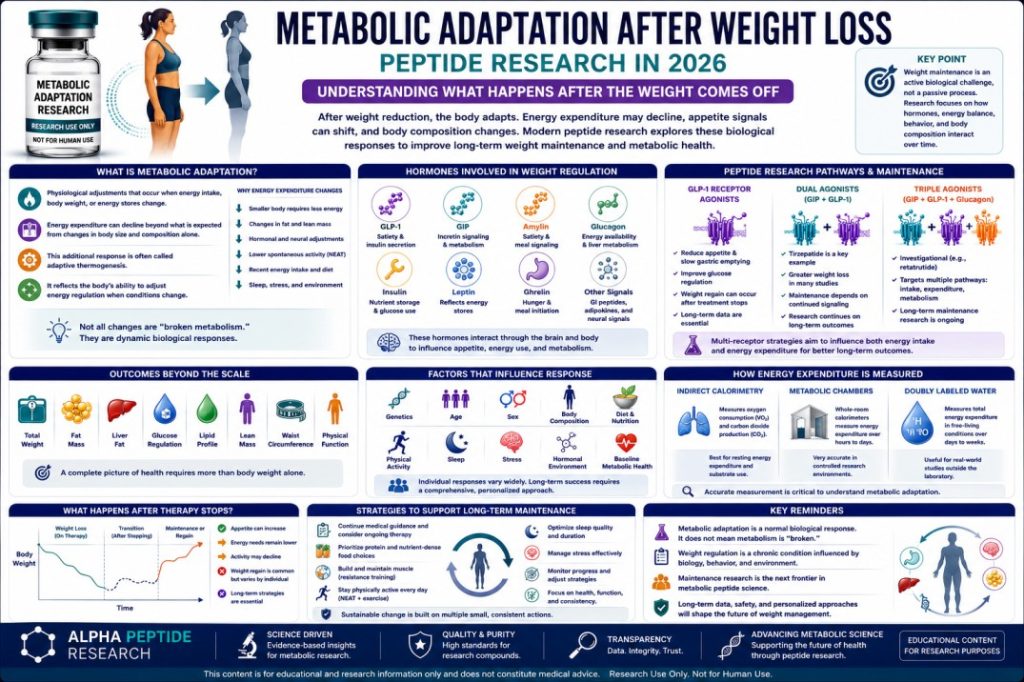
Jul
Losing body weight represents only one part of weight management research. Maintaining that change creates another scientific challenge.
After weight reduction, the body does not simply continue operating exactly as it did before.
Instead, several biological systems can adjust.
Energy expenditure may change. Appetite signals can shift. Meanwhile, body composition and energy requirements may also differ from baseline.
Scientists often study these changes under the broader concept of metabolic adaptation.
Consequently, metabolic adaptation after weight loss has become an important topic in modern metabolic research.
The rise of GLP-1, dual agonist, and multi-receptor research has made the subject even more relevant. Researchers now want to understand not only how body weight changes, but also what happens afterward.
What Is Metabolic Adaptation?
Metabolic adaptation describes physiological adjustments that occur when energy intake, body weight, or energy stores change.
Weight reduction naturally lowers the amount of energy required to maintain a smaller body.
However, researchers sometimes observe changes in energy expenditure that go beyond what they expect from changes in body size and composition alone.
This additional response is often discussed as adaptive thermogenesis.
Importantly, metabolic adaptation does not mean metabolism has permanently “stopped.”
Instead, it reflects the body’s ability to adjust energy regulation when conditions change.
Therefore, scientists study metabolic adaptation as a dynamic biological response.
Why Energy Expenditure Changes After Weight Loss
A smaller body generally requires less energy than a larger body.
For example, moving less total mass requires less energy. Maintaining tissues also requires energy, so changes in fat and lean mass can influence daily expenditure.
Consequently, some decline in energy requirements after weight loss is expected.
However, body size does not explain every observation.
Hormonal signals, energy intake, body composition, activity, sleep, and other factors may also affect energy expenditure.
For this reason, researchers need detailed measurements before they can determine whether true adaptive thermogenesis has occurred.
What Is Adaptive Thermogenesis?
Adaptive thermogenesis refers to changes in energy expenditure that cannot be fully explained by measured changes in body size or composition.
Scientists often investigate it during periods of calorie restriction and weight reduction.
However, the size and persistence of the effect can vary.
Study design matters. Measurement methods matter as well.
Furthermore, recent energy balance can influence results.
Therefore, researchers interpret adaptive thermogenesis carefully rather than treating it as a fixed response that occurs identically in everyone.
Why Weight Maintenance Can Be Difficult
Body weight regulation involves several interacting systems.
When energy stores decrease, the body may respond through changes in hunger, satiety, energy expenditure, and behavior.
As a result, maintaining a lower body weight can create a different biological environment than losing the weight initially.
Several factors may contribute:
Changes in appetite signals
Lower energy requirements
Altered food intake
Body composition changes
Reduced spontaneous activity
Sleep patterns
Stress
Environmental factors
Individual biology
Consequently, long-term weight management research needs to examine more than initial weight reduction.
Appetite Regulation After Weight Loss
Appetite is one of the most important parts of this research.
The brain receives signals from the gastrointestinal system, pancreas, adipose tissue, and other organs.
Together, these signals help regulate hunger and satiety.
After weight reduction, some appetite-related signals can change.
Therefore, scientists investigate whether these changes encourage greater energy intake.
This question is especially important because even small differences in daily intake can influence long-term energy balance.
Hormones and Weight Regulation
Several hormones participate in appetite and metabolic regulation.
These include:
GLP-1
GIP
Amylin
Glucagon
Insulin
Leptin
Ghrelin
Other gastrointestinal and metabolic signals
Each pathway contributes differently.
For example, GLP-1 participates in satiety and glucose-dependent insulin secretion. Amylin also contributes to satiety and meal-related signaling.
Meanwhile, leptin reflects aspects of energy storage in adipose tissue.
Consequently, researchers increasingly study weight regulation as a network rather than a single-hormone process.
Leptin and Energy Stores
Leptin is produced primarily by adipose tissue.
Its circulating levels generally relate to the amount of stored body fat, although the biology is more complex than a simple direct relationship.
When fat mass decreases, leptin levels can also decline.
That change may influence neural pathways involved in appetite and energy regulation.
Therefore, leptin remains an important part of weight maintenance research.
However, manipulating one hormone does not necessarily solve the broader challenge.
Multiple signals contribute to long-term energy balance.
Ghrelin and Hunger Research
Ghrelin is another hormone that attracts attention in weight regulation research.
The gastrointestinal system produces ghrelin, and its levels can change around meals.
Researchers often study it in relation to hunger and food intake.
Furthermore, weight reduction may alter ghrelin dynamics in some settings.
As a result, scientists investigate whether changes in ghrelin contribute to increased hunger during weight maintenance.
Again, the overall response depends on multiple interacting pathways.
GLP-1 and Weight Maintenance Research
GLP-1 receptor research has changed modern weight management science.
Much attention focuses on initial weight reduction. However, long-term maintenance has become equally important.
Researchers want to know what happens when GLP-1-related interventions continue over longer periods.
They also study what occurs after treatment stops.
These questions can reveal how much of the observed metabolic response depends on continued receptor activity.
Furthermore, they help scientists distinguish pharmacological effects from long-term biological adaptation.
What Happens After GLP-1 Therapy Stops?
Clinical research has shown that weight regain can occur after GLP-1-based treatment ends.
This observation provides an important lesson.
Obesity research increasingly treats weight regulation as a chronic biological process rather than a short intervention followed by a permanent reset.
However, the amount of regain varies among individuals.
Diet, physical activity, treatment duration, baseline biology, environment, and other factors can influence outcomes.
Therefore, researchers need long-term follow-up studies to understand what happens after treatment withdrawal.
Tirzepatide and Long-Term Weight Research
Dual agonist research creates similar questions.
Tirzepatide activates GIP and GLP-1 receptors.
Studies can therefore investigate not only initial changes in body weight but also longer-term outcomes.
Researchers may examine:
Weight maintenance
Body composition
Waist circumference
Glucose regulation
Cardiometabolic markers
Appetite
Treatment continuation
Outcomes after withdrawal
Consequently, maintenance research has become an important extension of dual agonist science.
Multi-Receptor Research and Metabolic Adaptation
Triple agonist research expands the field further.
Investigational compounds such as retatrutide combine GIP, GLP-1, and glucagon receptor activity.
Therefore, researchers can investigate several aspects of energy balance within one receptor strategy.
GLP-1 may influence appetite and food intake. GIP contributes to nutrient-related metabolic signaling. Meanwhile, glucagon receptor research includes questions about hepatic metabolism and energy expenditure.
Consequently, multi-receptor research may provide new insights into both energy intake and energy use.
However, long-term clinical evidence remains essential.
Retatrutide remains investigational in 2026.
Amylin and Weight Maintenance Research
Amylin represents another important pathway.
This peptide hormone participates in satiety, food intake, gastric emptying, and nutrient-related signaling.
Therefore, amylin-based research may also contribute to questions about long-term energy regulation.
Cagrilintide has increased scientific interest in sustained amylin receptor activity.
Meanwhile, combination approaches involving amylin and GLP-1 signaling have broadened the research landscape.
Future studies may help determine how these pathways influence maintenance after substantial weight change.
Why Body Composition Matters During Maintenance
A scale cannot explain every metabolic change.
For example, two people may maintain the same body weight while having different amounts of fat and lean tissue.
That difference matters because body composition influences energy expenditure.
Lean tissue, particularly skeletal muscle, contributes substantially to resting energy needs.
Therefore, researchers increasingly track body composition during both weight reduction and maintenance.
Relevant measurements may include:
Fat mass
Lean mass
Skeletal muscle
Visceral fat
Liver fat
Waist circumference
Physical function
Together, these measurements provide more context than body weight alone.
Lean Mass and Energy Expenditure
Lean mass is strongly related to resting energy expenditure.
Therefore, changes in lean tissue can affect energy requirements.
During substantial weight reduction, both fat mass and lean mass may change.
Consequently, scientists need to consider body composition when evaluating metabolic adaptation.
A reduction in measured energy expenditure may partly reflect a smaller body and less metabolically active tissue.
However, additional adaptation may also occur.
Careful measurement helps distinguish these factors.
Why Skeletal Muscle Is Important
Skeletal muscle contributes to much more than physical strength.
It also participates in glucose metabolism and overall energy use.
Therefore, preserving muscle function has become an important research goal during weight management.
Scientists may investigate resistance training, dietary protein, physical activity, and other factors that support muscle.
Furthermore, strength and function may provide information that lean mass measurements alone cannot capture.
This broader approach helps researchers evaluate the quality of weight change.
Resistance Training and Weight Maintenance
Resistance exercise provides a mechanical stimulus to skeletal muscle.
As a result, researchers study whether strength training can support lean tissue during periods of weight reduction.
The benefits may extend beyond muscle mass.
Resistance training can also influence strength, physical function, and metabolic health.
Therefore, weight maintenance research increasingly considers exercise alongside pharmacological and nutritional strategies.
However, individual programs need to account for age, fitness, mobility, and other factors.
Physical Activity and Energy Expenditure
Exercise is only one part of daily activity.
People also expend energy through walking, standing, occupational movement, household tasks, and spontaneous activity.
Researchers sometimes group part of this expenditure under non-exercise activity thermogenesis, or NEAT.
Interestingly, daily movement patterns can change during energy restriction.
Therefore, scientists may track physical activity when studying metabolic adaptation.
Wearable devices, activity monitors, and controlled measurements can provide useful data.
Nutrition and Long-Term Weight Maintenance
Nutrition remains central to energy balance.
However, long-term research goes beyond simply counting calories.
Scientists may investigate dietary patterns, protein intake, fiber, food quality, meal structure, and adherence.
Furthermore, nutrition interacts with appetite and body composition.
For example, adequate protein can support muscle protein synthesis when combined with appropriate physical activity.
Meanwhile, high-fiber foods may influence satiety and dietary quality.
Therefore, nutritional research remains an important partner to peptide science.
Sleep and Metabolic Regulation
Sleep has become another major research topic.
Insufficient or disrupted sleep can affect appetite, glucose regulation, behavior, and physical activity.
Consequently, sleep patterns may influence long-term weight management.
Researchers may examine sleep duration and sleep quality.
Circadian timing also matters.
Furthermore, metabolic research increasingly explores how sleep interacts with hormonal signals.
This integrated approach reflects the complexity of energy regulation.
Stress and Weight Maintenance
Stress can influence behavior and physiology.
For example, chronic stress may affect food choices, sleep, physical activity, and hormonal signaling.
Therefore, researchers sometimes include stress-related measures in weight management studies.
However, stress responses differ among individuals.
As a result, scientists need careful study designs when investigating these relationships.
Weight maintenance rarely depends on one variable alone.
Why Individual Responses Differ
Not everyone experiences metabolic adaptation in the same way.
Several factors may influence the response.
These include:
Genetics
Age
Sex
Baseline body composition
Magnitude of weight reduction
Diet
Physical activity
Sleep
Metabolic health
Hormonal environment
Medication exposure
Consequently, average study results cannot describe every individual.
Personal variability remains one of the most important challenges in metabolic research.
How Researchers Measure Energy Expenditure
Accurate measurement is essential when studying metabolic adaptation.
Scientists use several methods.
Indirect Calorimetry
Indirect calorimetry estimates energy expenditure by measuring oxygen consumption and carbon dioxide production.
Researchers commonly use it to assess resting energy expenditure.
Metabolic Chambers
Whole-room calorimeters can measure energy expenditure over longer periods in controlled environments.
Therefore, they can provide detailed information about daily metabolism.
Doubly Labeled Water
Doubly labeled water allows scientists to estimate total energy expenditure under free-living conditions.
As a result, researchers can study energy use outside highly controlled laboratory environments.
Each method answers different questions.
Consequently, study design strongly influences how metabolic adaptation is evaluated.
Why Weight Regain Does Not Mean Research Failure
Weight regain can provide valuable scientific information.
It may reveal how biological systems respond when an intervention ends.
Furthermore, it can help scientists understand which mechanisms require continued support.
For example, appetite signaling may change after treatment withdrawal.
Energy requirements may also remain lower after weight reduction.
Therefore, studying regain can improve understanding of long-term weight regulation.
It should not simply be treated as an inconvenient outcome to ignore.
Weight Cycling Research
Repeated periods of weight loss and regain are often called weight cycling.
Scientists continue to study how these cycles affect body composition and metabolic health.
Research questions may include:
Does fat distribution change?
What happens to lean mass?
Does energy expenditure change?
How does appetite respond?
Are cardiometabolic markers affected?
Does the magnitude of each cycle matter?
However, weight cycling research is complex.
Different populations, interventions, and definitions can produce different results.
Therefore, strong conclusions require careful evidence.
Metabolic Adaptation Is Not a “Broken Metabolism”
The phrase “broken metabolism” appears frequently online.
Scientifically, it can be misleading.
Metabolism is a collection of dynamic biological processes.
During weight reduction, the body can adjust energy expenditure, appetite signaling, and nutrient use.
These responses may make maintenance more challenging.
However, they do not mean metabolism has stopped functioning.
Therefore, metabolic adaptation provides a more accurate framework than claims about permanent metabolic damage.
Why Long-Term Clinical Trials Matter
Initial weight change can occur within months.
Long-term maintenance, however, requires much longer observation.
Therefore, scientists need extended clinical trials and follow-up studies.
Researchers may evaluate:
Weight trajectories
Body composition
Energy expenditure
Appetite
Glucose regulation
Cardiometabolic markers
Physical activity
Safety
Tolerability
Treatment continuation
Outcomes after withdrawal
These data can reveal whether metabolic changes persist.
Furthermore, they can help researchers understand what happens when treatment strategies change.
The Future of Weight Maintenance Research
The next phase of metabolic science may focus increasingly on maintenance rather than initial weight reduction alone.
Researchers will likely investigate how peptide pathways interact with nutrition, physical activity, sleep, and body composition.
In addition, scientists may explore different treatment durations and maintenance strategies.
Multi-receptor compounds could create additional questions.
Meanwhile, advanced imaging and wearable technologies may provide better long-term data.
Researchers may also use biomarkers to identify different response patterns.
Consequently, future studies could become more personalized and more comprehensive.
Frequently Asked Questions
What is metabolic adaptation after weight loss?
Metabolic adaptation describes physiological adjustments that occur as body weight and energy stores change. These adjustments can involve energy expenditure, appetite, hormones, and other metabolic processes.
Does metabolism slow after weight loss?
Energy requirements often decline after weight reduction because the body is smaller. In addition, some studies investigate adaptive changes beyond those expected from body size and composition alone.
What is adaptive thermogenesis?
Adaptive thermogenesis describes changes in energy expenditure that exceed what researchers predict from measured changes in body size and composition.
Does everyone experience metabolic adaptation?
No. The magnitude and persistence of metabolic adaptation can vary among individuals and across studies.
Why can hunger increase after weight loss?
Weight reduction can alter several appetite-related signals. Therefore, researchers study hormones and neural pathways that may influence hunger during maintenance.
Can weight return after GLP-1 treatment ends?
Clinical research has documented weight regain after withdrawal of GLP-1-based interventions. However, individual outcomes vary.
Why is body composition important?
Body composition helps researchers distinguish changes in fat mass from changes in lean tissue. Furthermore, lean tissue contributes to energy expenditure.
Does muscle affect metabolism?
Yes. Skeletal muscle contributes to energy use, glucose metabolism, physical function, and overall metabolic health.
What is NEAT?
NEAT stands for non-exercise activity thermogenesis. It includes energy used for everyday movement outside structured exercise.
Does sleep matter for weight maintenance?
Yes. Researchers study sleep because it can interact with appetite, glucose regulation, physical activity, and other metabolic processes.
Is metabolic adaptation permanent?
Not necessarily. Its magnitude and duration vary, and researchers continue to investigate how adaptation changes over time.
What is the future of metabolic adaptation research?
Future research will likely combine peptide science, body composition, energy expenditure, appetite biology, nutrition, exercise, sleep, biomarkers, and long-term clinical data.
Conclusion
Weight reduction is only one stage of metabolic research.
The next challenge is understanding what happens afterward.
As body weight changes, energy requirements can decrease. Meanwhile, appetite signals, body composition, physical activity, and hormonal regulation may also change.
Consequently, long-term weight maintenance involves a complex biological system.
Modern peptide research provides new ways to investigate that system.
GLP-1 receptor research has raised important questions about maintenance and treatment withdrawal. Dual agonists add GIP signaling, while investigational triple agonists introduce glucagon receptor activity.
Amylin research provides another pathway related to satiety and nutrient regulation.
However, no single hormone explains long-term weight regulation.
Nutrition, physical activity, skeletal muscle, sleep, environment, genetics, and individual biology all contribute.
Therefore, the future of metabolic research will likely move beyond asking how much weight someone loses.
Scientists will increasingly ask what happens to body composition, appetite, energy expenditure, metabolic health, and weight trajectories over time.
Ultimately, understanding metabolic adaptation after weight loss may help researchers build a more complete model of long-term weight regulation.
Alpha Peptide Research follows emerging peptide and metabolic science to provide research-focused educational information about developments shaping modern biotechnology.
Research Disclaimer: This article is provided for educational and research information only. Discussion of peptide pathways, medicines, or investigational compounds does not constitute medical advice or imply that research materials are approved for therapeutic use. Materials labeled for research use only are not intended for human consumption.
