

Weight Management & Metabolic Health
Visceral Fat and Peptide Research: Why Metabolic Scientists Are Looking Beyond Body Weight in 2026
Jul
Weight management research is becoming more precise. For decades, researchers relied heavily on body weight and BMI to evaluate obesity. Both measurements remain useful. However, neither tells scientists where the body stores fat.
That distinction matters because body fat is not distributed evenly.
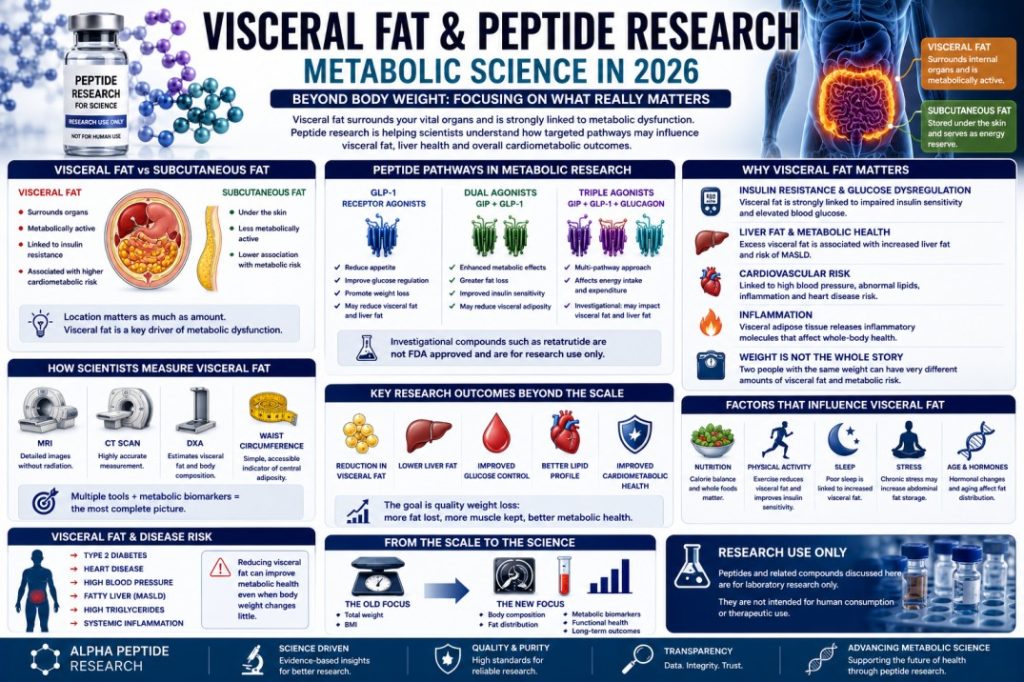
For example, subcutaneous fat sits beneath the skin. Visceral fat, by contrast, accumulates deeper inside the abdomen around internal organs. Although both tissues store energy, their biological characteristics differ.
Consequently, visceral adipose tissue has become an important focus of metabolic research.
Scientists now study its relationship with glucose regulation, insulin sensitivity, lipid metabolism, liver health, inflammation, and cardiometabolic risk. Meanwhile, advances in peptide science have created new ways to investigate these relationships.
GLP-1 receptor agonists changed the metabolic research landscape. Dual incretin agonists expanded it further. More recently, investigational multi-receptor compounds have opened additional research questions.
As a result, peptide research for visceral fat has become an important part of metabolic science in 2026.
What Is Visceral Fat?
Visceral fat is adipose tissue stored within the abdominal cavity. It surrounds several internal organs and differs from fat stored directly beneath the skin.
Scientists commonly distinguish between two major fat compartments.
Subcutaneous Fat
Subcutaneous adipose tissue sits beneath the skin. It stores energy and participates in hormonal and metabolic signaling.
Moreover, it represents a large share of total body fat in many people.
Visceral Fat
Visceral adipose tissue lies deeper within the abdominal cavity. It develops around organs such as the liver, intestines, pancreas, and kidneys.
Importantly, researchers do not study visceral fat simply because of appearance.
Instead, they investigate it because fat distribution can reveal information about metabolic health that body weight alone cannot provide.
Why Visceral Fat Matters in Metabolic Research
Adipose tissue is biologically active.
In addition to storing energy, it releases signaling molecules and interacts with several metabolic systems. Therefore, the amount and location of adipose tissue can influence the metabolic picture.
Excess visceral adiposity has been associated with insulin resistance and glucose dysregulation. Researchers also study its relationship with abnormal blood lipids, liver fat, inflammatory signaling, and cardiovascular risk.
However, visceral fat does not operate alone.
Genetics, nutrition, physical activity, sleep, age, hormones, and overall body composition also influence metabolic health. For this reason, scientists examine visceral adiposity as one part of a larger biological system.
Visceral Fat vs Subcutaneous Fat
Although both tissues store energy, visceral and subcutaneous fat are not identical.
Subcutaneous fat lies beneath the skin. Visceral fat, meanwhile, occupies space around organs inside the abdomen.
Their metabolic characteristics also differ.
For example, visceral adipose tissue has strong associations with insulin resistance and cardiometabolic risk. Therefore, two people with similar total body fat may still have different metabolic profiles.
Fat distribution helps explain part of that difference.
Consequently, researchers increasingly study where fat changes occur instead of measuring only total fat loss.
Why BMI Cannot Measure Visceral Fat
Body mass index uses height and weight to produce a standardized measurement.
However, BMI does not directly measure body fat. Furthermore, it cannot identify where adipose tissue is stored.
Two individuals with the same BMI may have very different amounts of muscle and fat. They may also differ substantially in visceral adiposity.
Therefore, researchers often combine BMI with additional measurements.
These may include:
Waist circumference
Body composition analysis
MRI
CT imaging
DXA
Blood biomarkers
Metabolic assessments
Together, these measurements provide a broader picture of metabolic health.
Why Fat Distribution Is Becoming More Important
Modern weight management science increasingly asks where biological changes occur.
Previously, a study might have focused heavily on total weight reduction. Today, researchers can examine several tissue compartments separately.
For instance, scientists may ask whether visceral fat decreased. They can also measure subcutaneous fat, liver fat, total fat mass, and lean tissue.
In addition, metabolic biomarkers can show whether these changes correspond with improved glucose or lipid regulation.
Therefore, researchers can build a much richer picture than body weight alone provides.
How Peptide Research Connects With Visceral Fat
Peptide signaling influences many biological processes related to metabolism.
Scientists study peptide pathways involved in appetite, nutrient signaling, glucose regulation, energy balance, and adipose tissue biology.
As peptide research advanced, scientists began asking a more detailed question.
Do changes in body weight correspond with changes in specific fat compartments?
To answer it, studies may measure:
Visceral adipose tissue
Subcutaneous fat
Total fat mass
Waist circumference
Liver fat
Lean mass
Glucose regulation
Lipid markers
Consequently, body composition has become an important component of modern peptide research.
GLP-1 Research and Visceral Fat
GLP-1 receptor research has transformed metabolic science.
GLP-1 participates in glucose-dependent insulin secretion, appetite regulation, gastric emptying, and energy intake.
Initially, much public attention centered on body weight. However, researchers increasingly began examining body composition and fat distribution.
As a result, GLP-1 studies may now investigate changes in total fat mass and visceral adiposity. Researchers may also examine waist circumference, liver fat, lean tissue, and cardiometabolic markers.
This broader approach helps scientists understand what changes beyond the scale.
GIP and GLP-1 Dual Agonist Research
Dual agonist science added another dimension to metabolic research.
Tirzepatide activates both GIP and GLP-1 receptors. Therefore, researchers can investigate coordinated signaling across two incretin pathways.
Importantly, research does not need to stop at total weight.
Scientists can also study visceral adiposity, body composition, glucose metabolism, insulin sensitivity, and lipid markers. Liver-related outcomes may be examined as well.
Together, these endpoints provide a more complete picture of metabolic response.
Triple Agonists and Visceral Fat Research
Triple agonist research has expanded the field again.
Retatrutide is an investigational compound designed to activate GIP, GLP-1, and glucagon receptors.
Adding glucagon receptor activity creates additional questions about energy expenditure and lipid metabolism. Moreover, researchers can investigate potential changes in hepatic biology and body composition.
Relevant endpoints may include visceral fat, total fat mass, liver fat, waist circumference, lean tissue, and metabolic biomarkers.
However, an important distinction remains.
Retatrutide is investigational in 2026. It should not be presented as an FDA-approved therapy.
Visceral Fat and Insulin Resistance
Insulin sensitivity remains a major focus of metabolic research.
Insulin helps regulate glucose and supports several other metabolic processes. When tissues become less responsive, the body may need higher insulin levels to maintain glucose control.
Visceral adiposity often appears within this research.
Therefore, scientists investigate how abdominal fat relates to fasting glucose, insulin levels, glycemic control, and lipid metabolism.
Furthermore, researchers can track whether changes in visceral fat correspond with changes in these biomarkers.
This approach helps characterize metabolic response more accurately.
Visceral Fat and Liver Fat
The relationship between visceral adiposity and liver fat is another important research area.
The liver plays a central role in both glucose and lipid metabolism. Consequently, excess hepatic fat can accompany broader metabolic dysfunction.
Researchers may examine visceral fat and liver fat together.
For example, a study could measure visceral adipose tissue volume, liver fat percentage, insulin sensitivity, triglycerides, and waist circumference.
Inflammatory biomarkers may also provide useful information.
By combining these measurements, scientists can study metabolism as an interconnected system.
Why Liver Health Is Receiving More Attention
Liver health has become increasingly important in metabolic research.
One reason involves metabolic dysfunction-associated steatotic liver disease, commonly known as MASLD.
Scientists are investigating how changes in metabolic health relate to hepatic fat accumulation. In addition, incretin and multi-receptor pathways have created new research questions involving liver biology.
However, weight loss alone cannot show what happened inside the liver.
Researchers therefore use appropriate imaging and biomarkers when liver outcomes matter.
This distinction improves scientific accuracy.
Visceral Fat and Cardiometabolic Health
Visceral adiposity also has important connections with cardiovascular research.
Scientists study its relationship with blood pressure, triglycerides, cholesterol, glucose regulation, and insulin resistance.
Furthermore, inflammatory markers can provide additional information about cardiometabolic status.
Waist circumference may also be included as a practical indicator of central adiposity.
Consequently, modern obesity research increasingly evaluates cardiometabolic outcomes alongside body weight.
Waist Circumference and Central Adiposity
Advanced imaging can provide detailed measurements of visceral fat. Nevertheless, simpler tools remain valuable.
Waist circumference is one example.
A larger waist measurement can indicate greater central adiposity. However, it cannot directly separate visceral fat from subcutaneous abdominal fat.
Therefore, researchers often interpret waist circumference alongside other measurements.
BMI, body weight, imaging, and metabolic biomarkers can all add useful context.
Combined measurements generally provide more information than one metric alone.
How Scientists Measure Visceral Fat
Several methods allow researchers to evaluate abdominal adiposity.
MRI
Magnetic resonance imaging can distinguish different tissue compartments without using ionizing radiation.
As a result, researchers can measure visceral and subcutaneous adipose tissue separately.
CT Imaging
Computed tomography provides detailed cross-sectional images.
Researchers can use these images to quantify abdominal fat distribution with high precision.
DXA
Dual-energy X-ray absorptiometry is widely used in body composition research.
Certain DXA systems can also estimate visceral adipose tissue within defined abdominal regions.
Waist Measurements
Waist circumference and waist-to-height ratio provide accessible measures of central adiposity.
However, these methods cannot directly distinguish visceral from subcutaneous fat.
Ultimately, researchers select measurement methods based on study design, accuracy requirements, resources, and participant considerations.
Fat Loss Does Not Occur Uniformly
Body fat is distributed across several regions and tissue compartments.
Therefore, fat loss does not necessarily occur at the same rate everywhere.
One study participant may experience substantial changes in visceral fat. Another may show a different pattern despite similar total weight change.
Researchers can investigate abdominal fat, subcutaneous fat, liver fat, and total fat mass separately.
As a result, regional body composition data can reveal changes that a scale cannot detect.
Why Individual Response Matters
Metabolic responses vary considerably among individuals.
Genetics can influence fat distribution. However, age, sex, hormones, physical activity, nutrition, sleep, and baseline metabolic health also matter.
For example, two people may have similar body fat percentages but very different amounts of visceral adiposity.
Likewise, similar weight changes do not guarantee identical changes in abdominal fat.
Consequently, personalized metabolic research has become increasingly important.
Scientists want to understand why individuals respond differently and which biological factors help explain those differences.
Visceral Fat and Aging
Aging can alter body composition even when body weight changes only slightly.
For instance, central adiposity may increase over time. Meanwhile, skeletal muscle mass and function can decline.
Together, these changes can influence metabolic health.
Therefore, researchers studying older populations often evaluate both adipose tissue and lean tissue.
This broader approach helps scientists distinguish fat-related changes from changes in muscle and other tissues.
Can Visceral Fat Change Without Major Weight Loss?
Yes. Changes in body composition do not always mirror changes on the scale.
Total body weight includes fat, muscle, bone, water, and other tissues.
Therefore, one component may decrease while another changes differently.
Researchers may detect reductions in visceral adiposity even when total weight provides only a limited view of the change.
For this reason, imaging, body composition analysis, and biomarkers can add valuable information.
Why “Targeting Belly Fat” Is Too Simplistic
Marketing language often refers to “belly fat” as though it were one type of tissue.
Scientifically, that description is too broad.
The abdominal region contains both visceral and subcutaneous adipose tissue. Therefore, visible abdominal fat does not reveal how much visceral fat surrounds internal organs.
Researchers can measure individual fat compartments. However, claims that a compound selectively removes fat from one visible area require strong evidence.
Consequently, credible metabolic research focuses on measurable biological outcomes instead of cosmetic promises.
Beyond Weight Loss: Metabolic Quality Matters
The definition of successful weight management is evolving.
Total weight change remains useful. Nevertheless, researchers increasingly examine the quality of that change.
A broader metabolic assessment may include:
Reduced excess fat mass
Lower visceral adiposity
Reduced liver fat
Improved glucose regulation
Improved lipid markers
Preserved lean tissue
Maintained physical function
Improved cardiometabolic markers
Therefore, future research may define successful outcomes using several measurements rather than one number.
Peptide Research Beyond GLP-1
GLP-1 receives enormous attention, but metabolic peptide science extends far beyond one pathway.
Scientists investigate signaling systems related to appetite, energy balance, adipose tissue, glucose metabolism, lipid metabolism, muscle biology, and cellular metabolism.
However, the evidence is not equal across all peptides.
Some compounds have extensive human clinical data. In contrast, others remain investigational or have primarily preclinical evidence.
Therefore, each compound should be evaluated according to the quality and maturity of its evidence.
Treating all metabolic peptides as interchangeable would oversimplify the science.
Why Research Quality Matters
Reliable peptide research depends on reliable experimental materials.
Researchers need confidence in the identity and characteristics of the compound under investigation.
Important laboratory considerations include:
Compound identity
Purity
Analytical characterization
Storage conditions
Stability
Handling
Documentation
Experimental controls
For example, incorrectly identified or poorly characterized material can introduce uncertainty into experimental results.
Therefore, rigorous laboratory standards remain essential when studying complex metabolic pathways.
What Researchers May Study Next
Visceral fat research will likely become more detailed as measurement technologies improve.
Future studies may examine specific fat depots and visceral-to-subcutaneous fat ratios. In addition, liver fat and lean tissue could receive greater attention.
Researchers may also investigate multi-receptor signaling, energy expenditure, insulin sensitivity, and inflammatory biomarkers.
Meanwhile, longer studies could provide more information about cardiometabolic outcomes and weight maintenance.
Advanced imaging may eventually be combined with molecular biomarkers and data-driven analysis.
As a result, scientists could gain a much deeper understanding of how adipose tissue responds to metabolic interventions.
Frequently Asked Questions
What is visceral fat?
Visceral fat is adipose tissue stored inside the abdominal cavity around internal organs.
How is visceral fat different from subcutaneous fat?
Visceral fat surrounds organs inside the abdomen. In contrast, subcutaneous fat is stored beneath the skin.
Why do researchers study visceral fat?
Researchers study visceral fat because excessive visceral adiposity is associated with insulin resistance, glucose dysregulation, liver fat, lipid abnormalities, and other cardiometabolic factors.
Can BMI measure visceral fat?
No. BMI uses height and weight. Therefore, it cannot directly measure body fat or determine where fat is stored.
How do scientists measure visceral fat?
Researchers may use MRI, CT imaging, DXA, waist circumference, and other body composition methods.
Why is visceral fat connected with metabolic health?
Visceral adipose tissue is metabolically active. Moreover, excessive visceral fat has been associated with several markers of metabolic dysfunction.
Are GLP-1 pathways studied in visceral fat research?
Yes. Researchers increasingly examine body composition and fat distribution alongside other outcomes in GLP-1-related metabolic research.
What role does GIP play in metabolic research?
GIP is an incretin hormone involved in nutrient-dependent metabolic signaling. Researchers study GIP both independently and alongside GLP-1 pathways.
Why are triple agonists relevant to visceral fat research?
Triple agonists allow scientists to investigate coordinated signaling across multiple metabolic receptors. As a result, researchers can study body composition alongside broader metabolic outcomes.
Is retatrutide FDA approved?
No. Retatrutide remains investigational in 2026.
Is visceral fat the same as belly fat?
No. Abdominal fat includes both visceral and subcutaneous adipose tissue. Therefore, visible belly fat does not directly indicate visceral fat levels.
What is the future of visceral fat research?
Researchers are moving toward advanced imaging, body composition analysis, molecular biomarkers, multi-receptor research, and long-term cardiometabolic outcomes.
Conclusion
Metabolic research is moving beyond body weight.
Visceral adipose tissue provides information that BMI and a standard scale cannot reveal. Moreover, its relationships with glucose regulation, insulin sensitivity, liver fat, lipid metabolism, and cardiometabolic risk make it an important research target.
At the same time, peptide science is expanding the field.
GLP-1 receptor agonists established an important foundation. Subsequently, GIP and GLP-1 dual agonists expanded incretin research. Investigational multi-receptor compounds are now creating additional questions about adipose tissue and metabolic signaling.
Therefore, the key question is no longer simply how much weight changes.
Scientists increasingly want to know where fat changes occur, how lean tissue responds, what happens to metabolic biomarkers, and whether those outcomes persist.
Ultimately, this broader approach may provide a more complete understanding of weight management and metabolic health.
Alpha Peptide Research follows emerging peptide and metabolic science to provide research-focused educational information about developments shaping modern biotechnology.
Research Disclaimer: This article is provided for educational and research information only. Discussion of peptide compounds does not constitute medical advice or imply approval for therapeutic use. Investigational compounds should not be represented as approved treatments. Materials labeled for research use only are not intended for human consumption.
