

-
×
 Creatine + B-Vitamin Complex Gummies 5g
2 × $35.00
Creatine + B-Vitamin Complex Gummies 5g
2 × $35.00 -
×
 GHRP-2 5mg
1 × $25.00
GHRP-2 5mg
1 × $25.00 -
×
 Creatine + Electrolyte Gummies 5g
1 × $30.00
Creatine + Electrolyte Gummies 5g
1 × $30.00 -
×
 DSIP 5mg
1 × $55.00
DSIP 5mg
1 × $55.00 -
×
 Creatine Monohydrate Gummies 5g
1 × $50.00
Creatine Monohydrate Gummies 5g
1 × $50.00 -
×
 GHK-Cu 50mg
1 × $54.00
GHK-Cu 50mg
1 × $54.00 -
×
 Creatine + CoQ10 Gummies 5g
1 × $35.00
Creatine + CoQ10 Gummies 5g
1 × $35.00 -
×
 Creatine + Electrolyte Gummies 5g
1 × $35.00
Creatine + Electrolyte Gummies 5g
1 × $35.00 -
×
 Creatine + Magnesium Gummies 5g
1 × $35.00
Creatine + Magnesium Gummies 5g
1 × $35.00
Weight Management & Metabolic Health
Peptides, Fat Loss and Lean Mass: What Body Composition Research Is Revealing in 2026
27
Jul
Jul
Weight management research is undergoing an important shift.
For years, total body weight dominated the conversation. Researchers measured pounds lost, percentage weight change, and body mass index.
Those measurements remain useful, but they do not tell the whole story.
Scientists increasingly want to know what changed inside the body.
How much fat mass changed?
What happened to visceral fat?
Was lean tissue affected?
Did skeletal muscle function change?
These questions have become especially important as modern metabolic research produces increasingly substantial changes in body weight.
As a result, peptides and body composition research has become a major area of interest in 2026.
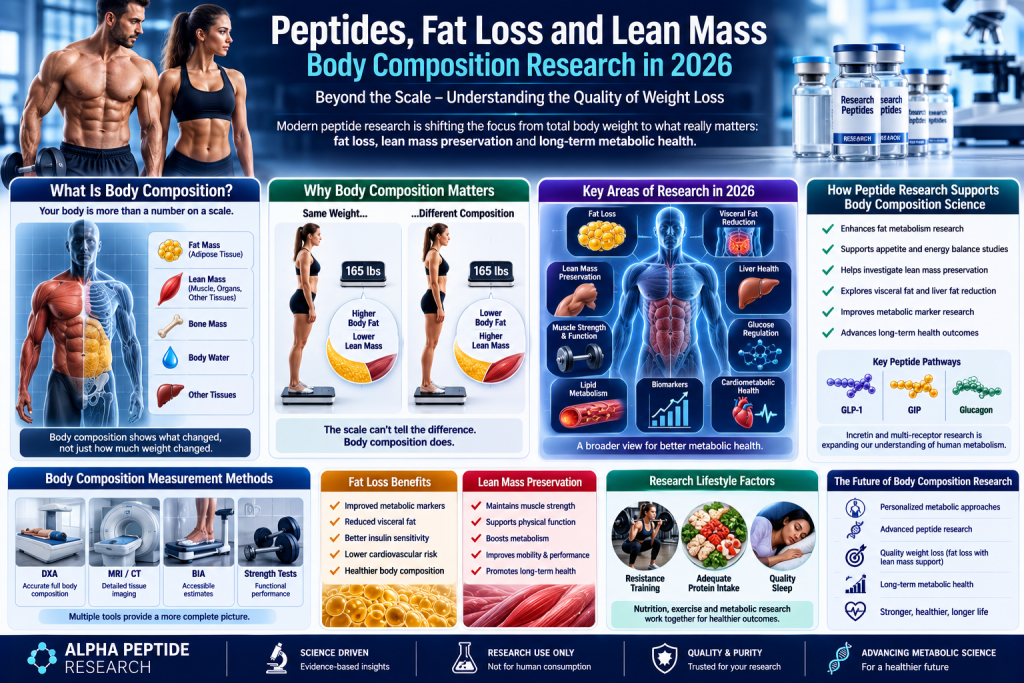
What Is Body Composition?
Body composition describes the different components that make up total body mass.
These components include:
Fat mass
Lean tissue
Skeletal muscle
Bone
Body water
Organs and other tissues
A standard scale combines all of these components into one number.
That creates an important limitation.
Two individuals can have identical body weights while having very different amounts of fat and lean tissue.
Researchers therefore use body composition measurements to gain a more detailed understanding of metabolic change.
Why Body Weight Alone Is Not Enough
Imagine two research participants who each experience the same reduction in total body weight.
The scale suggests identical outcomes.
However, one participant may have experienced a greater reduction in fat mass while retaining more lean tissue. The other may have experienced a different combination of fat and lean tissue changes.
Those outcomes are biologically different.
This is why modern weight management research increasingly examines the composition of weight change rather than only the amount.
The question is shifting from “How much weight changed?” to “What tissue changed?”
Fat Mass vs Lean Mass
Understanding these terms is essential.
What Is Fat Mass?
Fat mass refers to the body’s adipose tissue.
Adipose tissue plays several biological roles. It stores energy, participates in hormonal signaling, and contributes to metabolic regulation.
However, the location and amount of adipose tissue can influence metabolic health.
What Is Lean Mass?
Lean mass generally includes everything that is not body fat.
That means lean mass is not identical to skeletal muscle.
Depending on the measurement method, lean mass can include muscle, organs, connective tissue, and body water.
This distinction matters.
A reduction in measured lean mass does not automatically mean the same amount of skeletal muscle tissue has been lost.
Researchers must interpret body composition data carefully.
Why Skeletal Muscle Matters During Weight Management Research
Skeletal muscle does much more than create movement.
It is metabolically active tissue.
Muscle participates in glucose disposal, energy metabolism, physical performance, and overall functional capacity.
Researchers therefore pay close attention to skeletal muscle during substantial weight reduction.
Scientists are asking:
How much muscle changes?
Does muscle strength change?
Does physical function change?
How does resistance training influence outcomes?
What role does dietary protein play?
Does baseline muscle mass affect response?
These questions are becoming central to metabolic research.
How Peptide Research Connects With Body Composition
Modern peptide research includes several pathways related to appetite, glucose metabolism, energy balance, growth signaling, and other biological processes.
This has created strong scientific interest in how peptide-based compounds may influence body composition.
Researchers may examine:
Total body weight
Fat mass
Lean mass
Visceral adipose tissue
Waist circumference
Skeletal muscle
Metabolic biomarkers
Physical function
The goal is to understand biological change more precisely.
Different peptide pathways may influence these outcomes through different mechanisms.
GLP-1 Research and Body Composition
GLP-1 receptor agonist research helped accelerate interest in body composition.
These compounds can produce substantial changes in body weight in appropriate clinical settings.
As the magnitude of weight reduction increased, researchers began asking what proportion came from fat versus lean tissue.
Studies involving GLP-1-based therapies have generally shown that fat mass accounts for a substantial portion of weight reduction.
However, lean mass can also decrease.
This has created an important research priority.
Scientists want to understand how to evaluate lean tissue changes and preserve physical function during substantial weight reduction.
Dual Agonists and Body Composition
Dual agonist research has expanded these questions.
Tirzepatide targets both GIP and GLP-1 receptors.
Researchers studying dual agonism can evaluate how combined incretin signaling affects:
Fat mass
Visceral adiposity
Waist circumference
Lean mass
Glucose metabolism
Overall body composition
These measurements provide a more detailed picture than total weight alone.
Triple Agonists and the Next Research Frontier
Triple agonist research adds another level of complexity.
Investigational compounds such as retatrutide combine GIP, GLP-1, and glucagon receptor activity.
Researchers are interested in how this combination may influence both energy intake and energy expenditure.
That makes body composition particularly relevant.
Scientists want to determine whether changes in total weight correspond with changes in:
Adipose tissue
Visceral fat
Lean tissue
Skeletal muscle
Liver fat
Other metabolic markers
Retatrutide remains investigational in 2026, so research findings should not be interpreted as approval for human use outside authorized clinical research.
Why Visceral Fat Deserves Special Attention
Not all body fat is biologically identical.
Subcutaneous fat sits beneath the skin.
Visceral fat is stored around internal organs within the abdominal cavity.
Visceral adiposity has strong associations with metabolic dysfunction.
Researchers therefore increasingly measure visceral fat separately.
A study participant could experience a moderate change in total body weight while showing meaningful changes in visceral adiposity.
A scale alone would miss this information.
That makes visceral fat an important endpoint in metabolic research.
Liver Fat Is Another Important Measurement
The liver is another major focus of metabolic science.
Excessive accumulation of fat within the liver is closely connected to metabolic dysfunction.
Researchers studying weight management interventions may therefore examine changes in liver fat alongside total body weight.
Scientists can investigate relationships among:
Liver fat
Visceral fat
Insulin sensitivity
Glucose regulation
Lipid metabolism
Body composition
These relationships help researchers understand metabolic health more comprehensively.
What Does Lean Mass Loss Actually Mean?
Discussions about weight management sometimes treat any reduction in lean mass as equivalent to muscle loss.
The reality is more complicated.
Lean mass measurements can reflect changes in several components, including water and other non-fat tissues.
Researchers therefore use multiple methods when possible.
They may evaluate:
Body composition scans
Muscle imaging
Muscle strength
Physical performance
Functional tests
Biochemical markers
Combining these measurements gives scientists a better understanding of what is actually changing.
How Researchers Measure Body Composition
Several technologies are used in body composition research.
DXA
Dual-energy X-ray absorptiometry, commonly called DXA, can estimate fat mass, lean mass, and bone mineral content.
Researchers frequently use DXA because it provides more information than body weight or BMI alone.
MRI
Magnetic resonance imaging can provide detailed measurements of specific tissues and fat distribution.
It can help researchers examine visceral adipose tissue and skeletal muscle.
CT Imaging
Computed tomography can measure tissue distribution in specific regions of the body.
Researchers may use CT to investigate abdominal fat and muscle.
Bioelectrical Impedance
Bioelectrical impedance analysis estimates body composition by measuring electrical properties of body tissues.
It is accessible, but hydration and other variables can affect results.
No measurement method is perfect.
Researchers choose methods based on study design, accuracy requirements, cost, and availability.
Muscle Quality vs Muscle Quantity
Researchers are also beginning to look beyond muscle mass.
More muscle does not automatically mean better muscle function.
Muscle quality considers characteristics such as strength, composition, and functional performance.
Two individuals with similar amounts of skeletal muscle can have different levels of strength and physical capability.
Therefore, future body composition research may increasingly combine muscle quantity with measurements of:
Strength
Mobility
Physical performance
Muscle composition
Metabolic function
This provides a more complete understanding of lean tissue health.
Resistance Training and Lean Mass Research
Resistance exercise has become an important area of investigation during weight reduction.
Researchers study whether strength training can help maintain muscle mass and physical function while body weight changes.
Resistance exercise provides a mechanical stimulus to skeletal muscle.
Scientists may evaluate:
Changes in muscle mass
Strength
Physical function
Body composition
Metabolic markers
Exercise adherence
The interaction between metabolic interventions and resistance training will likely remain an important research topic.
Protein Intake and Body Composition
Nutrition also plays a major role.
Protein provides amino acids used in muscle protein synthesis and many other biological processes.
Researchers studying weight management increasingly examine how dietary protein interacts with:
Calorie reduction
Resistance exercise
Age
Baseline muscle mass
Metabolic interventions
Body composition
However, optimal nutritional strategies can differ between populations.
Researchers must consider overall diet quality, energy intake, kidney function, age, activity level, and other variables when designing clinical studies.
Why Age Matters
Body composition changes naturally throughout life.
Aging can involve changes in skeletal muscle, fat distribution, bone mass, and metabolic function.
This makes lean tissue especially important in older populations.
Researchers studying weight management must consider whether an intervention affects younger and older participants differently.
Maintaining physical function may become particularly important when substantial weight reduction occurs later in life.
Metabolic Health Is More Than Fat Loss
Reducing excess adiposity can be an important research outcome.
However, metabolic health includes much more.
Scientists also evaluate:
Glucose regulation
Insulin sensitivity
Blood pressure
Lipid markers
Liver health
Inflammatory biomarkers
Physical function
Cardiovascular risk
Body composition
A participant could show improvements in several metabolic markers even when body weight does not tell the complete story.
This is why researchers increasingly use multiple endpoints.
The Rise of Quality Weight Loss Research
One of the biggest concepts emerging in 2026 is the idea of weight-loss quality.
Researchers are not simply asking how much weight changed.
They want to understand where the change came from.
An ideal research outcome may involve meaningful reductions in excess adipose tissue while supporting lean tissue and physical function.
Scientists are therefore paying more attention to the ratio of fat mass change to lean mass change.
This could reshape how future weight management studies define successful outcomes.
Peptide Research Beyond Incretins
GLP-1, GIP, and glucagon receive enormous attention, but metabolic peptide science extends beyond incretin pathways.
Researchers investigate many peptide signaling systems involved in:
Energy balance
Growth signaling
Appetite
Glucose metabolism
Muscle biology
Fat metabolism
Cellular signaling
However, evidence varies widely among different compounds.
Some peptides have extensive clinical data. Others remain experimental or have primarily preclinical evidence.
Researchers should evaluate each compound based on the strength of available evidence rather than assuming all peptides produce similar effects.
Why Research Purity and Characterization Matter
Reliable laboratory research depends on knowing what is being studied.
Researchers working with peptide materials need accurate characterization.
Important research considerations may include:
Identity
Purity
Storage conditions
Stability
Handling
Analytical documentation
Experimental design
Poorly characterized material can introduce uncertainty into research results.
High-quality experimental science therefore depends on rigorous laboratory standards and transparent documentation.
What Researchers Are Likely to Study Next
Body composition research is likely to become even more important as metabolic science advances.
Researchers may increasingly focus on:
Fat versus lean mass changes
Visceral fat reduction
Skeletal muscle preservation
Muscle strength
Physical function
Liver fat
Metabolic biomarkers
Long-term weight maintenance
Age-specific responses
Nutrition and exercise interactions
Multi-receptor peptide research
These questions could change how scientists evaluate metabolic interventions.
Frequently Asked Questions
What is body composition?
Body composition describes the different tissues that make up body mass, including fat, lean tissue, bone, water, and other components.
Why is body composition important in weight management research?
It allows researchers to determine whether changes in body weight come from fat, lean tissue, or other components.
Is lean mass the same as muscle?
No. Lean mass includes skeletal muscle but may also include organs, water, connective tissue, and other non-fat components.
What is visceral fat?
Visceral fat is adipose tissue stored around internal organs within the abdominal cavity.
Why are researchers concerned about lean mass during weight reduction?
Skeletal muscle contributes to physical function, glucose metabolism, and overall metabolic health. Researchers therefore want to understand how substantial weight reduction affects muscle and other lean tissues.
Do GLP-1-based interventions affect lean mass?
Research shows that substantial weight reduction can include changes in both fat and lean mass. The amount varies across studies and individuals.
How do researchers measure body composition?
Common methods include DXA, MRI, CT imaging, and bioelectrical impedance analysis.
Why is muscle strength important?
Muscle quantity alone does not fully describe physical function. Strength and performance provide additional information about muscle health.
Can researchers study visceral fat separately from total body fat?
Yes. Imaging techniques can help scientists measure visceral adipose tissue and examine changes in fat distribution.
What is quality weight loss?
In research, the concept generally refers to examining the composition and functional consequences of weight reduction rather than focusing only on total pounds or kilograms lost.
Conclusion
Weight management science is moving beyond the scale.
Researchers increasingly recognize that total body weight provides only one piece of the metabolic picture.
Fat mass, visceral adiposity, lean tissue, skeletal muscle, liver fat, strength, and physical function can all provide valuable information.
This shift has become especially important as peptide and incretin research produces increasingly substantial changes in body weight.
The next generation of metabolic studies will likely focus not only on how much weight changes but on the quality of that change.
Understanding the balance between fat loss and lean tissue may help researchers build a more complete picture of metabolic health.
At Alpha Peptide Research, we follow emerging peptide and metabolic science to provide research-focused information about the developments shaping modern biotechnology and body composition research.
Research Disclaimer: This article is provided for educational and research information only. Discussion of peptide science does not constitute medical advice or imply that research materials are approved for therapeutic use. Materials labeled for research use only are not intended for human consumption.
