

Muscle Growth & Recovery
CJC-1295 and Ipamorelin Research: GH Signaling, Recovery and Body Composition
Jul
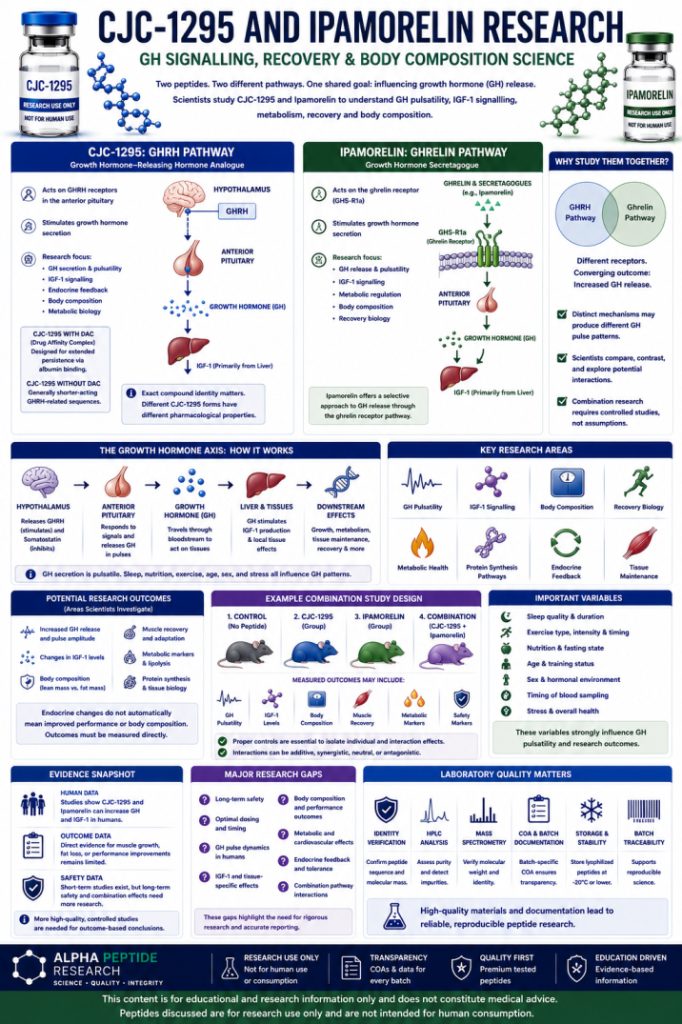
CJC-1295 and Ipamorelin frequently appear together in discussions about growth hormone signaling, recovery, and body composition research.
However, the two peptides act through different biological pathways.
CJC-1295 belongs to a class of synthetic peptides designed to interact with the growth hormone-releasing hormone pathway. Ipamorelin, by comparison, acts as a growth hormone secretagogue through the ghrelin receptor, also known as the growth hormone secretagogue receptor.
Consequently, scientists can study two distinct signaling mechanisms that converge on growth hormone release.
This relationship has generated interest in laboratory research involving GH pulsatility, IGF-1 signaling, body composition, skeletal muscle biology, metabolism, and recovery.
Nevertheless, pathway activation does not automatically establish a clinical benefit.
Researchers must distinguish mechanistic findings, controlled human evidence, and unsupported claims.
This guide examines CJC-1295 and Ipamorelin research, their different mechanisms, areas of overlap, evidence limitations, and the laboratory standards required for reliable peptide research.
What Is CJC-1295?
CJC-1295 is a synthetic peptide analogue associated with growth hormone-releasing hormone, commonly abbreviated GHRH.
GHRH participates in the regulation of growth hormone secretion.
The hypothalamus produces GHRH and communicates with the anterior pituitary, where specialized cells release growth hormone.
Researchers developed CJC-1295-related compounds to investigate this signaling system.
Therefore, CJC-1295 research primarily belongs to the broader field of GH-axis biology rather than direct tissue-repair pathways.
Scientific questions may involve:
Growth hormone secretion
GH pulsatility
IGF-1 signaling
Pituitary responses
Endocrine feedback
Body composition
Metabolic signaling
Recovery biology
However, different CJC-1295 forms and related analogues may have different pharmacological characteristics.
Exact compound identity therefore matters.
What Is Ipamorelin?
Ipamorelin is a synthetic peptide that researchers classify as a growth hormone secretagogue.
Its mechanism differs from CJC-1295.
Instead of acting through the GHRH receptor, ipamorelin interacts with the growth hormone secretagogue receptor, GHS-R1a.
Ghrelin also activates this receptor.
Consequently, scientists often discuss ipamorelin within ghrelin-receptor and GH-secretagogue research.
Researchers have investigated its effects on growth hormone release and endocrine signaling.
This mechanism creates an important distinction between the two peptides.
CJC-1295 approaches GH regulation through GHRH-related signaling, whereas ipamorelin approaches it through the ghrelin receptor.
Why Are CJC-1295 and Ipamorelin Studied Together?
The answer lies in pathway convergence.
Two biological signals can reach the same physiological system through different receptors.
CJC-1295-related research focuses on GHRH signaling.
Ipamorelin research focuses on GHS-R1a signaling.
Both pathways can influence pituitary growth hormone release.
Therefore, scientists may investigate whether the pathways produce distinct, overlapping, or interacting endocrine responses.
However, researchers should not assume that combining two GH-related signals automatically produces superior outcomes.
Controlled experiments must measure the interaction directly.
Understanding the Growth Hormone Axis
Growth hormone regulation involves communication between several tissues.
The hypothalamus plays an important role in controlling pituitary activity.
GHRH can stimulate growth hormone release.
Somatostatin, meanwhile, can inhibit GH secretion.
Ghrelin and related growth hormone secretagogues can also influence the system through GHS-R1a.
The pituitary then releases growth hormone into circulation.
Growth hormone can act directly on tissues. Additionally, it can stimulate downstream signaling involving insulin-like growth factor 1, commonly called IGF-1.
Therefore, the GH axis represents a network rather than a single hormone.
Understanding that network helps explain why CJC-1295 and ipamorelin attract research interest.
What Is Growth Hormone?
Growth hormone, or GH, is a peptide hormone that the anterior pituitary produces.
It participates in growth, metabolism, tissue maintenance, and several other physiological processes.
GH secretion does not remain constant throughout the day.
Instead, the pituitary releases growth hormone in pulses.
Sleep, age, nutritional status, exercise, sex, and other physiological factors can influence these patterns.
Consequently, researchers studying GH-related peptides need to consider timing and pulsatility.
A single measurement may not capture the full endocrine response.
Why GH Pulsatility Matters
Hormone patterns can carry biological information.
Growth hormone provides a clear example.
Instead of maintaining one steady concentration, GH levels rise and fall.
These pulses can influence downstream signaling.
Therefore, researchers studying CJC-1295, ipamorelin, or other GH secretagogues may examine pulse amplitude, frequency, duration, and overall exposure.
This approach provides more information than simply asking whether GH increased.
Furthermore, experimental design can strongly affect how researchers interpret endocrine data.
What Is GHRH?
Growth hormone-releasing hormone is a hypothalamic peptide.
It binds to GHRH receptors on pituitary somatotroph cells.
Receptor activation can stimulate growth hormone secretion.
Consequently, researchers use GHRH-related compounds to investigate pituitary signaling and GH regulation.
CJC-1295 belongs within this research framework.
However, structural modifications can alter how synthetic analogues behave.
Researchers should therefore identify the exact CJC-related molecule used in an experiment.
CJC-1295 With DAC vs Without DAC
The term CJC-1295 can create confusion because researchers and commercial sources may use related names for compounds with different structures.
One important distinction involves DAC, or Drug Affinity Complex.
CJC-1295 with DAC was designed to extend biological persistence through albumin binding.
By contrast, compounds commonly described online as “CJC-1295 without DAC” may refer to shorter-acting GHRH-related sequences, often associated with Modified GRF 1-29 terminology.
These compounds should not automatically be treated as pharmacologically identical.
Duration of exposure can influence endocrine responses.
Therefore, exact sequence and formulation matter when interpreting CJC-1295 research.
What Is the Ghrelin Receptor?
The growth hormone secretagogue receptor, especially GHS-R1a, responds to ghrelin.
Ghrelin participates in several physiological processes.
Researchers often associate it with appetite regulation. However, ghrelin biology extends beyond hunger.
GHS-R1a signaling can influence growth hormone secretion and other physiological systems.
Ipamorelin interacts with this receptor.
Consequently, researchers use ipamorelin-related models to investigate GH secretagogue biology.
Ipamorelin and GH Release
Ipamorelin research has examined growth hormone release through GHS-R1a activation.
This pathway differs from direct GHRH receptor activation.
Therefore, scientists can compare endocrine responses across distinct receptor systems.
Researchers may examine:
GH concentration
Pulse characteristics
Time-course responses
Receptor signaling
Downstream IGF-1 changes
Metabolic markers
Interactions with other pathways
These measurements help scientists understand mechanism.
However, an increase in GH does not automatically demonstrate improved muscle growth, recovery, or body composition.
Those outcomes require separate evidence.
What Is IGF-1?
Insulin-like growth factor 1 is an important downstream component of the growth hormone axis.
The liver produces a substantial portion of circulating IGF-1 in response to GH signaling.
Other tissues can also produce IGF-related signals locally.
IGF-1 participates in growth, cellular signaling, metabolism, and tissue biology.
Therefore, researchers studying GH-related peptides often measure both GH and IGF-1.
However, these biomarkers answer different questions.
GH secretion can change rapidly, whereas IGF-1 may reflect downstream endocrine activity over a different timescale.
CJC-1295 and IGF-1 Research
CJC-1295 research has included questions involving GH and downstream IGF-1 signaling.
A GHRH-related intervention may influence pituitary GH secretion.
In turn, altered GH exposure can affect IGF-1 biology.
Therefore, researchers may measure IGF-1 alongside GH to understand the broader endocrine response.
Still, higher biomarker levels do not automatically translate into beneficial outcomes.
Scientists need outcome-specific research.
For example, demonstrating a change in IGF-1 does not by itself establish improved recovery or increased muscle mass.
Ipamorelin and IGF-1 Research
Ipamorelin can influence GH signaling through the growth hormone secretagogue receptor.
Consequently, researchers may also investigate downstream IGF-1 responses.
However, several variables can influence the relationship between GH secretion and IGF-1.
Age, nutrition, liver function, endocrine status, timing, and experimental conditions all matter.
Therefore, researchers should interpret IGF-1 changes within the broader physiological context.
CJC-1295 and Ipamorelin in Recovery Research
Recovery involves many biological systems.
Muscle tissue must respond to mechanical stress.
Energy stores require restoration.
Connective tissue adapts to loading.
Sleep and endocrine regulation also influence recovery.
Because growth hormone participates in tissue and metabolic biology, researchers may investigate GH-related pathways within recovery models.
CJC-1295 and ipamorelin provide two experimental approaches to GH signaling.
Nevertheless, pathway relevance does not prove that either peptide accelerates recovery in healthy humans.
Researchers need controlled outcome data.
Muscle Recovery vs Muscle Growth
Muscle recovery and muscle hypertrophy are not identical.
Recovery describes processes that restore function after physiological stress or damage.
Hypertrophy refers to increased muscle fiber size.
Although the processes can interact, they depend on different measurements and experimental questions.
Therefore, a study showing endocrine changes cannot automatically establish muscle growth.
Researchers need direct measures of body composition, muscle size, protein metabolism, strength, or other relevant outcomes.
This distinction prevents mechanistic research from becoming an unsupported performance claim.
Do CJC-1295 and Ipamorelin Build Muscle?
Current evidence does not justify describing CJC-1295 and ipamorelin as proven muscle-building treatments.
Both peptides attract interest because of their relationship with GH signaling.
Growth hormone and IGF-1 participate in tissue biology.
However, muscle hypertrophy involves far more than circulating GH.
Resistance training, nutrition, muscle protein synthesis, genetics, sleep, training history, and other endocrine signals all contribute.
Therefore, researchers should distinguish changes in GH-axis biomarkers from demonstrated increases in skeletal muscle.
Body Composition Research
Body composition refers to the distribution of fat mass, lean mass, bone, and other body tissues.
GH biology has long attracted interest in this field because growth hormone influences metabolism and tissue maintenance.
Consequently, researchers may examine body composition when studying GH-related pathways.
Relevant outcomes can include:
Lean body mass
Fat mass
Visceral adipose tissue
Muscle measurements
Waist circumference
Metabolic markers
However, researchers need controlled studies to determine whether biomarker changes translate into meaningful body composition effects.
GH Signaling and Fat Metabolism
Growth hormone participates in lipid metabolism.
Therefore, GH-related research often intersects with questions about adipose tissue and energy utilization.
Scientists may examine lipolysis, free fatty acids, body fat distribution, or other metabolic markers.
However, metabolism involves numerous hormonal and nutritional signals.
Consequently, scientists should avoid describing CJC-1295 or ipamorelin as proven fat-loss agents simply because they influence GH pathways.
Mechanism alone cannot establish a weight-management outcome.
CJC-1295 and Body Composition Research
CJC-1295-related studies may examine how altered GH signaling affects downstream physiological outcomes.
Body composition represents one possible research area.
Researchers can measure lean mass and fat mass using validated methods.
Furthermore, imaging techniques can help distinguish visceral and subcutaneous fat.
These direct measurements provide stronger evidence than relying solely on hormone concentrations.
Therefore, high-quality CJC-1295 research should connect endocrine biomarkers with meaningful physiological endpoints when appropriate.
Ipamorelin and Body Composition Research
Ipamorelin-related research can also intersect with body composition through GH secretagogue biology.
However, scientists need to separate receptor activation from outcome claims.
GHS-R1a activation can influence growth hormone release.
That does not mean every downstream body composition outcome will necessarily change.
Therefore, controlled experiments should measure the endpoint directly.
This principle applies throughout endocrine research.
CJC-1295 vs Ipamorelin
CJC-1295 and ipamorelin differ primarily in how they interact with GH regulation.
CJC-1295-related compounds act through the GHRH pathway.
Ipamorelin acts through GHS-R1a, the ghrelin receptor.
Thus, the peptides provide different experimental approaches to the same broader endocrine system.
Researchers may compare:
Receptor pathways
GH release patterns
Duration of action
IGF-1 responses
Endocrine feedback
Metabolic markers
Body composition outcomes
Recovery-related endpoints
Such comparisons can clarify whether different mechanisms produce distinct physiological responses.
CJC-1295 and Ipamorelin Combination Research
Researchers may investigate both pathways together because GHRH and ghrelin-receptor signaling can influence pituitary GH release through different mechanisms.
A controlled experiment could compare each pathway individually and in combination.
For example, groups might include:
Control
CJC-1295
Ipamorelin
CJC-1295 plus ipamorelin
Scientists could then measure predefined outcomes.
However, combination research requires proper controls.
Without individual-compound groups, researchers cannot determine whether an observed effect results from one peptide or an interaction.
Why Combination Does Not Automatically Mean Synergy
Synergy has a specific scientific meaning.
Two interventions show synergy when their combined effect exceeds what researchers would expect from their individual effects under an appropriate model.
Simply observing a larger response in a combination group does not necessarily prove synergy.
Researchers need suitable statistical analysis.
Furthermore, biological pathways can interact in complex ways.
A combination may produce additive, synergistic, neutral, or antagonistic effects.
Therefore, scientists should measure interactions rather than assume them.
CJC-1295 and Ipamorelin “Stacks”
Online communities often use the term “CJC-1295 and ipamorelin stack.”
However, anecdotal self-administration reports do not provide controlled evidence.
They usually lack standardized material characterization, controls, predefined endpoints, blinding, and systematic safety monitoring.
Therefore, such reports cannot establish efficacy, safety, or optimal exposure.
Scientific combination research should instead focus on receptor biology, endocrine responses, and measurable outcomes.
Sleep and Growth Hormone Research
Sleep and GH physiology share an important relationship.
Growth hormone secretion often follows characteristic patterns during sleep.
Consequently, sleep quality and timing can affect endocrine measurements.
Researchers studying GH-related peptides should consider this variable.
Otherwise, differences in sleep patterns could complicate interpretation.
Furthermore, observing GH-related changes does not establish that an experimental peptide improves sleep.
Sleep outcomes require direct measurement.
Exercise and GH Research
Exercise can influence growth hormone secretion.
The response depends on exercise type, intensity, duration, training status, nutrition, and other factors.
Therefore, exercise represents another important variable in CJC-1295 and ipamorelin research.
Researchers may need standardized exercise conditions.
Alternatively, studies can investigate how GH-related pathways interact with controlled exercise.
Either way, scientists should account for exercise when interpreting endocrine measurements.
Nutrition and GH Signaling
Nutritional status influences endocrine physiology.
Energy intake, glucose availability, amino acids, fasting state, and other factors can affect hormonal responses.
Therefore, researchers studying GH secretagogues should control relevant nutritional variables.
This becomes especially important when measuring metabolism or body composition.
Without standardized conditions, dietary differences can complicate interpretation.
Age and the GH Axis
Growth hormone physiology changes across the lifespan.
GH secretion generally differs between younger and older populations.
IGF-1 patterns also change with age.
Therefore, age can strongly influence research outcomes.
Scientists should account for this factor when designing GH-related experiments.
Results from one age group may not apply directly to another.
Sex and Endocrine Research
Sex-related physiological differences can influence growth hormone secretion patterns.
Therefore, researchers should consider sex when designing studies and interpreting results.
Hormonal environment, body composition, and other variables may affect endocrine responses.
Including diverse research populations can help scientists understand whether findings remain consistent across groups.
Why Timing Matters in GH Research
Growth hormone can fluctuate substantially over short periods.
Therefore, measurement timing matters.
A single blood sample may capture a peak, trough, or intermediate point.
Researchers can use repeated sampling to better characterize GH dynamics.
They may also calculate integrated exposure across time.
Consequently, strong endocrine research requires more than one isolated hormone measurement when pulsatility forms part of the question.
Human Evidence for CJC-1295
CJC-1295 has undergone human research examining pharmacokinetic and endocrine effects.
Such studies provide useful information about how specific compounds influence GH and IGF-1.
However, endocrine responses do not establish every outcome commonly claimed online.
Researchers still need outcome-specific evidence for questions involving recovery, body composition, performance, or long-term effects.
Furthermore, different CJC-related sequences should not automatically share the same evidence.
Compound identity remains essential.
Human Evidence for Ipamorelin
Researchers have also investigated ipamorelin in human and experimental contexts.
Much of the scientific interest focuses on its activity as a selective growth hormone secretagogue.
However, common online claims can extend beyond what controlled evidence establishes.
Therefore, scientists should separate receptor activity and hormone responses from proven physiological outcomes.
Long-term safety also requires appropriate evidence.
Regulatory Status
Neither online popularity nor research activity establishes regulatory approval.
Researchers and suppliers should describe CJC-1295 and ipamorelin according to their actual regulatory status in the relevant jurisdiction.
In the United States, these compounds should not be marketed as approved treatments simply because research has examined their biological activity.
Research-use materials also require clear labeling.
Accurate regulatory language supports scientific credibility.
Safety Research
The GH axis affects many tissues.
Therefore, researchers must investigate safety alongside endocrine effects.
Important questions include:
Short-term tolerability
Long-term exposure
Glucose metabolism
Insulin sensitivity
Fluid balance
Cardiovascular effects
Endocrine feedback
IGF-1 exposure
Potential interactions
Tissue-specific responses
Researchers also need to determine whether combined pathway activation changes the safety profile.
Why Glucose Metabolism Matters
Growth hormone can influence glucose and lipid metabolism.
Therefore, scientists studying GH-related peptides may monitor glucose regulation.
Relevant measurements can include fasting glucose, insulin, and other metabolic markers.
Researchers may also examine how responses change over time.
This area matters because a biological pathway can produce multiple downstream effects.
Consequently, scientists should evaluate both intended experimental outcomes and broader physiological responses.
Endocrine Feedback
Hormonal systems rely heavily on feedback mechanisms.
When downstream signals change, the body can adjust upstream activity.
The GH/IGF-1 axis follows this principle.
Therefore, sustained or altered signaling can produce compensatory responses.
Researchers studying CJC-1295 and ipamorelin should consider these feedback loops.
Otherwise, short-term hormone changes may provide an incomplete picture of the biological response.
Why Compound Identity Matters
Accurate identity forms the foundation of peptide research.
CJC-1295 terminology can refer to compounds with important structural differences.
Likewise, researchers need to confirm ipamorelin identity.
Therefore, a label alone cannot provide sufficient analytical assurance.
Laboratories should evaluate sequence information, molecular mass, chromatographic data, batch documentation, and other relevant specifications.
Without accurate identity, researchers cannot confidently interpret experimental results.
HPLC Analysis
High-performance liquid chromatography helps researchers characterize peptide samples.
The technique can separate sample components and reveal chromatographic purity profiles.
Consequently, HPLC provides useful information about impurities.
However, purity does not equal identity.
A chromatographically pure material could still require confirmation that it contains the intended peptide.
Therefore, laboratories should combine purity analysis with appropriate identity testing.
Mass Spectrometry
Mass spectrometry provides information about molecular mass.
Researchers can compare measured values with the expected characteristics of a peptide.
Consequently, mass spectrometry can support identity verification.
When combined with HPLC, the two methods answer complementary questions.
One helps characterize purity, while the other contributes to molecular identification.
This combination strengthens analytical confidence.
Certificates of Analysis
A Certificate of Analysis can summarize analytical information for a peptide batch.
Useful documentation may include:
Compound name
Peptide sequence
Batch number
Purity result
Analytical methods
Mass data
Testing date
Specifications
Storage information
Laboratory details
However, researchers should confirm that the COA corresponds to the exact batch they receive.
Batch-specific documentation supports traceability.
Storage and Stability
Peptide stability depends on several environmental factors.
Temperature, moisture, light, formulation, and time may all matter.
Therefore, researchers should follow validated storage information for the exact material.
Lyophilized material and prepared laboratory solutions may require different handling.
Furthermore, laboratories should document storage conditions.
Reliable handling supports reproducibility.
Research Quality Beyond Purity
A high purity percentage can provide useful information.
However, quality involves more than one analytical number.
Researchers should also consider:
Identity
Sequence
Molecular mass
Batch traceability
Storage conditions
Analytical methods
Documentation
Label accuracy
Research-use designation
Supplier transparency
Together, these factors create a stronger foundation for reproducible peptide research.
How Researchers Can Evaluate CJC-1295 and Ipamorelin
The research question should come first.
Scientists need to determine which pathway they want to investigate.
Next, they should verify the exact compounds.
For CJC-1295-related research, this step becomes particularly important because DAC status and sequence terminology can affect interpretation.
Researchers should then examine analytical documentation.
Finally, experimental design should account for endocrine variables such as timing, sleep, exercise, nutrition, age, and baseline physiology.
This structured approach produces stronger research than selecting compounds based on online popularity.
Major Research Gaps
Important questions remain about CJC-1295 and ipamorelin.
Future studies need stronger evidence involving:
Long-term safety
Human pharmacokinetics
GH pulse dynamics
IGF-1 responses
Body composition
Muscle recovery
Metabolic effects
Glucose regulation
Endocrine feedback
Age-related responses
Sex-related differences
Combination effects
Compound-specific outcomes
Long-term exposure
These gaps create opportunities for more rigorous research.
Future of CJC-1295 Research
Future CJC-1295 research may focus on better characterization of specific analogues.
Researchers can examine how structural differences influence persistence, receptor signaling, GH patterns, and downstream IGF-1.
Furthermore, controlled studies can connect endocrine changes with direct physiological outcomes.
This distinction matters because biomarkers alone cannot establish functional benefits.
Better compound identification will also improve comparisons across studies.
Future of Ipamorelin Research
Ipamorelin research may continue exploring selective GHS-R1a signaling.
Scientists can investigate how receptor activation affects GH dynamics and downstream physiology.
Furthermore, future studies can examine metabolic outcomes, endocrine feedback, and long-term responses.
Controlled comparisons with other growth hormone secretagogues could also clarify differences in receptor activity.
Again, strong research requires direct measurement rather than assumptions based on mechanism.
Why This Research Matters
Growth hormone biology connects several areas of physiology.
Metabolism, growth, body composition, tissue maintenance, and endocrine feedback all interact with the GH axis.
Therefore, CJC-1295 and ipamorelin provide useful experimental tools for studying different entry points into that system.
Their scientific value does not depend on exaggerated claims.
Instead, value comes from understanding receptor signaling, endocrine dynamics, and downstream responses.
Frequently Asked Questions
What is CJC-1295?
CJC-1295 is a synthetic peptide analogue associated with growth hormone-releasing hormone research and GH-axis signaling.
What is Ipamorelin?
Ipamorelin is a synthetic growth hormone secretagogue that interacts with the growth hormone secretagogue receptor, GHS-R1a.
Are CJC-1295 and Ipamorelin the same peptide?
No. They differ structurally and act through different receptor pathways.
How does CJC-1295 differ from Ipamorelin?
CJC-1295-related compounds act through GHRH signaling, whereas ipamorelin activates the ghrelin receptor pathway associated with GHS-R1a.
Why are CJC-1295 and Ipamorelin studied together?
Researchers may study them together because GHRH and ghrelin-receptor pathways can both influence pituitary growth hormone secretion through different mechanisms.
What is growth hormone?
Growth hormone is a pituitary peptide hormone involved in growth, metabolism, tissue maintenance, and several other physiological processes.
What is IGF-1?
IGF-1 is an important downstream component of GH signaling that participates in growth, metabolism, and cellular biology.
Does CJC-1295 build muscle?
Changes in GH-axis signaling do not by themselves establish direct muscle growth. Researchers need direct outcome evidence to demonstrate hypertrophy.
Does Ipamorelin build muscle?
Current evidence does not justify describing ipamorelin as a proven direct muscle-building treatment.
Are CJC-1295 and Ipamorelin studied for recovery?
Researchers can investigate GH-related pathways in recovery biology. However, pathway involvement does not establish that either peptide improves human recovery.
What is CJC-1295 with DAC?
CJC-1295 with DAC refers to a long-acting design that uses a Drug Affinity Complex approach to extend biological persistence.
Is CJC-1295 without DAC the same compound?
Not necessarily. Commercial terminology may refer to shorter-acting GHRH-related sequences, so researchers should verify exact molecular identity.
Why does GH pulsatility matter?
Growth hormone secretion naturally occurs in pulses. Therefore, timing, frequency, amplitude, and overall exposure can influence endocrine research.
What testing matters for research peptides?
Researchers may evaluate HPLC purity, mass spectrometry, sequence information, batch-specific COAs, traceability, and validated storage documentation.
Why does batch traceability matter?
Traceability connects experimental results with the exact material used and therefore supports reproducibility.
Conclusion
CJC-1295 and ipamorelin research provides a useful framework for understanding how different biological pathways can converge on the growth hormone axis.
CJC-1295-related compounds interact with GHRH signaling.
Ipamorelin, by contrast, acts through the growth hormone secretagogue receptor associated with ghrelin biology.
Both pathways can influence pituitary growth hormone release.
Consequently, researchers can study GH pulsatility, downstream IGF-1 signaling, metabolic responses, recovery biology, and body composition.
However, endocrine activation does not automatically establish a functional benefit.
Changes in GH or IGF-1 cannot independently prove muscle growth, accelerated recovery, fat loss, or improved performance.
Scientists need direct measurements and controlled outcome studies.
Compound identity also deserves careful attention.
Different CJC-1295-related sequences may have different pharmacological properties. Therefore, researchers should verify exact molecular identity rather than relying on broad product terminology.
Laboratory quality provides another essential foundation.
HPLC analysis, mass spectrometry, sequence information, batch-specific COAs, traceability, and documented storage conditions help researchers conduct more reproducible experiments.
Ultimately, CJC-1295 and ipamorelin remain scientifically interesting because they allow researchers to investigate two distinct entry points into a complex endocrine system.
Better controlled research will determine how those mechanisms translate into measurable physiological outcomes.
Alpha Peptide Research provides research-focused educational information about emerging peptide science, laboratory standards, and developments shaping modern biotechnology.
Research Disclaimer: This article provides educational and scientific research information only. CJC-1295 and ipamorelin are discussed in the context of experimental peptide and endocrine research. The content does not provide dosing, administration, or treatment instructions and does not establish safety, efficacy, or suitability for human use. Research-use materials are not intended for human consumption.
