

Muscle Growth & Recovery
BPC-157 and TB-500 Research: Why Scientists Study Different Tissue Repair Pathways
Jul
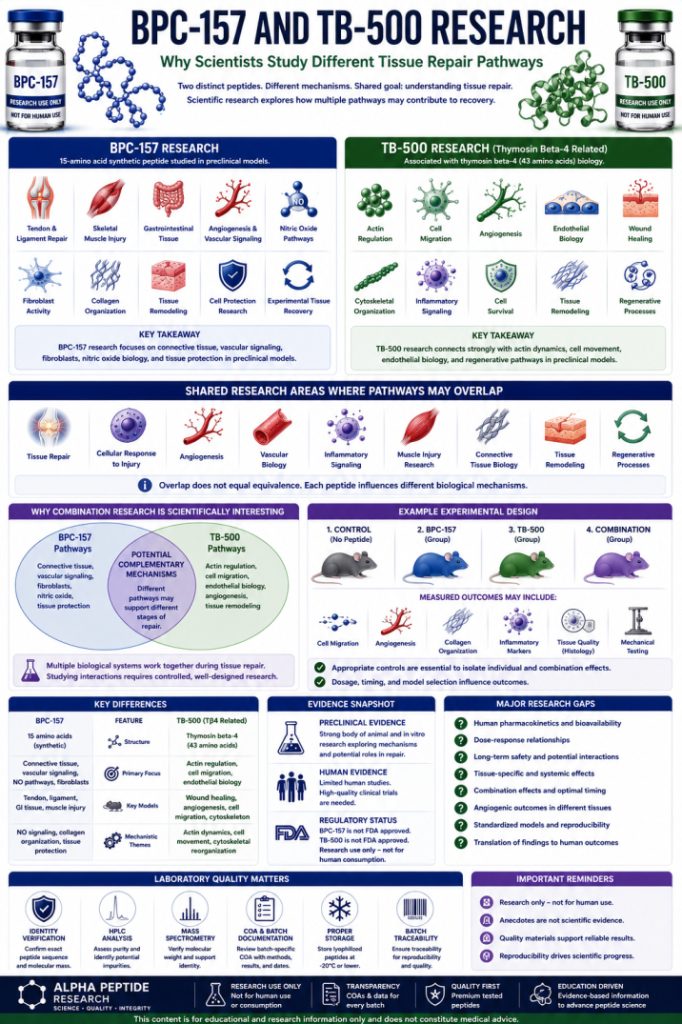
BPC-157 and TB-500 frequently appear together in discussions about tissue repair, recovery, and regenerative research.
However, the two peptides represent different research pathways.
Scientists have investigated BPC-157 in experimental models involving tendons, ligaments, skeletal muscle, gastrointestinal tissue, vascular signaling, and other repair-related processes.
TB-500 discussions, meanwhile, connect strongly with thymosin beta-4 research. That scientific field includes actin regulation, cell migration, angiogenesis, wound repair, endothelial biology, and tissue remodeling.
Consequently, researchers may find the two areas interesting for different reasons.
Studying both pathways does not mean they produce identical effects. Instead, scientists can ask whether distinct biological mechanisms influence different stages of tissue repair.
That question provides a better foundation for BPC-157 and TB-500 research than the popular idea of a peptide “stack.”
This guide explores the science behind both research pathways, where they may overlap, how researchers can design controlled experiments, and which evidence gaps remain in 2026.
BPC-157 and TB-500 Research at a Glance
Tissue repair is not a single biological event.
Instead, recovery involves a coordinated sequence of processes.
Cells respond to damage. Inflammatory signaling changes. Blood vessels support recovering tissue. Meanwhile, cells migrate, extracellular structures reorganize, and tissue gradually remodels.
Because multiple systems participate, scientists often investigate more than one pathway.
BPC-157 research focuses on several experimental mechanisms associated with tissue protection and repair.
Thymosin beta-4-related research, by comparison, has a particularly strong connection with actin dynamics and cellular migration.
Therefore, researchers can study the two pathways separately or examine how they interact within controlled models.
What Is BPC-157?
BPC-157 is a synthetic peptide containing 15 amino acids.
Researchers have investigated it primarily through preclinical models.
Scientific areas of interest include:
Tendon repair
Ligament research
Skeletal muscle injury
Gastrointestinal tissue
Angiogenesis
Vascular signaling
Nitric oxide pathways
Fibroblast activity
Collagen organization
Tissue remodeling
These studies have created substantial interest in BPC-157.
Nevertheless, researchers still need stronger human evidence before drawing therapeutic conclusions.
What Is TB-500?
TB-500 is commonly discussed in connection with thymosin beta-4-related research.
Thymosin beta-4 is a naturally occurring 43-amino-acid peptide found across many tissues and cell types.
One of its best-known biological relationships involves actin.
Actin forms an important part of the cellular cytoskeleton. It contributes to cell structure, movement, adhesion, and many other processes.
Consequently, thymosin beta-4 research has explored:
Actin regulation
Cell migration
Angiogenesis
Endothelial biology
Wound repair
Inflammatory signaling
Cell survival
Cytoskeletal organization
Tissue remodeling
Regenerative processes
However, scientists should distinguish specific TB-500 materials from full-length thymosin beta-4 and related fragments.
Exact molecular identity matters.
Why Researchers Study Different Repair Pathways
Imagine tissue repair as a complex biological project.
No single process completes the entire job.
Cells must respond to damage. Other cells may migrate toward the injury. Blood supply may change. Extracellular structures require remodeling. Finally, the tissue needs to regain appropriate organization and function.
Therefore, researchers investigate multiple biological pathways.
BPC-157 research raises questions involving connective tissue, vascular signaling, fibroblast behavior, nitric oxide biology, and experimental tissue protection.
Meanwhile, thymosin beta-4-related research provides a way to investigate actin dynamics, cellular movement, endothelial biology, and other regenerative mechanisms.
Together, these fields illustrate the complexity of tissue repair.
Where BPC-157 and TB-500 Research Overlap
Although their mechanisms differ, several research areas overlap.
Both fields intersect with:
Tissue repair
Cellular responses to injury
Angiogenesis
Vascular biology
Inflammatory signaling
Muscle injury research
Connective tissue biology
Tissue remodeling
Regenerative processes
However, overlap does not mean equivalence.
For example, both research areas may involve angiogenesis. Yet scientists may investigate different signaling mechanisms within that process.
Therefore, researchers need pathway-specific measurements to understand what each compound actually influences.
BPC-157 and Tendon Repair Research
Tendons connect muscle to bone.
Their organized collagen fibers allow them to transfer mechanical force.
However, tendon repair presents biological challenges because tendons have different vascular and cellular characteristics from many other tissues.
BPC-157 has appeared in several preclinical tendon models.
Scientists have investigated tissue organization, cellular behavior, mechanical outcomes, and repair-related pathways.
Furthermore, fibroblast migration and collagen remodeling have attracted research interest.
These findings make tendon biology an important part of the BPC-157 research landscape.
Still, preclinical results do not establish clinical efficacy in humans.
TB-500 and Connective Tissue Research
TB-500-related research approaches connective tissue through a different biological framework.
Thymosin beta-4 interacts with actin biology.
Because actin helps cells move, researchers can investigate whether thymosin beta-4-related mechanisms influence cellular migration during repair.
Connective tissue remodeling requires coordinated cellular activity.
Therefore, actin dynamics may contribute to experimental questions involving tendons, ligaments, and other structural tissues.
However, scientists need to verify which peptide sequence each experiment uses.
Evidence involving full-length thymosin beta-4 does not automatically apply to every TB-500 material.
BPC-157 and TB-500 in Muscle Research
Muscle repair requires multiple biological processes.
After damage, inflammatory responses help initiate recovery. Subsequently, cellular activity, vascular responses, extracellular matrix changes, and muscle regeneration contribute to tissue restoration.
BPC-157 has appeared in experimental muscle injury research.
Meanwhile, thymosin beta-4-related science investigates mechanisms involving cellular migration, actin regulation, vascular biology, and tissue remodeling.
Therefore, both pathways can generate useful research questions about muscle recovery.
However, neither research field should be reduced to claims about direct muscle growth.
Muscle repair and muscle hypertrophy are different scientific topics.
Do BPC-157 and TB-500 Build Muscle?
Current evidence does not establish BPC-157 or TB-500 as proven direct muscle-building compounds.
Muscle hypertrophy depends on several factors, including mechanical loading, muscle protein synthesis, nutrition, endocrine signaling, training status, and genetics.
By comparison, BPC-157 and TB-500-related research focuses more strongly on repair and regenerative biology.
Scientists may study damaged muscle tissue, cellular migration, vascular processes, or tissue remodeling.
Those research questions differ from demonstrating direct hypertrophic effects.
Therefore, accurate content should distinguish recovery research from muscle-building claims.
The Role of Cell Migration in Tissue Repair
Cells rarely remain static during repair.
Instead, certain cell populations move toward areas where biological work needs to occur.
Cell migration depends heavily on cytoskeletal dynamics.
Actin plays a central role in this process.
Because thymosin beta-4 interacts with actin biology, scientists study it within models of cellular movement.
BPC-157 research also includes questions involving cellular behavior.
However, researchers should investigate each pathway independently rather than assuming both compounds influence migration through identical mechanisms.
Understanding Actin Regulation
Actin exists in different organizational states inside cells.
Monomeric G-actin can contribute to filamentous F-actin structures.
Cells continually reorganize these structures.
As a result, actin dynamics help support movement, shape, adhesion, and other cellular functions.
Thymosin beta-4 can interact with G-actin.
Therefore, researchers use this relationship to investigate cytoskeletal regulation.
This mechanism represents one of the clearest scientific distinctions between thymosin beta-4-related research and BPC-157 research.
Fibroblasts and BPC-157 Research
Fibroblasts contribute heavily to connective tissue biology.
These cells produce and organize extracellular matrix components.
Furthermore, fibroblast migration can play an important role during repair.
Experimental BPC-157 studies have investigated fibroblast-related responses.
Consequently, scientists may examine migration, signaling, extracellular matrix organization, and other repair mechanisms.
However, laboratory findings involving fibroblasts cannot independently establish a therapeutic effect.
Researchers need broader tissue and clinical evidence.
Collagen Remodeling
Collagen provides structural support to many tissues.
Tendons and ligaments rely particularly heavily on organized collagen.
During repair, collagen structure can change substantially.
Early tissue may differ from mature tissue in both organization and mechanical strength.
Therefore, researchers often measure collagen-related outcomes in connective tissue studies.
BPC-157 research has intersected with these questions.
Meanwhile, thymosin beta-4-related pathways may influence cellular processes involved in broader tissue remodeling.
Consequently, collagen biology offers another area where different repair pathways can converge.
Angiogenesis and Recovery Research
Angiogenesis refers to the development of new blood vessels from existing vascular structures.
Recovering tissue needs oxygen and nutrients.
Therefore, vascular responses can play an important role during repair.
Both BPC-157 and thymosin beta-4-related research have explored angiogenic biology.
However, researchers should avoid interpreting angiogenesis as universally beneficial.
The location, timing, magnitude, and biological context of vascular growth all matter.
Accordingly, controlled research needs to characterize angiogenic responses rather than simply labeling them positive or negative.
BPC-157 and Vascular Signaling
Vascular biology forms an important part of BPC-157 research.
Experimental studies have examined pathways involving blood vessels, endothelial responses, and nitric oxide signaling.
Nitric oxide contributes to vascular regulation and many other cellular functions.
Therefore, researchers may investigate how BPC-157-related responses interact with nitric oxide pathways.
Still, the biology remains complex.
Scientists need to determine which mechanisms operate in specific tissues and experimental conditions.
Thymosin Beta-4 and Endothelial Research
Endothelial cells line blood vessels.
During angiogenesis, these cells can migrate, reorganize, and contribute to new vascular structures.
Thymosin beta-4 research has examined endothelial biology.
Its relationship with actin provides a particularly relevant mechanism because endothelial migration requires cytoskeletal reorganization.
Consequently, TB-500-related research may intersect with vascular biology through mechanisms that differ from those studied with BPC-157.
Understanding these differences can help scientists design more informative experiments.
Inflammation During Tissue Repair
Inflammation represents a normal part of tissue repair.
Immediately after damage, inflammatory signaling helps coordinate the biological response.
However, the inflammatory environment changes as recovery progresses.
Both BPC-157 and thymosin beta-4-related research have explored inflammatory processes.
Nevertheless, describing either compound simply as “anti-inflammatory” oversimplifies the science.
Researchers need to identify specific signals, cell types, timing, and outcomes.
Furthermore, reducing inflammation does not automatically improve every stage of tissue repair.
Context matters.
Tissue Remodeling and Recovery
Repair continues long after the earliest response to injury.
During remodeling, tissues reorganize extracellular structures and adapt to mechanical demands.
Cells continue communicating throughout this process.
Furthermore, blood vessels and extracellular matrix components may change.
BPC-157 and thymosin beta-4-related research both intersect with aspects of tissue remodeling.
However, scientists need precise outcome measurements to determine whether an experimental intervention produces meaningful changes.
Visual appearance alone cannot establish functional recovery.
Why Mechanical Testing Matters
A tissue can appear repaired without recovering its original mechanical properties.
Therefore, connective tissue research often requires functional measurements.
For tendons and ligaments, researchers may examine tensile strength, stiffness, load to failure, or other mechanical properties.
These measurements help determine whether tissue organization translates into functional performance.
Consequently, future BPC-157 and TB-500 research should combine molecular findings with structural and mechanical outcomes when appropriate.
That approach provides stronger evidence than relying on one type of measurement.
Why Combination Research Is Scientifically Interesting
Different pathways can interact during tissue repair.
Therefore, researchers may want to know whether two experimental interventions influence complementary mechanisms.
For example, one pathway could affect cellular migration while another influences vascular or connective tissue responses.
This possibility creates a valid scientific question.
However, researchers cannot assume that combining pathways automatically improves outcomes.
Interactions may be additive, neutral, antagonistic, or more complex.
Consequently, combination research requires controlled experimental design.
How Scientists Could Study BPC-157 and TB-500 Together
A controlled experiment needs comparison groups.
For example, a research design might include:
Control group
BPC-157 experimental group
TB-500 experimental group
Combination experimental group
Researchers could then compare predefined biological outcomes across groups.
Depending on the model, measurements might include cellular migration, tissue organization, molecular markers, vascular responses, or mechanical properties.
Furthermore, scientists should characterize both research materials before beginning the experiment.
This design helps separate individual effects from combination effects.
Why Controls Matter
Without a control group, researchers cannot determine how much change would have occurred without an experimental intervention.
Controls provide a reference point.
Individual-compound groups also matter during combination studies.
Otherwise, scientists cannot determine whether an observed effect came from BPC-157, TB-500, their interaction, or unrelated experimental variation.
Therefore, strong controls improve interpretation.
They also make research easier to reproduce.
Dose-Response Research
Dose-response relationships help scientists understand how biological effects change across different experimental exposures.
A larger amount does not necessarily create a proportionally larger response.
Instead, biological systems may show thresholds, plateaus, or unexpected effects.
Therefore, researchers should investigate multiple experimental concentrations when appropriate.
Dose-response studies can also reveal whether two compounds interact differently across exposure levels.
However, experimental dose-response research should not become a human dosing guide.
The scientific objectives are fundamentally different.
Why Online “Stacks” Are Not Scientific Evidence
Online discussions frequently use the term “BPC-157 and TB-500 stack.”
However, anecdotal reports cannot establish causation.
They usually lack standardized material characterization, controlled exposure, comparison groups, blinding, predefined endpoints, and systematic safety monitoring.
Consequently, such reports cannot answer the same questions as controlled research.
Scientific combination studies should focus on mechanisms and measurable outcomes.
They should not begin with the assumption that a popular combination produces a beneficial result.
Human Evidence Remains Limited
Much of the interest surrounding BPC-157 and TB-500 comes from preclinical research and online discussion.
Human evidence remains much less developed.
Researchers still need stronger data involving pharmacokinetics, safety, dose-response relationships, interactions, and clinical outcomes.
Furthermore, evidence involving thymosin beta-4 does not automatically establish effects for every material labeled TB-500.
Therefore, researchers must distinguish among compounds, experimental models, and evidence levels.
This distinction helps prevent promising mechanisms from becoming unsupported health claims.
Regulatory Status
BPC-157 does not have FDA approval as a therapeutic drug.
Likewise, TB-500 should not be represented as an FDA-approved treatment for muscle recovery, tendon injuries, ligament injuries, or athletic performance.
Regulatory status matters because online popularity can create the appearance of established medical use.
However, scientific interest and regulatory approval represent different standards.
Research content should communicate that difference clearly.
Safety Questions
Combination research creates additional safety questions.
Even when researchers understand individual pathways, interactions can introduce new biological effects.
Scientists may need to investigate:
Pharmacokinetics
Dose-response relationships
Tissue-specific effects
Vascular responses
Immune effects
Long-term exposure
Potential interactions
Systemic outcomes
Sequence-specific activity
Combination effects
These questions reinforce why researchers need controlled studies rather than anecdotal reports.
Why Peptide Identity Matters
Reliable experiments require researchers to know exactly what they study.
This principle applies to BPC-157.
It becomes especially important with TB-500 because terminology may overlap with thymosin beta-4 and related sequences.
Therefore, laboratories should verify compound identity.
Sequence information, molecular mass, analytical data, and batch documentation can all contribute.
Without accurate identity, researchers cannot confidently connect experimental results to the intended molecule.
HPLC and Research Purity
High-performance liquid chromatography can help characterize peptide purity.
The method separates sample components, allowing scientists to evaluate chromatographic profiles and impurities.
However, HPLC purity alone cannot confirm peptide identity.
A sample can appear highly pure while still requiring additional identity verification.
Therefore, researchers should interpret HPLC alongside complementary analytical methods.
This approach supports stronger laboratory quality control.
Mass Spectrometry
Mass spectrometry provides molecular mass information.
Consequently, it can help researchers determine whether a peptide matches expected molecular characteristics.
When combined with HPLC, mass spectrometry provides complementary evidence.
Chromatography addresses purity.
Mass spectrometry contributes to identity assessment.
Depending on the research objective, laboratories may also use other analytical techniques.
Ultimately, reliable characterization should answer more than one quality question.
Certificates of Analysis
A Certificate of Analysis, commonly called a COA, summarizes analytical information for research material.
Useful documentation may include:
Compound identity
Batch number
Purity result
Analytical methods
Identity testing
Testing date
Specifications
Storage information
Laboratory details
However, researchers should confirm that the COA corresponds to the specific batch they receive.
Batch-specific documentation improves traceability.
Why Batch Traceability Matters
Research depends on reproducibility.
If researchers cannot identify the material used in an experiment, reproducing the findings becomes harder.
Batch traceability links experimental results with a specific research material.
Furthermore, scientists can compare analytical records when different batches produce different outcomes.
Therefore, traceability contributes directly to research quality.
It also helps laboratories investigate unexpected results.
Storage and Stability
Peptide stability can depend on temperature, moisture, light, formulation, and time.
Therefore, researchers should follow validated storage instructions for each material.
Lyophilized peptides and prepared laboratory solutions may require different handling.
Scientists should also document storage conditions during experiments.
Poor storage can introduce an uncontrolled variable.
Consequently, handling practices form part of reproducible experimental design.
Choosing Materials for Combination Research
Scientists should select research materials based on the experimental question rather than marketing claims.
Before beginning a BPC-157 and TB-500 study, researchers should consider:
Exact compound identity
Peptide sequence
Analytical purity
Mass confirmation
Batch-specific COA
Traceability
Storage documentation
Relevant scientific literature
Experimental controls
Research-use labeling
These factors create a stronger foundation for meaningful laboratory work.
Research Quality vs Marketing Claims
Peptide marketing often emphasizes purity percentages.
However, quality involves much more.
A reliable research material should have clear identity, analytical documentation, traceability, appropriate storage information, and accurate labeling.
Furthermore, supplier claims should match the evidence.
Claims of guaranteed healing, rapid injury recovery, or proven human performance effects exceed what current research establishes for these experimental compounds.
Therefore, scientific transparency can become a useful indicator of supplier quality.
Research Questions for 2026 and Beyond
BPC-157 and TB-500 research still contains major gaps.
Scientists need stronger evidence regarding:
Mechanisms of action
Human pharmacokinetics
Tissue-specific effects
Long-term safety
Dose-response relationships
Compound interactions
Angiogenic responses
Connective tissue outcomes
Muscle recovery
Sequence-specific TB-500 activity
Human translation
Combination effects
Answering these questions requires controlled research and accurate material characterization.
Could Different Repair Pathways Work Together?
Biologically, multiple repair pathways operate at the same time.
Therefore, studying interactions among pathways makes scientific sense.
However, researchers cannot assume that two potentially relevant mechanisms will create a better outcome when combined.
Biological systems contain feedback loops and complex interactions.
Consequently, combination effects require direct measurement.
Future research may reveal additive effects, no meaningful interaction, or unexpected outcomes.
Every possibility remains scientifically important.
Frequently Asked Questions
Why are BPC-157 and TB-500 researched together?
Both research fields intersect with tissue repair, but they involve different biological pathways. Scientists may study them together to investigate how distinct repair mechanisms interact.
Are BPC-157 and TB-500 the same peptide?
No. They differ in structure, biological background, and research profile.
What does BPC-157 research focus on?
Researchers have investigated BPC-157 in experimental models involving tendons, ligaments, muscle injury, gastrointestinal tissue, vascular signaling, fibroblasts, and other repair-related pathways.
What does TB-500 research focus on?
TB-500-related research connects strongly with thymosin beta-4 biology, including actin regulation, cellular migration, angiogenesis, endothelial biology, wound repair, and tissue remodeling.
Why does actin matter in TB-500 research?
Actin contributes to cellular structure and movement. Thymosin beta-4 interacts with actin biology, making cytoskeletal dynamics an important research area.
Does BPC-157 affect fibroblasts?
Experimental BPC-157 research has examined fibroblast-related processes, including cellular migration and connective tissue responses. Researchers still need stronger evidence to determine broader relevance.
Do BPC-157 and TB-500 build muscle?
Current evidence does not establish either compound as a proven direct muscle-building agent.
Can scientists research BPC-157 and TB-500 together?
Yes. Controlled laboratory studies can investigate both pathways when a valid research question supports the design.
What groups should a combination experiment include?
Depending on the research question, scientists may use a control group, individual BPC-157 and TB-500 groups, and a combination group.
Are online peptide stacks scientific evidence?
No. Anecdotal reports lack the controls and standardized methods required to establish safety, efficacy, or interactions.
Are BPC-157 and TB-500 FDA approved?
BPC-157 does not have FDA approval as a therapeutic drug. TB-500 should not be represented as an FDA-approved treatment for tissue repair or athletic recovery.
Why does HPLC matter?
HPLC helps characterize peptide purity and impurity profiles. Researchers should combine it with appropriate identity testing.
Why is mass spectrometry important?
Mass spectrometry provides molecular mass information that can support peptide identity verification.
What should a peptide COA contain?
Useful COAs may include compound identity, batch number, analytical methods, purity results, identity testing, test dates, specifications, and storage information.
Why does batch traceability matter?
Traceability connects research results with the specific material used, which supports reproducibility and quality control.
Conclusion
BPC-157 and TB-500 research provides an example of why tissue repair science requires more than one biological explanation.
BPC-157 research has explored experimental pathways involving connective tissue, vascular signaling, fibroblast behavior, gastrointestinal biology, and tissue repair.
Meanwhile, TB-500-related science connects strongly with thymosin beta-4, actin regulation, cellular migration, endothelial biology, angiogenesis, and tissue remodeling.
Some of these research areas overlap.
However, the compounds remain biologically distinct.
Therefore, studying them together should begin with a scientific question rather than an assumption that combining two popular peptides must produce a better outcome.
Controlled experiments need comparison groups, clearly defined endpoints, accurate compound identity, analytical characterization, and reproducible methods.
Furthermore, human evidence remains limited.
Researchers still need stronger data involving pharmacokinetics, safety, dose-response relationships, tissue-specific effects, and interactions.
Laboratory quality also matters.
HPLC, mass spectrometry, batch-specific COAs, sequence information, storage documentation, and traceability help researchers understand exactly what material enters an experiment.
Ultimately, the scientific value of BPC-157 and TB-500 research lies in understanding how different biological pathways contribute to repair.
Better evidence—not popularity—will determine which proposed mechanisms prove meaningful.
Alpha Peptide Research provides research-focused educational information about emerging peptide science, laboratory standards, and developments shaping modern biotechnology.
Research Disclaimer: This article provides educational and scientific research information only. BPC-157 and TB-500 are discussed as experimental research compounds. The content does not establish safety, efficacy, or suitability for human use and does not provide dosing, administration, or treatment instructions. Research-use materials are not intended for human consumption.
