

Weight Management & Metabolic Health
Retatrutide Research in 2026: What Scientists Are Learning About Triple Agonist Peptides
Jul
Retatrutide Research in 2026: What Scientists Are Learning About Triple Agonist Peptides
Retatrutide research has become one of the most closely watched areas of metabolic science in 2026.
The reason is its unusual receptor profile.
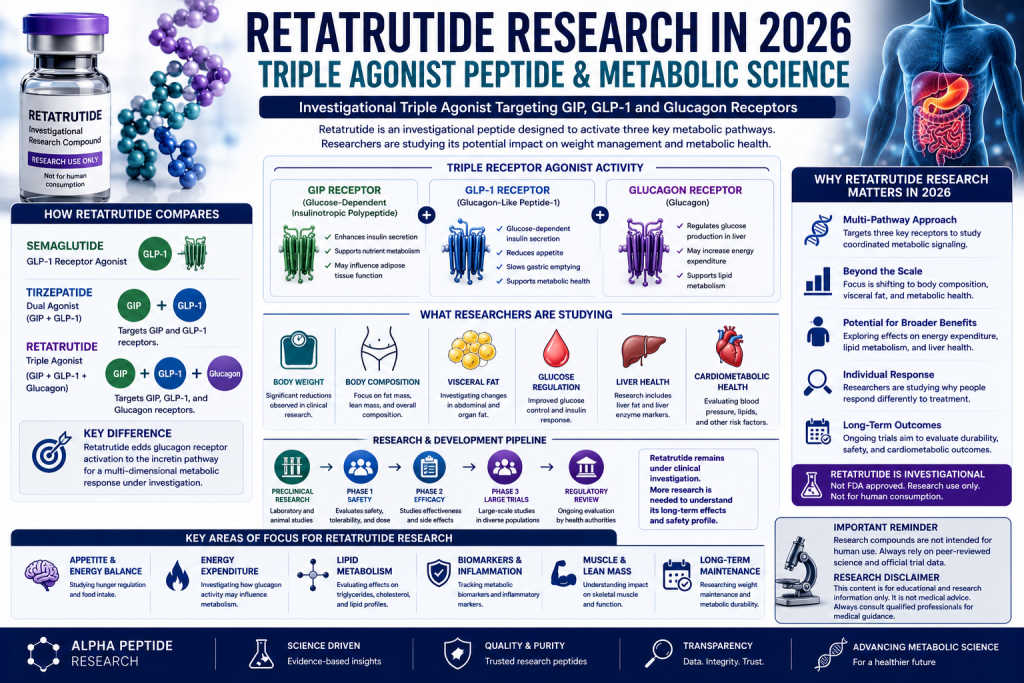
Retatrutide is an investigational triple agonist designed to activate three metabolic receptor systems: GIP, GLP-1, and glucagon.
This distinguishes it from semaglutide, which targets the GLP-1 receptor, and tirzepatide, which activates GIP and GLP-1 receptors.
For researchers, triple agonism creates an opportunity to study how several metabolic signals interact within one compound.
Interest now extends beyond body weight. Scientists are examining body composition, visceral fat, glucose regulation, lipid metabolism, liver health, energy balance, and long-term cardiometabolic outcomes.
So, what makes retatrutide research important in 2026?
What Is Retatrutide?
Retatrutide is an investigational peptide-based compound being studied for its activity at three receptors.
These are:
GIP receptor
GLP-1 receptor
Glucagon receptor
Each receptor participates in metabolic signaling.
Researchers are interested in whether coordinated activity across all three pathways may produce biological effects that differ from single or dual receptor agonism.
Retatrutide remains under clinical investigation in 2026. It is not an FDA-approved medicine.
That distinction matters when evaluating research claims and information found online.
Why Is Retatrutide Called a Triple Agonist?
An agonist activates a biological receptor.
A single agonist primarily targets one receptor pathway. A dual agonist targets two. A triple agonist targets three.
Retatrutide combines activity at GIP, GLP-1, and glucagon receptors.
GIP
GIP stands for glucose-dependent insulinotropic polypeptide.
It is an incretin hormone associated with nutrient-dependent metabolic signaling.
Researchers study GIP in relation to insulin secretion, adipose tissue biology, nutrient metabolism, and energy balance.
GLP-1
GLP-1 stands for glucagon-like peptide-1.
Scientists study GLP-1 signaling in relation to glucose-dependent insulin secretion, appetite regulation, gastric emptying, food intake, and metabolic health.
Glucagon
Glucagon has an important role in glucose regulation. Researchers also study its relationship with hepatic metabolism, lipid metabolism, and energy expenditure.
Combining these pathways gives researchers a different model for studying metabolic biology.
Why Retatrutide Research Is Attracting Attention
Retatrutide research sits at the intersection of several major trends.
Obesity research is expanding.
Incretin science is advancing.
Multi-receptor agonists are becoming more sophisticated.
Researchers are also looking beyond total weight loss.
Instead, scientists increasingly want to understand what happens to fat mass, lean mass, visceral adiposity, metabolic biomarkers, and long-term health outcomes.
Retatrutide provides an important experimental model for investigating these questions.
Retatrutide vs Semaglutide
Semaglutide and retatrutide belong to different generations of incretin research.
Semaglutide primarily activates the GLP-1 receptor.
Retatrutide is designed to activate GIP, GLP-1, and glucagon receptors.
Therefore, the scientific comparison involves more than differences in reported weight changes.
Researchers can ask whether triple receptor activity produces different effects on:
Appetite signaling
Energy balance
Glucose metabolism
Fat distribution
Body composition
Lipid metabolism
Other cardiometabolic markers
However, comparisons must be interpreted carefully.
Results from separate clinical trials do not automatically establish that one compound is superior to another. Study populations, durations, doses, protocols, and endpoints can differ.
Direct comparative evidence provides stronger conclusions than comparing headline numbers across unrelated trials.
Retatrutide vs Tirzepatide
Tirzepatide provides another important comparison.
Tirzepatide activates GIP and GLP-1 receptors. Retatrutide adds glucagon receptor agonism to those pathways.
In simple terms:
Tirzepatide: GIP + GLP-1
Retatrutide: GIP + GLP-1 + glucagon
Researchers are interested in what that additional glucagon activity contributes to the overall metabolic response.
This question is central to triple agonist research.
Scientists must also evaluate tolerability, dose response, individual variability, and long-term outcomes. More receptor targets do not automatically mean better results.
Body Weight Is Only One Research Endpoint
Headlines surrounding metabolic compounds often emphasize percentage weight reduction.
Modern research is becoming broader.
Body weight cannot tell scientists whether a change came primarily from fat, lean tissue, water, or other components.
Therefore, researchers increasingly evaluate body composition alongside total weight.
This shift is especially important when large changes in body mass occur.
Retatrutide and Body Composition Research
Body composition is likely to remain a major area of metabolic research.
Scientists can evaluate several variables.
Fat Mass
Researchers measure changes in total adipose tissue to better understand the composition of weight reduction.
Visceral Fat
Visceral adipose tissue surrounds internal organs and has strong associations with metabolic health.
Scientists therefore study changes in visceral fat separately from total body weight.
Lean Mass
Lean mass includes muscle and other non-fat tissue.
Researchers increasingly want to understand how substantial weight reduction affects lean tissue.
Fat Distribution
Where fat is stored can matter metabolically.
Changes in abdominal and visceral adiposity may provide insights that a scale cannot show.
These measures help scientists examine the quality of weight change.
Why Lean Mass Matters
Lean mass has become a major discussion within modern weight management research.
When body weight falls substantially, some lean tissue may also be lost.
Scientists therefore want to determine how much of the change comes from fat versus lean tissue.
Researchers are studying questions involving:
Skeletal muscle mass
Muscle strength
Physical function
Protein intake
Resistance exercise
Baseline body composition
Age-related differences
This does not mean researchers should focus only on preserving a number measured by a scanner.
Physical function and metabolic health also matter.
The broader goal is to understand how changes in body composition affect health.
Retatrutide and Visceral Fat Research
Visceral fat is particularly important within metabolic science.
Unlike subcutaneous fat stored beneath the skin, visceral adipose tissue surrounds internal organs.
Higher levels of visceral fat are associated with metabolic dysfunction.
Researchers studying advanced incretin compounds therefore examine whether changes in body weight occur alongside changes in visceral adiposity.
This provides a more detailed understanding of metabolic response.
Glucose Regulation and Triple Agonism
All three receptor systems involved in retatrutide research connect with metabolism, although they have different physiological roles.
GIP and GLP-1 are incretin hormones.
Their signaling is closely connected to nutrient-dependent insulin secretion and glucose regulation.
Glucagon biology adds another layer.
Glucagon can increase hepatic glucose production. At the same time, glucagon receptor signaling is being investigated for its effects on energy expenditure and broader metabolic pathways.
Triple agonism therefore requires careful balance.
Researchers want to understand how these signals interact rather than viewing each receptor independently.
Energy Expenditure Is an Important Research Question
Appetite regulation represents only one side of energy balance.
Energy expenditure represents another.
The glucagon component of triple agonist research has generated interest partly because researchers are investigating how glucagon receptor activity may influence energy metabolism.
Scientists can examine:
Resting energy expenditure
Substrate utilization
Fat metabolism
Energy intake
Body composition
Metabolic adaptation
Understanding these variables may help explain how triple agonists differ biologically from earlier incretin approaches.
Liver Health and Metabolic Research
Liver health has become increasingly important within obesity and metabolic science.
Excess liver fat is closely associated with metabolic dysfunction.
Researchers studying incretin-based compounds increasingly examine liver-related outcomes alongside body weight and glucose regulation.
These studies may evaluate:
Liver fat
Liver enzymes
Insulin sensitivity
Lipid metabolism
Body composition
Inflammatory markers
This broader approach reflects how metabolic research is evolving beyond simple weight measurements.
Cardiometabolic Outcomes
Modern metabolic research increasingly connects obesity science with cardiovascular health.
Researchers may examine changes in:
Blood pressure
Lipid markers
Glucose regulation
Waist circumference
Inflammatory biomarkers
Body composition
Other cardiovascular risk factors
Long-term studies will be important for determining how changes in these markers translate into clinical outcomes.
Individual Response to Retatrutide Research
Average results never tell the entire story.
Research participants can respond differently to the same intervention.
Scientists are increasingly investigating factors that may explain this variation.
These include:
Genetics
Age
Sex
Baseline weight
Body composition
Metabolic health
Diet
Physical activity
Sleep
Dose exposure
Understanding individual response could become one of the most important areas of metabolic science.
What Phase 3 Research Can Tell Scientists
Phase 3 trials generally involve larger populations and provide more evidence about efficacy and safety than earlier-stage studies.
For retatrutide, Phase 3 research is particularly important.
Researchers can examine outcomes across larger and more diverse groups. They can also gather more information about adverse events, tolerability, metabolic outcomes, and longer-term response.
However, even promising trial results do not make an investigational compound approved.
Regulatory review remains a separate process.
Why Research Quality Matters
Interest in retatrutide has grown rapidly online.
That creates a problem.
Scientific information, marketing claims, speculation, and unverified products can become mixed together.
Readers should distinguish between:
Peer-reviewed research
Registered clinical trials
Regulatory information
Company trial announcements
Preclinical evidence
Unverified online claims
These sources do not carry equal evidentiary weight.
High-quality metabolic research depends on controlled methods, accurate compound identification, appropriate analysis, and transparent reporting.
Retatrutide Research and the Future of Metabolic Science
Retatrutide represents a larger trend.
Metabolic peptide research is moving toward multi-pathway biology.
Scientists are no longer limited to asking what happens when one receptor is activated.
They can investigate coordinated signaling across several systems.
Future research may expand into:
New multi-receptor combinations
Longer-acting molecules
Oral metabolic compounds
Body composition focused research
Lean mass preservation
Personalized response models
Long-term weight maintenance
Cardiometabolic outcomes
Metabolic disease research
The result could be a much deeper understanding of how appetite, energy expenditure, adipose tissue, glucose regulation, and hormonal signaling interact.
Frequently Asked Questions
What is retatrutide?
Retatrutide is an investigational triple receptor agonist designed to activate GIP, GLP-1, and glucagon receptors.
Why is retatrutide called a triple agonist?
It is called a triple agonist because it targets three receptor pathways: GIP, GLP-1, and glucagon.
Is retatrutide FDA approved?
No. Retatrutide remains investigational in 2026 and should not be represented as an FDA-approved therapy.
How is retatrutide different from semaglutide?
Semaglutide primarily targets the GLP-1 receptor. Retatrutide targets GIP, GLP-1, and glucagon receptors.
How is retatrutide different from tirzepatide?
Tirzepatide targets GIP and GLP-1 receptors. Retatrutide adds glucagon receptor agonism.
Why are researchers interested in glucagon receptor activity?
Scientists are investigating glucagon signaling in relation to hepatic metabolism, glucose regulation, lipid metabolism, and energy expenditure.
Are researchers studying retatrutide and body composition?
Body composition has become an important area of modern metabolic research because total weight alone cannot distinguish changes in fat and lean tissue.
Why is visceral fat important?
Visceral adipose tissue is metabolically significant and is associated with several markers of metabolic dysfunction.
Does triple agonism automatically outperform dual agonism?
No. Researchers must evaluate efficacy, safety, tolerability, dose response, body composition, and long-term outcomes. Receptor count alone cannot determine superiority.
What is next for retatrutide research?
Large clinical studies, longer-term outcomes, body composition, metabolic markers, safety, and cardiometabolic research will remain important areas of investigation.
Conclusion
Retatrutide research represents an important step in the evolution of metabolic peptide science.
Single receptor agonists demonstrated the importance of GLP-1 signaling. Dual agonists expanded the research landscape by combining GIP and GLP-1 pathways.
Triple agonism adds another dimension.
By targeting GIP, GLP-1, and glucagon receptors, retatrutide allows scientists to investigate how several metabolic pathways interact within one research model.
The most important questions now extend beyond total weight.
Researchers are examining body composition, visceral fat, lean tissue, glucose regulation, energy balance, liver health, individual response, and long-term cardiometabolic outcomes.
As research progresses through 2026, retatrutide will remain an important part of the broader scientific effort to understand metabolic biology and the next generation of multi-receptor peptide research.
Alpha Peptide Research follows emerging peptide science and metabolic research to provide clear educational information about developments shaping modern laboratory and biotechnology research.
Research Disclaimer: This article is provided for educational and research information only. Retatrutide remains investigational as of 2026. References to research compounds do not imply approval, safety, efficacy, or suitability for human use. Materials labeled for research use only are not intended for human consumption.
