

Weight Management & Metabolic Health
Dual vs Triple Agonist Peptides: The Future of Metabolic Research in 2026
Jul
Metabolic peptide research is changing quickly in 2026.
For years, GLP-1 receptor agonists dominated discussions surrounding incretin science, obesity, and metabolic health. Researchers are now looking beyond a single receptor.
Dual and triple agonists have become major areas of scientific interest.
These compounds allow researchers to investigate several metabolic signaling pathways at the same time. Instead of focusing only on GLP-1, scientists can study how GLP-1 interacts with GIP, glucagon, and other biological signals.
This development has raised an important question.
Could multi-receptor agonists define the next generation of metabolic research?
To understand why scientists are interested, we need to examine the differences between single, dual, and triple agonist research.
What Is a Metabolic Receptor Agonist?
An agonist is a compound that activates a receptor and produces a biological response.
Metabolic peptide research frequently focuses on receptors involved in appetite, glucose regulation, digestion, and energy balance.
Three receptors have become especially important within modern incretin research:
GLP-1 receptors
GIP receptors
Glucagon receptors
Each pathway has distinct biological functions. However, researchers increasingly want to understand what happens when these pathways are targeted together.
That question has helped drive the development of multi-receptor agonists.
Understanding GLP-1 Agonist Research
GLP-1 stands for glucagon-like peptide-1.
The body naturally releases GLP-1 after food intake. The hormone participates in several processes related to metabolic regulation.
Researchers study GLP-1 signaling because it is associated with:
Glucose-dependent insulin secretion
Appetite regulation
Gastric emptying
Energy intake
Metabolic health
Semaglutide is a well-known example of a GLP-1 receptor agonist.
Its development helped demonstrate the importance of incretin pathways in modern metabolic research.
However, scientists did not stop with GLP-1.
Researchers began investigating whether targeting another metabolic receptor alongside GLP-1 could produce different biological effects.
That research led to growing interest in dual agonists.
What Are Dual Agonist Peptides?
Dual agonists are designed to activate two receptor systems.
One of the most prominent examples is tirzepatide.
Tirzepatide activates both GIP and GLP-1 receptors.
This approach allows scientists to investigate how two incretin pathways interact within metabolic regulation.
What Is GIP?
GIP stands for glucose-dependent insulinotropic polypeptide.
Like GLP-1, GIP is an incretin hormone released in response to nutrient intake.
Researchers study GIP for its involvement in areas such as:
Insulin secretion
Nutrient metabolism
Adipose tissue biology
Energy balance
Metabolic signaling
Combining GIP and GLP-1 receptor activity created a new research model for studying metabolic health.
Why Dual Agonist Research Became Important
Dual agonists changed how researchers thought about incretin science.
Instead of asking how one receptor affects metabolism, scientists could investigate coordinated signaling across multiple pathways.
This opened new research questions.
How do GIP and GLP-1 interact?
Can combined receptor activity alter appetite regulation?
How does dual agonism affect body composition?
What happens to glucose metabolism?
How do individual responses differ?
These questions continue to influence metabolic research in 2026.
However, researchers are now moving another step forward.
Triple agonists are becoming one of the most closely watched areas of metabolic peptide science.
What Are Triple Agonist Peptides?
Triple agonists are compounds designed to activate three receptor pathways.
One of the best-known investigational examples is retatrutide.
Retatrutide targets:
GIP receptors
GLP-1 receptors
Glucagon receptors
This combination allows researchers to investigate three important metabolic signaling systems within one experimental compound.
Retatrutide remains investigational in 2026. It should therefore be distinguished from approved metabolic medicines.
Its scientific importance comes from the questions that triple agonism allows researchers to explore.
Why Add the Glucagon Receptor?
Glucagon is often associated with glucose regulation. However, glucagon biology extends into several aspects of metabolism.
Researchers study glucagon signaling in relation to:
Hepatic metabolism
Energy expenditure
Glucose regulation
Lipid metabolism
Energy balance
Combining glucagon receptor activity with GIP and GLP-1 signaling creates a complex metabolic research model.
The goal is not simply to activate more receptors.
Researchers want to determine whether coordinated receptor activity produces meaningful biological differences.
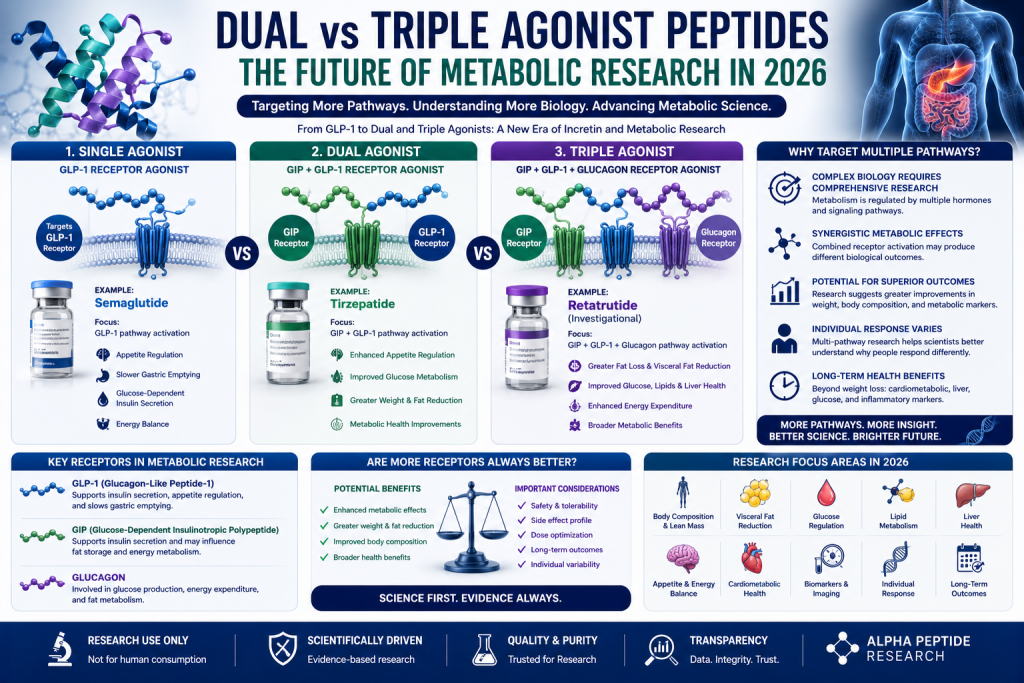
Single vs Dual vs Triple Agonists
The progression of incretin research can be understood through three major approaches.
Single Agonist Research
A single agonist primarily targets one receptor pathway.
Example:
Semaglutide: GLP-1 receptor agonist
Researchers can study how GLP-1 signaling influences metabolic processes.
Dual Agonist Research
A dual agonist targets two receptor pathways.
Example:
Tirzepatide: GIP and GLP-1 receptor agonist
Researchers can study interactions between two incretin systems.
Triple Agonist Research
A triple agonist targets three receptor pathways.
Example:
Retatrutide: GIP, GLP-1, and glucagon receptor agonist
Researchers can investigate coordinated signaling across three metabolic pathways.
This progression demonstrates how metabolic peptide science is becoming increasingly sophisticated.
Why Triple Agonist Research Is Trending in 2026
Triple agonist research has gained significant attention because scientists are looking beyond traditional weight management endpoints.
Researchers want to understand broader metabolic outcomes.
Several areas are receiving particular attention.
Body Composition
Scientists are studying how metabolic interventions affect fat mass and lean tissue.
Total body weight alone cannot answer these questions.
Body composition research provides a more detailed picture.
Visceral Fat
Visceral adipose tissue surrounds internal organs and has strong connections with metabolic health.
Researchers increasingly measure changes in visceral adiposity during metabolic studies.
Glucose Regulation
Multi-receptor compounds provide new opportunities to investigate glucose metabolism and insulin-related pathways.
Lipid Metabolism
Scientists are studying how metabolic signaling influences triglycerides, cholesterol, and other lipid-related markers.
Liver Health
Metabolic research increasingly examines liver fat and other markers associated with metabolic dysfunction.
These endpoints show why modern metabolic research extends far beyond the number on a scale.
Retatrutide and the Rise of Triple Agonism
Retatrutide has become one of the most discussed investigational metabolic compounds.
Its significance comes from its receptor profile.
Rather than targeting only GLP-1 or combining GIP with GLP-1, retatrutide adds glucagon receptor activity.
Researchers can therefore investigate how three signaling pathways work together.
Clinical development has generated significant scientific interest in areas including:
Body weight
Body composition
Metabolic markers
Glucose regulation
Cardiometabolic health
Long-term outcomes
However, an important distinction remains.
Retatrutide is investigational as of 2026.
Research findings should not be interpreted as approval for clinical or consumer use.
Are More Receptors Automatically Better?
No.
The number of receptors targeted does not automatically determine whether a compound is better.
Metabolic biology is complex.
Activating additional pathways may produce different biological responses, but researchers must study those responses carefully.
Scientists evaluate factors such as:
Receptor activity
Dose response
Tolerability
Duration of action
Metabolic outcomes
Body composition
Individual response
Long-term effects
The scientific goal is not simply to maximize receptor count.
Researchers want to understand how specific combinations affect metabolic biology.
Body Composition Is Changing Metabolic Research
One of the most important developments in weight management science is the shift toward body composition.
Historically, many studies focused heavily on total body weight.
Researchers now recognize that two individuals can experience similar weight reduction while having different changes in fat and lean tissue.
Scientists increasingly study:
Total fat mass
Visceral fat
Lean mass
Skeletal muscle
Waist circumference
Fat distribution
Metabolic biomarkers
This provides a much richer picture of metabolic change.
Multi-receptor agonist research will likely continue contributing to this shift.
Lean Mass and Muscle Research
Muscle has become another major research topic.
Substantial weight reduction can involve changes in both fat and lean mass.
Therefore, researchers want to understand how metabolic interventions affect skeletal muscle and physical function.
Current research questions include:
How much lean mass changes during weight reduction?
What proportion of total weight change comes from fat?
How does resistance exercise affect body composition?
What role does dietary protein play?
How should muscle function be assessed?
These questions are becoming increasingly important as metabolic interventions produce larger changes in body weight.
Personalized Metabolic Research
Not every research participant responds identically.
Scientists are studying why responses vary.
Several factors may influence metabolic outcomes:
Genetics
Age
Sex
Baseline body composition
Metabolic health
Diet
Physical activity
Sleep
Hormonal signaling
Researchers may eventually use these variables to better understand individual response patterns.
This could move metabolic science toward more personalized research models.
What Comes After Triple Agonists?
Triple agonists are not necessarily the final stage of metabolic peptide research.
Scientists continue to explore additional approaches.
Future research may investigate:
New receptor combinations
Longer-acting compounds
Oral metabolic compounds
Combination research strategies
Body composition focused approaches
Muscle preservation
Personalized metabolic models
Long-term weight maintenance
Scientists are also studying pathways outside traditional incretin biology.
The next generation of metabolic research may therefore combine several biological strategies rather than relying on one pathway.
Why This Research Matters for Weight Management Science
Weight management is increasingly viewed as a metabolic research problem rather than a simple question of calories or body weight.
Researchers are studying complex interactions between:
Appetite signaling
Hormones
Glucose metabolism
Energy expenditure
Adipose tissue
Skeletal muscle
Genetics
Lifestyle
Multi-receptor agonists provide scientists with powerful models for exploring these interactions.
That is why dual and triple agonist research has become so important.
Frequently Asked Questions
What is a dual agonist?
A dual agonist activates two receptor pathways. Tirzepatide targets GIP and GLP-1 receptors.
What is a triple agonist?
A triple agonist activates three receptor pathways. Retatrutide targets GIP, GLP-1, and glucagon receptors.
What is the difference between semaglutide and tirzepatide?
Semaglutide primarily acts as a GLP-1 receptor agonist. Tirzepatide activates both GIP and GLP-1 receptors.
What is the difference between tirzepatide and retatrutide?
Tirzepatide targets GIP and GLP-1 receptors. Retatrutide is designed to activate GIP, GLP-1, and glucagon receptors.
Is retatrutide a triple agonist?
Yes. Retatrutide is an investigational triple agonist targeting GIP, GLP-1, and glucagon receptors.
Is retatrutide FDA approved?
No. Retatrutide remains investigational in 2026.
Why are scientists studying glucagon receptors?
Researchers study glucagon signaling because it plays important roles in glucose regulation, hepatic metabolism, lipid metabolism, and energy balance.
Are triple agonists better than dual agonists?
That cannot be determined simply by receptor count. Researchers must compare efficacy, tolerability, biological response, body composition, and long-term outcomes.
Why is body composition important in metabolic research?
Body composition helps researchers distinguish changes in fat mass, lean tissue, and fat distribution rather than relying only on total body weight.
What is the future of metabolic peptide research?
Research is moving toward multi-receptor signaling, personalized metabolic science, oral approaches, body composition, muscle preservation, and long-term metabolic outcomes.
Conclusion
Metabolic peptide science is moving rapidly beyond single-receptor research.
GLP-1 receptor agonists established an important foundation. Dual agonists expanded the field by combining GIP and GLP-1 signaling. Triple agonists are now allowing researchers to investigate GIP, GLP-1, and glucagon pathways together.
This progression represents more than a race to target additional receptors.
Scientists are trying to understand how metabolic pathways interact.
Body composition, visceral fat, muscle preservation, glucose regulation, liver health, and long-term outcomes are becoming central research questions.
As these studies progress, dual and triple agonists may help researchers build a more complete understanding of human metabolic biology.
Alpha Peptide Research follows emerging peptide and metabolic science to help readers understand the research developments shaping the next generation of weight management and metabolic health research.
Research Disclaimer: This article is for educational and research information only. Investigational compounds discussed in this article are not presented as approved treatments. Research materials labeled for research use only are not intended for human consumption.
