

-
×
 Cartalax 50mg
1 × $70.00
Cartalax 50mg
1 × $70.00 -
×
 Thymalin 10mg
1 × $50.00
Thymalin 10mg
1 × $50.00
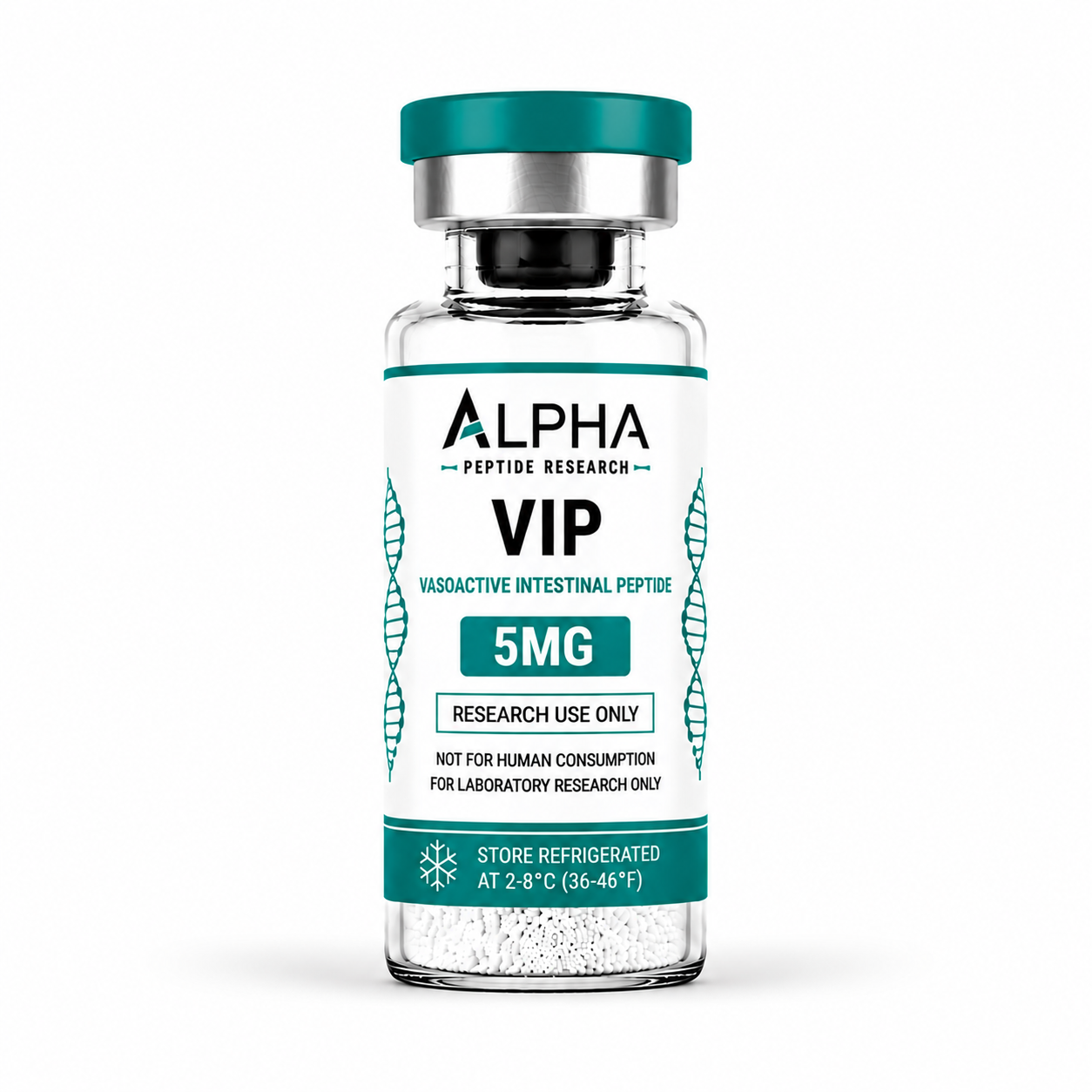
VIP 5mg
VIP 5mg contains Vasoactive Intestinal Peptide, a naturally occurring 28-amino-acid neuropeptide studied across cellular signaling, neurobiology, gastrointestinal biology, vascular processes, and immune-related research. Its broad signaling profile makes VIP an important experimental material for controlled peptide studies. Research Use Only. Not for human consumption.
$55.00
✓
Research Use Only
✓
High Purity Standards
✓
Laboratory Tested
✓
Secure Checkout
✓
Fast & Secure Shipping
Research Use Only
Products offered by Alpha Peptide Research are intended exclusively for laboratory and scientific research. They are not intended for human consumption, therapeutic use, veterinary use, or diagnostic purposes.
VIP 5mg introduces a widely studied signaling peptide to the Alpha Peptide Research Healing Peptides collection.
Vasoactive Intestinal Peptide, commonly abbreviated VIP, is a naturally occurring neuropeptide composed of 28 amino-acid residues. Researchers have identified VIP throughout several biological systems, including neural and gastrointestinal tissues.
Although its name highlights the intestine, scientific interest in VIP extends far beyond gastrointestinal biology. For example, researchers study the peptide in cellular signaling, neurobiology, vascular biology, smooth-muscle physiology, and immune-related experimental systems.
Furthermore, VIP interacts with specific G protein-coupled receptors, providing scientists with established molecular pathways for controlled investigation.
Alpha Peptide Research supplies VIP 5mg exclusively for laboratory research.
What Is Vasoactive Intestinal Peptide?
Vasoactive Intestinal Peptide is a 28-amino-acid peptide that functions as a signaling molecule in several biological systems.
Researchers originally identified VIP in intestinal tissue. However, subsequent research found the peptide in the nervous system and other tissues.
As a result, scientists now investigate VIP across a much broader range of biological questions.
VIP belongs to a peptide family that includes several structurally related signaling molecules. Its biological activity is strongly associated with receptor-mediated signaling.
Therefore, VIP provides researchers with a defined peptide for studying how extracellular signals influence cellular behavior.
Why Do Scientists Study VIP?
Cells constantly exchange information through chemical signals.
Peptides can act as signaling molecules by interacting with receptors on target cells. Once activated, these receptors can influence intracellular pathways and alter cellular responses.
VIP has attracted substantial research interest because it participates in multiple signaling systems.
In particular, researchers have investigated VIP in neural, gastrointestinal, vascular, smooth-muscle, and immune-related models.
Scientists may measure receptor activation, intracellular signaling, cellular responses, or molecular markers depending on the experimental design.
Consequently, VIP provides laboratories with several avenues for controlled biological research.
VIP Receptor Research
Much of VIP biology involves two receptors commonly known as VPAC1 and VPAC2.
These receptors belong to the G protein-coupled receptor family.
When VIP interacts with an appropriate receptor, the interaction can trigger intracellular signaling processes. Therefore, researchers study VIP receptor systems to understand how extracellular peptide signals translate into cellular responses.
Scientists may examine receptor expression, signaling activity, downstream molecules, or other measurable endpoints.
Additionally, researchers can compare responses across different cell types to investigate receptor-specific biology.
Cellular Signaling Research
Cellular signaling controls many biological processes.
Cells use receptors and intracellular pathways to interpret information from their environment. VIP provides a useful research peptide for examining these mechanisms.
For example, researchers may introduce VIP into an appropriate cellular model and monitor changes in selected signaling markers.
Other experiments can compare VIP responses under different conditions.
In this way, scientists can investigate how peptide-receptor interactions influence cellular behavior.
Strong experimental controls remain essential because signaling responses can vary significantly between biological systems.
Neurobiology Research
VIP functions as a neuropeptide and has a substantial history in neuroscience research.
Neurons and other cells in the nervous system communicate through complex combinations of electrical and chemical signals.
Peptides represent one part of this communication network.
Because VIP occurs in neural systems, scientists study it to explore neuropeptide signaling and related cellular processes.
Researchers may examine receptor distribution, cellular responses, signaling pathways, or interactions with other neurobiological systems.
Moreover, these studies can help scientists understand the broader role of peptide signaling in nervous-system biology.
Gastrointestinal Biology Research
The word “intestinal” in Vasoactive Intestinal Peptide reflects the peptide’s historical discovery and biological presence in gastrointestinal systems.
Researchers have investigated VIP in experimental models involving gastrointestinal signaling and smooth-muscle biology.
In addition, scientists study interactions among neurons, signaling peptides, smooth-muscle cells, and other components of gastrointestinal systems.
VIP can provide a defined experimental material for examining these relationships.
However, gastrointestinal research does not establish VIP 5mg as a treatment for digestive disorders.
Vascular Biology Research
Vascular systems rely on coordinated communication among endothelial cells, smooth-muscle cells, nerves, and signaling molecules.
VIP has attracted research interest because scientists have observed its involvement in vascular signaling.
Consequently, laboratories may use VIP in controlled experiments examining vascular and smooth-muscle responses.
Researchers can measure selected cellular or molecular endpoints while controlling experimental conditions.
Such studies contribute to understanding signaling mechanisms. Nevertheless, they do not establish this research product as a treatment for cardiovascular conditions.
Smooth-Muscle Research
Smooth muscle occurs throughout several organ systems, including the gastrointestinal tract and blood vessels.
Unlike skeletal muscle, smooth muscle operates primarily through involuntary biological control.
Researchers investigate the molecular signals that regulate smooth-muscle behavior.
Within this context, VIP has become a useful subject for experimental research.
Scientists may study receptor activation, cellular signaling, or changes in experimental smooth-muscle responses.
Furthermore, comparisons with appropriate controls can help clarify peptide-specific mechanisms.
VIP and Immune-Related Research
Researchers have also explored VIP within immune-related experimental systems.
Immune biology involves complex communication among cells, receptors, signaling proteins, and other molecules.
VIP signaling can interact with aspects of these networks. Therefore, scientists may investigate the peptide in cellular models involving immune-associated pathways.
Studies can examine signaling markers, cellular responses, receptor activity, or other defined endpoints.
However, these findings should remain within the context of research and should not become claims that VIP 5mg treats immune or inflammatory diseases.
VIP and Circadian Biology Research
VIP has also attracted interest in research involving biological timing.
The nervous system contains specialized signaling networks associated with circadian rhythms. Researchers investigate how neuropeptides contribute to communication within these systems.
In particular, VIP signaling has appeared in studies of neural circuits associated with circadian organization.
This research adds another dimension to VIP’s broader neurobiological profile.
Nevertheless, laboratory findings should not become claims that VIP 5mg treats sleep or circadian disorders.
VIP vs. Thymosin Alpha-1
VIP and Thymosin Alpha-1 both contain 28 amino-acid residues, but they are distinct peptides.
Thymosin Alpha-1 has a strong research history involving immune signaling and thymic biology.
VIP, meanwhile, functions as a neuropeptide and has a broader research profile involving neural, gastrointestinal, vascular, and receptor signaling.
Therefore, identical peptide length does not imply similar biological function.
Including both products gives laboratories access to distinct research materials.
VIP vs. ARA-290
V.IP and ARA-290 also have different structures and research backgrounds.
VIP contains 28 amino-acid residues and is a naturally occurring neuropeptide.
ARA-290 contains 11 amino-acid residues and originated from research involving a region of erythropoietin.
Consequently, the two products provide researchers with different experimental tools.
VIP focuses strongly on neuropeptide and VPAC receptor signaling, while ARA-290 has a different signaling research profile.
Why Choose VIP 5mg?
VIP 5mg expands the Healing Peptides collection with a peptide associated with several well-established research areas.
Key characteristics include:
- 5mg research presentation
- 28-amino-acid peptide
- Naturally occurring neuropeptide
- VPAC1 receptor research
- VPAC2 receptor research
- Cellular signaling research
- Neurobiology research
- Gastrointestinal biology research
- Vascular and smooth-muscle research
- Immune-related research
- Professional laboratory presentation
- Research Use Only labeling
- Not intended for human consumption
Overall, VIP adds a distinct neuropeptide-signaling profile to the Alpha Peptide Research catalog.
Product Specifications
| Specification | Details |
|---|---|
| Product Name | Vasoactive Intestinal Peptide |
| Abbreviation | VIP |
| Quantity | 5mg |
| Peptide Length | 28 amino-acid residues |
| Product Class | Neuropeptide |
| Product Type | Research Peptide |
| Category | Healing Peptides |
| Primary Research Area | Cellular & Neuropeptide Signaling |
| Receptor Research | VPAC1 and VPAC2 |
| Additional Research Areas | Gastrointestinal, Vascular & Immune Biology |
| Presentation | Laboratory Research Vial |
| Intended Use | Laboratory Research Only |
| Human Consumption | Not Intended |
| Brand | Alpha Peptide Research |
| Product Number | Healing Peptides #12 |
VIP 5mg Research Presentation
The 5mg presentation provides laboratories with a clearly identified quantity of VIP research material.
Depending on their research objectives, scientists may incorporate appropriately characterized VIP into cellular, biochemical, receptor, or other controlled experimental systems.
For instance, laboratories may investigate VPAC receptor signaling and compare experimental responses with suitable controls.
Other studies may focus on neural, gastrointestinal, or vascular systems.
The 5mg designation describes the amount of research material supplied in the vial. It does not represent a human dose, treatment protocol, or administration recommendation.
Quality and Analytical Documentation
Reliable peptide research requires accurate product characterization.
For this reason, researchers should review batch-specific documentation before incorporating VIP 5mg into an experiment.
Relevant information may include product identity, sequence confirmation, analytical purity, molecular characterization, quantity, and batch number.
Furthermore, Alpha Peptide Research should publish exact purity percentages only when analytical results support those claims for the supplied batch.
The same principle applies to claims such as third-party tested or GMP manufactured.
Ultimately, accurate documentation helps researchers understand the material used in their experiments.
Storage and Laboratory Handling
Researchers should follow the validated storage requirements associated with the actual VIP 5mg formulation and batch.
Keep the research material protected from unsuitable environmental conditions. Additionally, laboratories should maintain accurate inventory, batch, and storage records.
Qualified personnel should handle experimental peptide materials according to established laboratory procedures.
Any temperature range printed on the product label should match verified documentation for the supplied formulation.
Controlled Laboratory Research
VIP 5mg supports controlled scientific investigation involving neuropeptide and cellular signaling biology.
Potential research areas include VPAC receptor systems, neural signaling, gastrointestinal biology, vascular processes, smooth-muscle physiology, and immune-related pathways.
For example, scientists may compare experimental systems exposed to VIP with appropriate controls and evaluate selected molecular or cellular endpoints.
Moreover, researchers can combine receptor, biochemical, and cellular methods to explore different aspects of VIP biology.
Therefore, careful experimental design remains important for reliable interpretation.
Research Use Only
Alpha Peptide Research supplies VIP 5mg exclusively for scientific and laboratory research.
The product is not intended for human consumption, self-administration, diagnosis, therapeutic use, or veterinary treatment.
Furthermore, VIP 5mg should not carry claims that it treats gastrointestinal disease, cardiovascular conditions, immune disorders, sleep disorders, or other medical conditions.
The 5mg designation identifies research quantity only and does not provide dosing or administration guidance.
Frequently Asked Questions
What is VIP 5mg?
VIP 5mg is a laboratory presentation containing 5mg of Vasoactive Intestinal Peptide research material.
What does VIP stand for?
VIP stands for Vasoactive Intestinal Peptide.
How many amino acids does VIP contain?
VIP contains 28 amino-acid residues.
Is VIP a neuropeptide?
Yes. Researchers classify Vasoactive Intestinal Peptide as a neuropeptide.
What receptors interact with VIP?
VIP primarily signals through receptors known as VPAC1 and VPAC2.
Why do scientists study VIP?
Researchers investigate VIP in cellular signaling, neurobiology, gastrointestinal biology, vascular systems, smooth-muscle biology, receptor research, and immune-related pathways.
Is VIP studied in gastrointestinal biology?
Yes. VIP has an extensive research history involving gastrointestinal signaling and related biological processes.
Is VIP studied in neurobiology?
Yes. Because VIP functions as a neuropeptide, neural signaling represents an important area of research.
Is VIP involved in vascular research?
Scientists have studied VIP within experimental models involving vascular and smooth-muscle signaling.
Is VIP the same as Thymosin Alpha-1?
No. Although both peptides contain 28 amino-acid residues, they have different sequences, biological roles, and research profiles.
Is VIP the same as ARA-290?
No. VIP is a 28-amino-acid neuropeptide, while ARA-290 is an 11-amino-acid research peptide derived from EPO-related research.
Does VIP 5mg treat digestive or cardiovascular conditions?
No. Experimental research involving these biological systems does not establish VIP 5mg as an approved treatment.
What does 5mg mean?
The 5mg designation identifies the amount of research material supplied. Importantly, it does not represent a recommended dose.
Is VIP 5mg intended for human consumption?
No. Alpha Peptide Research supplies VIP 5mg strictly for laboratory research.
How should researchers store VIP 5mg?
Follow the validated storage requirements associated with the actual formulation and batch.
VIP 5mg From Alpha Peptide Research
VIP 5mg adds a naturally occurring 28-amino-acid neuropeptide to the Alpha Peptide Research Healing Peptides collection.
Its established role as a signaling molecule has contributed to research involving VPAC receptors, neurobiology, gastrointestinal systems, vascular biology, smooth-muscle physiology, and immune-related pathways.
Furthermore, VIP offers a different research profile from Follistatin-344, ARA-290, LL-37, KPV, and the thymosin products already represented in the collection.
The 5mg presentation provides laboratories with a clearly identified format for appropriately designed scientific studies.
Professional packaging, accurate product identification, appropriate analytical documentation, and clear research-use labeling support responsible laboratory investigation.
Overall, VIP 5mg expands the Healing Peptides catalog with an important neuropeptide research material.
VIP 5mg is for laboratory research only and is not intended for human consumption.
Be the first to review “VIP 5mg”
Related products
-17%
Reviews
There are no reviews yet.