

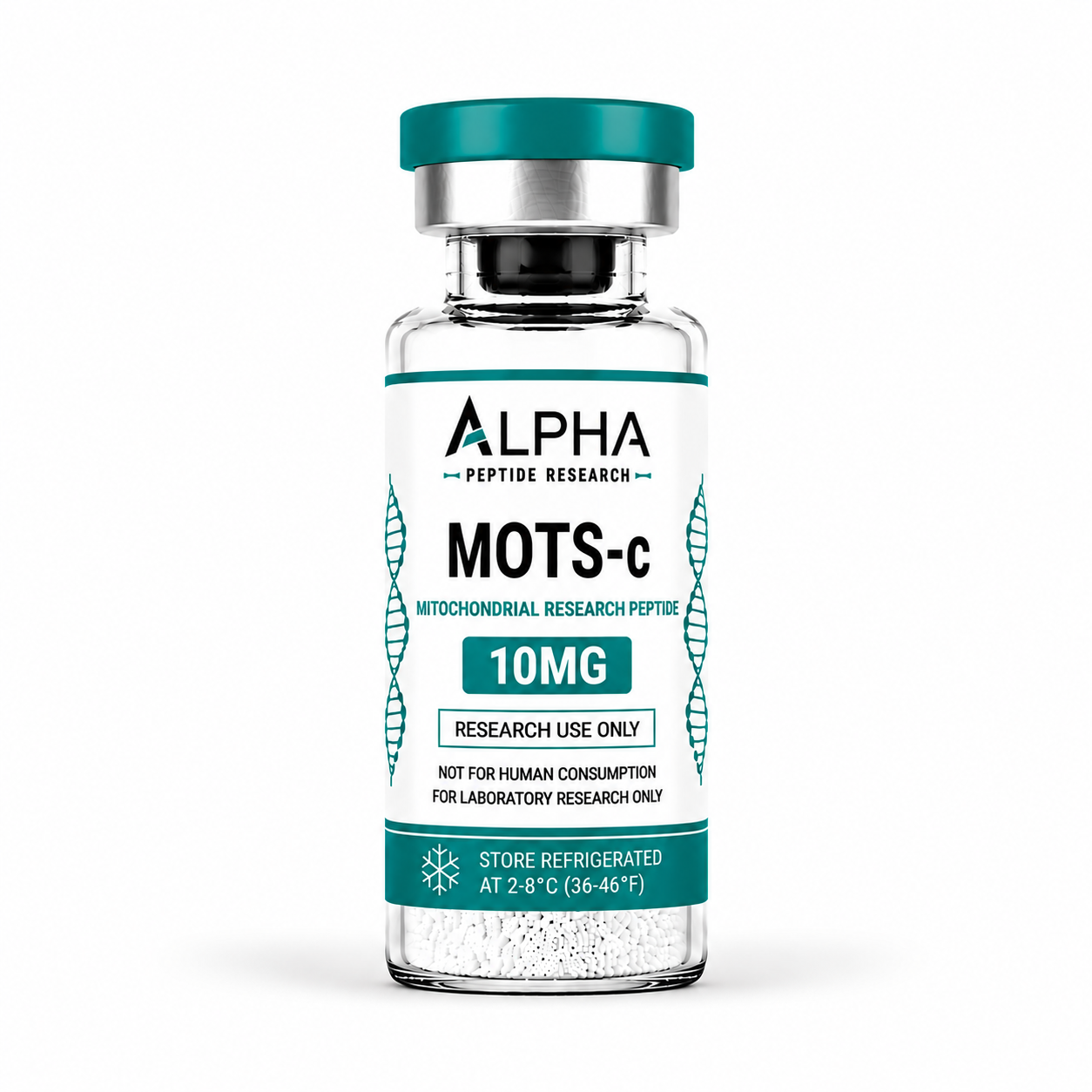
MOTS-c 10mg
MOTS-c 10mg is a mitochondrial-derived 16-amino-acid research peptide from Alpha Peptide Research. Scientists study MOTS-c in experimental models involving cellular metabolism, mitochondrial communication, metabolic stress responses, and energy-related signaling pathways. Its mitochondrial origin gives MOTS-c a distinct research profile within peptide biology. Research Use Only. Not for human consumption.
$69.00
Research Use Only
Products offered by Alpha Peptide Research are intended exclusively for laboratory and scientific research. They are not intended for human consumption, therapeutic use, veterinary use, or diagnostic purposes.
MOTS-c 10mg introduces a mitochondrial-derived research peptide to the Alpha Peptide Research Healing Peptides collection.
MOTS-c is a 16-amino-acid peptide encoded within mitochondrial DNA. Unlike many research peptides associated with nuclear genes or larger protein precursors, MOTS-c belongs to a group of signaling molecules known as mitochondrial-derived peptides.
Researchers have investigated MOTS-c because mitochondria do much more than contribute to cellular energy production. In addition, these organelles participate in metabolic regulation, cellular communication, and responses to changing biological conditions.
Consequently, MOTS-c provides researchers with an interesting experimental material for investigating the relationship between mitochondrial signaling and cellular metabolism. Moreover, its unusual origin distinguishes it from many conventional research peptides.
Alpha Peptide Research supplies MOTS-c 10mg strictly for controlled laboratory investigation.
What Is MOTS-c?
MOTS-c stands for Mitochondrial Open Reading Frame of the 12S rRNA-c. It is a naturally occurring peptide consisting of 16 amino-acid residues.
Scientists identified MOTS-c through research into mitochondrial DNA and mitochondrial-derived signaling molecules. As a result, its discovery contributed to a broader understanding of mitochondria as active participants in cellular communication.
Furthermore, MOTS-c has attracted scientific interest because experimental research has connected it with metabolic and cellular stress-response pathways. Its compact structure and mitochondrial origin, therefore, create a distinctive research profile.
Why Do Scientists Study MOTS-c?
Mitochondria support numerous cellular functions. Although scientists commonly associate these organelles with energy metabolism, mitochondria also participate in signaling and cellular responses.
For this reason, researchers study MOTS-c to better understand mitochondrial communication.
For example, experimental studies have explored MOTS-c in relation to metabolic signaling, cellular stress, glucose metabolism, and communication between mitochondria and other cellular systems.
Additionally, scientists can examine molecular markers and signaling pathways after introducing MOTS-c into suitable experimental models. These approaches help researchers investigate mitochondrial biology while keeping conclusions within the limits of the evidence.
Mitochondrial Signaling Research
Mitochondria constantly interact with other parts of the cell. Cells depend on this communication to coordinate metabolism and respond to changing conditions.
Mitochondrial-derived peptides represent one mechanism researchers investigate within this communication network. Therefore, MOTS-c provides a defined experimental peptide for exploring mitochondrial signaling.
Researchers may measure changes in signaling molecules, gene activity, metabolic markers, or other cellular endpoints. Moreover, comparisons with suitable controls can help determine whether observed differences relate to the experimental conditions.
In this way, MOTS-c research can contribute to a broader understanding of mitochondrial communication.
Cellular Metabolism Research
Cells require coordinated metabolic pathways to process nutrients and support biological activity. These pathways involve carbohydrates, fats, amino acids, enzymes, and numerous signaling molecules.
MOTS-c has attracted significant research interest because of its relationship with metabolic biology. In particular, preclinical studies have explored the peptide in experimental systems involving glucose metabolism and metabolic regulation.
Furthermore, researchers can use cellular and other laboratory models to investigate how MOTS-c relates to selected metabolic pathways. Different experimental conditions may also help scientists examine how cellular environments influence observed responses.
However, this research does not establish MOTS-c 10mg as a treatment for diabetes, obesity, or other metabolic conditions.
Cellular Energy Research
Mitochondria play a central role in cellular energy metabolism. Cells process nutrients through interconnected biochemical pathways, while mitochondria contribute to mechanisms supporting energy production.
Because MOTS-c originates from mitochondrial genetic material, scientists have examined its relationship with energy-related cellular pathways.
For instance, researchers may investigate changes in metabolic markers under different experimental conditions. Additionally, studies can examine how cells respond when nutrient availability or energy demands change.
Consequently, MOTS-c provides another experimental tool for investigating connections between cellular signaling and energy metabolism.
Metabolic Stress Research
Cells regularly encounter changes in nutrient availability, environmental conditions, and energy demand. Therefore, biological systems rely on coordinated mechanisms to respond to these changes.
MOTS-c research has included experimental investigation of metabolic stress responses. Scientists may expose appropriate models to controlled metabolic conditions and examine how MOTS-c relates to the resulting biological response.
Meanwhile, researchers can measure selected molecular markers before and after experimental changes. In addition, comparison groups can provide useful context for interpreting those measurements.
Ultimately, these approaches may help researchers investigate mechanisms involved in mitochondrial and metabolic signaling.
MOTS-c and AMPK Research
AMP-activated protein kinase, commonly abbreviated AMPK, plays an important role in cellular energy sensing.
Researchers study AMPK because the pathway responds to changes in cellular energy status and helps coordinate several metabolic processes. Within this area, MOTS-c has appeared in preclinical research involving AMPK-associated signaling.
Therefore, scientists may examine this pathway while exploring the molecular biology of MOTS-c.
However, cellular signaling involves many interacting components. Researchers should not reduce MOTS-c biology to one pathway alone. Instead, controlled studies can evaluate several endpoints to develop a more complete picture.
Mitochondrial-to-Nuclear Communication
Mitochondria and the nucleus maintain complex communication systems. Signals traveling from mitochondria toward the nucleus are often discussed within the broader concept of retrograde signaling.
These signals can influence cellular responses to metabolic and environmental conditions.
In this context, MOTS-c has attracted research interest in studies involving mitochondrial-to-nuclear communication. Experimental work has also examined aspects of MOTS-c localization and signaling under particular cellular conditions.
Consequently, this research highlights why mitochondrial-derived peptides have become an important topic in modern cellular biology.
MOTS-c and Glucose Metabolism Research
Glucose metabolism represents another major area of MOTS-c research.
Cells use glucose as an important metabolic substrate. However, glucose metabolism depends on interconnected enzymes, transport systems, signaling pathways, and cellular conditions.
Preclinical research has investigated MOTS-c in experimental models involving glucose-related metabolism. As a result, laboratories may examine selected metabolic markers after introducing MOTS-c into an appropriate research system.
Additionally, researchers can compare experimental conditions to identify differences in metabolic responses.
Nevertheless, these findings do not establish MOTS-c 10mg as a glucose-control medication or diabetes treatment.
MOTS-c and Exercise-Related Research
Scientists have also explored MOTS-c within research involving physiological stress and exercise-related biology.
Exercise changes energy demand and cellular metabolism. Therefore, it provides an interesting research context for investigating mitochondrial signaling.
Studies in this area may measure peptide levels, metabolic markers, or cellular responses associated with changing energy demands. Moreover, researchers can compare different experimental conditions to investigate how metabolic systems respond to physiological challenges.
However, Alpha Peptide Research should not market MOTS-c 10mg as an exercise enhancer, athletic performance product, or endurance treatment. Instead, the product remains strictly a laboratory research material.
MOTS-c vs. Humanin
MOTS-c and Humanin both belong to the broader family of mitochondrial-derived peptides. However, they are distinct molecules.
MOTS-c contains 16 amino-acid residues and has attracted substantial research interest in mitochondrial signaling and metabolic biology. Humanin, in contrast, has a different sequence and research profile.
Therefore, laboratories should treat MOTS-c and Humanin as separate research materials rather than interchangeable mitochondrial peptides.
MOTS-c vs. ARA-290
MOTS-c and ARA-290 also differ considerably.
MOTS-c is a 16-amino-acid mitochondrial-derived peptide associated strongly with metabolic and mitochondrial signaling research. ARA-290, on the other hand, is an 11-amino-acid peptide derived from EPO-related research.
Consequently, their origins and primary research areas differ. Moreover, including both products provides laboratories with experimental materials representing separate areas of peptide biology.
Why Choose MOTS-c 10mg?
MOTS-c 10mg adds a distinctive mitochondrial-derived research peptide to the Healing Peptides collection.
Key characteristics include:
- 10mg research presentation
- 16-amino-acid peptide
- Mitochondrial-derived peptide
- Mitochondrial signaling research
- Cellular metabolism research
- Metabolic stress research
- Cellular energy research
- AMPK-associated research interest
- Mitochondrial-to-nuclear communication research
- Professional laboratory presentation
- Research Use Only labeling
- Not intended for human consumption
Overall, its mitochondrial origin gives MOTS-c a research profile that differs significantly from many other products in the collection.
MOTS-c 10mg Research Presentation
The 10mg presentation provides laboratories with a clearly identified quantity of MOTS-c research material.
Depending on their objectives, researchers may incorporate appropriately characterized MOTS-c into cellular, biochemical, metabolic, or other controlled experimental models.
For example, laboratories may investigate mitochondrial signaling, metabolic pathways, cellular stress responses, or related molecular processes. Additionally, suitable controls can help researchers interpret experimental observations.
The 10mg designation identifies the quantity of research material supplied in the vial. Importantly, it does not represent a human dose, treatment protocol, or administration recommendation.
Quality and Analytical Documentation
Reliable peptide research requires accurate characterization of experimental materials.
For this reason, researchers should review batch-specific documentation before using MOTS-c 10mg. Relevant information may include peptide identity, sequence confirmation, analytical purity, molecular characterization, quantity, and batch number.
Furthermore, Alpha Peptide Research should advertise exact purity percentages only when analytical results confirm those values for the relevant batch. Similarly, claims such as third-party tested or GMP manufactured should appear only when appropriate documentation supports them.
Ultimately, transparent product information helps laboratories design more reproducible experiments.
Storage and Laboratory Handling
Researchers should follow validated storage requirements for the actual MOTS-c 10mg formulation and batch.
Keep the vial securely closed and protect the research material from unsuitable environmental conditions. Additionally, laboratories should maintain accurate inventory, batch, and storage records.
Qualified personnel should handle research peptides according to established laboratory procedures. Moreover, any specific storage temperature printed on the product label should match verified documentation for the supplied formulation.
Controlled Laboratory Research
MOTS-c 10mg supports controlled scientific investigation involving mitochondrial and cellular biology.
Research areas may include mitochondrial signaling, cellular metabolism, metabolic stress responses, energy-related pathways, AMPK-associated signaling, and mitochondrial-to-nuclear communication.
For example, laboratories may compare experimental systems exposed to MOTS-c with suitable controls and evaluate selected metabolic or molecular markers.
Furthermore, researchers can combine cellular and biochemical methods to investigate different aspects of peptide behavior. As a result, multiple approaches may provide a broader picture than a single experimental endpoint.
Therefore, careful experimental design remains essential for reliable interpretation.
Research Use Only
Alpha Peptide Research supplies MOTS-c 10mg exclusively for scientific and laboratory research.
This product is not intended for human consumption, self-administration, therapeutic use, diagnosis, weight management, athletic performance enhancement, or veterinary treatment.
Furthermore, MOTS-c 10mg should not carry claims that it treats diabetes, obesity, metabolic disease, fatigue, or other medical conditions.
Importantly, the 10mg designation describes research quantity only and does not provide dosing or administration guidance.
Be the first to review “MOTS-c 10mg”
Related products




Reviews
There are no reviews yet.