

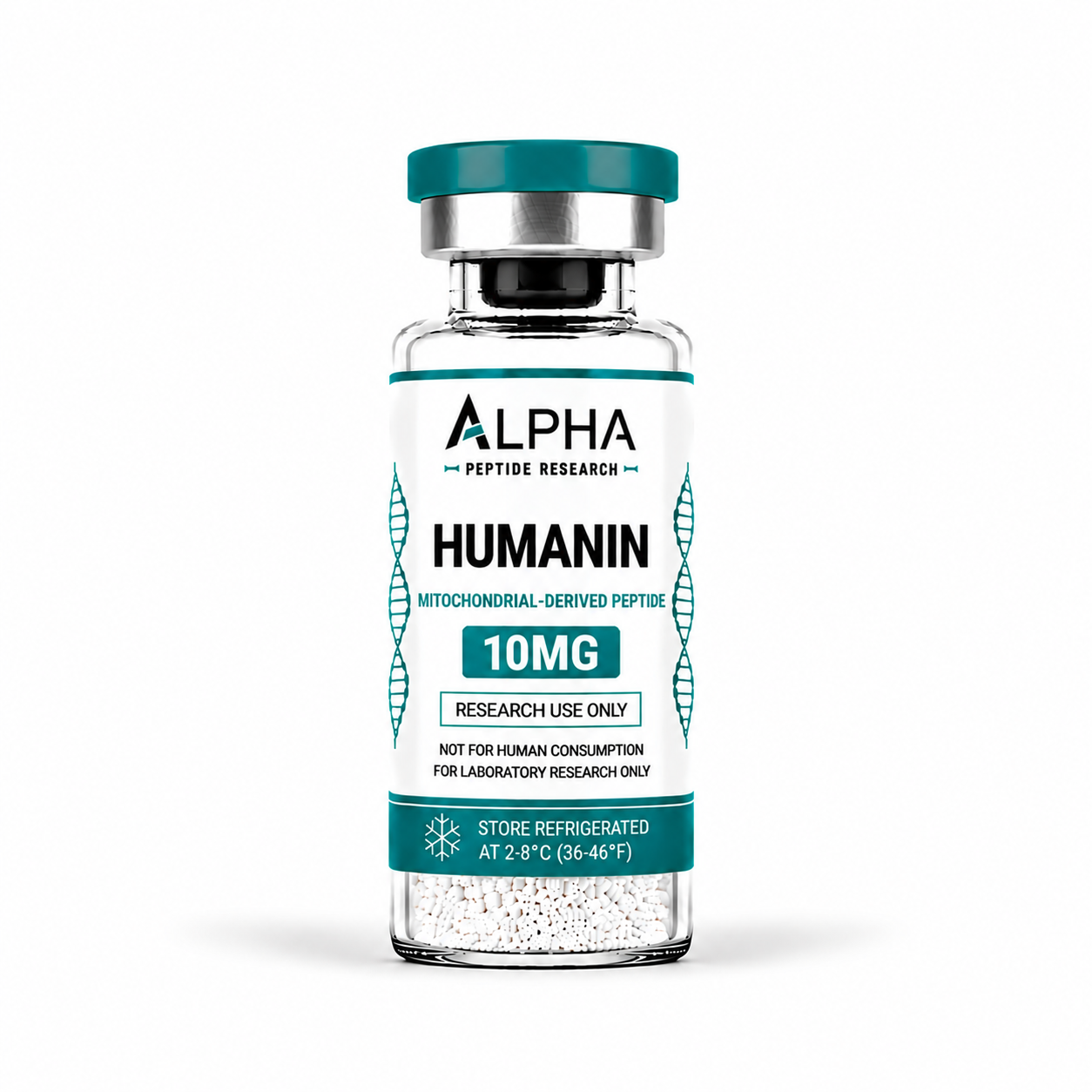
Humanin 10mg
Humanin 10mg is a research-grade mitochondrial-derived peptide supplied by Alpha Peptide Research for controlled laboratory investigation. Humanin has been studied in experimental research involving mitochondrial biology, cellular signaling, metabolic pathways, oxidative stress, and cellular protection mechanisms. Research Use Only. Not for human consumption.
$140.00
Research Use Only
Products offered by Alpha Peptide Research are intended exclusively for laboratory and scientific research. They are not intended for human consumption, therapeutic use, veterinary use, or diagnostic purposes.
Humanin 10mg adds another specialized mitochondrial-derived peptide to the Alpha Peptide Research Healing Peptides collection.
Humanin is a short peptide encoded by a small open reading frame within the mitochondrial genome. Its mitochondrial origin has made it particularly interesting to researchers investigating the relationship between mitochondrial activity and cellular signaling.
Unlike many conventional peptides that are encoded within nuclear DNA, Humanin belongs to a group of mitochondrial-derived peptides that researchers study as potential signaling molecules.
Furthermore, Humanin research spans several areas of molecular and cellular biology, including mitochondrial signaling, cellular stress responses, metabolic regulation, and neurobiological research.
Alpha Peptide Research supplies Humanin 10mg strictly as a laboratory research material.
What Is Humanin?
Humanin is a mitochondrial-derived peptide originally identified through research involving neuronal cells.
It is commonly described as a short peptide associated with a mitochondrial short open reading frame.
Researchers became interested in Humanin because experimental studies suggested that mitochondrial-derived peptides may participate in communication between mitochondria and other parts of the cell.
Consequently, Humanin provides a useful research model for investigating how mitochondrial activity can influence cellular signaling.
The peptide has subsequently been studied across several experimental fields, including mitochondrial biology, cellular stress, neurobiology, and metabolic research.
Humanin Sequence
Humanin is commonly reported as a 24-amino-acid peptide in its mature form.
A commonly reported sequence is:
MAPRGFSCLLLLTSEIDLPVKRRA
Researchers should verify the exact identity, sequence, formulation, and analytical characterization of any specific Humanin research material before beginning an experiment.
In addition, native Humanin should be distinguished from modified Humanin analogs when comparing research findings.
Humanin and Mitochondrial Biology
Mitochondria are involved in much more than cellular energy production.
They participate in signaling, calcium regulation, oxidative processes, apoptosis, and cellular adaptation.
Humanin is particularly interesting because it originates from the mitochondrial genome.
Therefore, researchers can investigate Humanin as part of broader research into mitochondrial-to-cellular communication.
Experimental studies may examine mitochondrial markers, cellular signaling pathways, metabolic changes, or responses to defined stress conditions.
Humanin and Mitochondrial Signaling
Cells rely on interconnected signaling networks to maintain internal balance.
Mitochondria communicate with the nucleus and other cellular structures through numerous molecular pathways.
Humanin has attracted scientific interest within this area of research.
For example, researchers can investigate whether Humanin-associated signaling corresponds with changes in specific cellular pathways.
Moreover, researchers can compare Humanin with other mitochondrial-derived peptides, including MOTS-c, to examine differences in structure and biological signaling.
Humanin and Cellular Stress Research
Cells encounter many forms of stress, including oxidative, metabolic, and environmental stress.
Researchers investigate how cells detect these conditions and activate appropriate signaling pathways.
Humanin has been examined in experimental models involving cellular stress responses.
As a result, Humanin provides researchers with another peptide model for investigating cellular adaptation.
Experimental systems may measure changes in cellular markers, protein signaling, gene expression, or other predefined endpoints.
Humanin and Oxidative Stress Research
Oxidative biology is closely connected with mitochondrial function.
Mitochondrial activity can influence the production and regulation of reactive oxygen species, while cells maintain antioxidant systems to manage these molecules.
Humanin has been investigated in experimental research involving oxidative stress and cellular responses.
However, oxidative stress is a complex process involving multiple pathways.
Therefore, researchers should use appropriate controls and multiple analytical markers when evaluating Humanin-associated effects.
Humanin and Cellular Signaling
Humanin research extends beyond mitochondrial biology.
Researchers have investigated interactions between Humanin and broader cellular signaling networks.
These studies can involve receptor-associated signaling, intracellular pathways, gene-expression changes, and other measurable cellular responses.
Furthermore, different experimental models can produce different outcomes.
For that reason, observations should always be interpreted within the specific conditions under which the research was conducted.
Humanin and Neurobiology
Humanin was originally identified through research involving neuronal cells, which contributed to its continued investigation within neurobiology.
Neurons depend on tightly regulated mitochondrial function because of their high energy requirements.
Consequently, researchers have examined mitochondrial-derived peptides such as Humanin in experimental neuroscience models.
Research may investigate cellular signaling, mitochondrial function, stress responses, and other molecular endpoints.
Importantly, laboratory findings should not be interpreted as evidence that Humanin is an approved treatment for neurological conditions.
Humanin and Cellular Metabolism
Mitochondria play a central role in cellular metabolism.
They participate in the processing of energy substrates and influence multiple metabolic signaling pathways.
Humanin has therefore attracted research interest within cellular metabolism.
For instance, researchers can investigate whether Humanin-associated signaling corresponds with measurable changes in metabolic markers.
Additionally, researchers can compare Humanin with other mitochondrial-derived peptides to study how different peptide sequences relate to cellular metabolism.
Humanin and Metabolic Stress
Metabolic stress can occur when cellular energy requirements and available resources become mismatched.
Cells respond through coordinated changes in energy sensing, mitochondrial activity, and intracellular signaling.
Humanin has been investigated in experimental systems involving metabolic stress.
As a result, the peptide can serve as a research material for examining how mitochondrial-derived signaling relates to cellular adaptation.
Researchers should use validated assays and appropriate experimental controls when evaluating these pathways.
Humanin and Cellular Protection Research
One of the areas of scientific interest surrounding Humanin involves cellular responses to stress.
Researchers have investigated whether Humanin-associated signaling correlates with changes in cellular survival pathways under defined experimental conditions.
Nevertheless, research observations should not be converted into therapeutic claims.
The purpose of Humanin research is to investigate biological mechanisms under controlled laboratory conditions.
Humanin and Apoptosis Research
Apoptosis is a regulated process through which cells undergo programmed cell death.
Mitochondria participate in several pathways associated with apoptosis.
Humanin has consequently been investigated in experimental research examining cellular signaling associated with apoptosis.
For example, laboratories can measure defined molecular markers associated with apoptotic pathways and compare experimental groups with appropriate controls.
Furthermore, researchers can investigate how experimental conditions influence observed responses.
Humanin and Longevity Research
Mitochondrial function is an important subject within longevity and aging research.
Changes in mitochondrial activity, cellular stress, and metabolic signaling are frequently examined in models of cellular aging.
Humanin has therefore attracted interest within experimental longevity research.
However, scientific interest in Humanin and aging does not establish the peptide as an anti-aging treatment.
Research findings should remain within the context of the experimental model and available scientific evidence.
Humanin vs. MOTS-c
Humanin and MOTS-c are both mitochondrial-derived peptides.
However, they are distinct molecules with different sequences and research profiles.
Humanin is commonly described as a 24-amino-acid mitochondrial-derived peptide, whereas MOTS-c is a 16-amino-acid mitochondrial-derived peptide.
Therefore, the two should not be treated as interchangeable research materials.
Studying both peptides can instead provide researchers with useful comparisons between different mitochondrial-derived signaling molecules.
Humanin vs. SS-31
Humanin and SS-31 are also different research peptides.
Humanin is a naturally occurring mitochondrial-derived peptide.
SS-31 is a synthetic mitochondria-targeted tetrapeptide designed for mitochondrial research.
Consequently, their structures, origins, and experimental applications differ.
Researchers should select the appropriate material according to the specific research question.
Humanin vs. LL-37
Humanin and LL-37 represent different areas of peptide research.
LL-37 is a human cathelicidin extensively investigated in antimicrobial and innate immune research.
Humanin is a mitochondrial-derived peptide primarily associated with mitochondrial, metabolic, cellular stress, and neurobiological research.
As a result, the two products complement one another within a broader research-peptide collection.
Why Choose Humanin 10mg?
Humanin 10mg provides laboratories with a defined mitochondrial-derived peptide for controlled scientific investigation.
Key characteristics include:
- 10mg research presentation
- 24-amino-acid peptide
- Mitochondrial-derived peptide
- Mitochondrial biology research
- Cellular signaling research
- Cellular stress research
- Oxidative stress research
- Metabolic research
- Neurobiology research
- Apoptosis research
- Cellular adaptation research
- Longevity and aging research
- Professional laboratory presentation
- Research Use Only labeling
- Not intended for human consumption
Overall, Humanin expands the Healing Peptides collection into mitochondrial-derived peptide research.
Product Specifications
| Specification | Details |
|---|---|
| Product Name | Humanin |
| Quantity | 10mg |
| Peptide Length | 24 amino acids |
| Peptide Type | Mitochondrial-Derived Peptide |
| Commonly Reported Sequence | MAPRGFSCLLLLTSEIDLPVKRRA |
| Genetic Origin | Mitochondrial genome |
| Product Type | Research Peptide |
| Category | Healing Peptides |
| Primary Research Area | Mitochondrial Biology |
| Additional Research Areas | Cellular Stress, Metabolism & Neurobiology |
| Presentation | Laboratory Research Vial |
| Intended Use | Laboratory Research Only |
| Human Consumption | Not Intended |
| Brand | Alpha Peptide Research |
| Product Number | Healing Peptides #21 |
Humanin 10mg Research Presentation
The 10mg presentation provides laboratories with a clearly identified quantity of Humanin research material.
Researchers may investigate the peptide using appropriately designed biochemical, cellular, mitochondrial, or molecular research models.
For example, studies can examine mitochondrial signaling, cellular stress responses, metabolic pathways, or defined molecular markers.
Furthermore, Humanin can be compared with related mitochondrial-derived peptides such as MOTS-c.
The 10mg designation identifies the quantity of research material supplied. It does not represent a human dose or administration recommendation.
Quality and Analytical Documentation
Accurate peptide characterization supports reliable laboratory research.
For this reason, researchers should review batch-specific analytical documentation before using Humanin 10mg.
Relevant documentation may include:
- Peptide identity
- Sequence confirmation
- Analytical purity
- Molecular characterization
- Batch number
- Quantity
- Manufacturing information where applicable
Additionally, researchers should distinguish native Humanin from modified analogs when comparing experimental findings with published literature.
Specific purity percentages should only be stated when supported by appropriate batch-specific testing.
Likewise, claims regarding third-party testing or certifications should only be made when supporting documentation is available.
Storage and Laboratory Handling
Researchers should follow the validated storage requirements supplied with the specific Humanin 10mg formulation and batch.
Keep the vial securely closed and protect the research material from unsuitable environmental conditions.
In addition, laboratories should maintain accurate inventory and batch records.
Qualified personnel should handle research peptides according to established laboratory procedures.
Any storage temperature stated on the product label should correspond with verified documentation for the supplied formulation.
Controlled Laboratory Research
Humanin 10mg is intended for controlled scientific investigation.
Potential research areas include:
- Mitochondrial biology
- Mitochondrial signaling
- Cellular metabolism
- Cellular stress
- Oxidative stress
- Neurobiology
- Cellular communication
- Apoptosis research
- Cellular adaptation
- Aging and longevity research
For instance, researchers may compare Humanin-treated and control experimental systems while measuring predefined cellular or molecular endpoints.
Moreover, laboratories can investigate Humanin alongside related mitochondrial-derived peptides.
Careful experimental design remains essential when interpreting research results.
Research Use Only
Alpha Peptide Research supplies Humanin 10mg exclusively for scientific and laboratory research.
The product is not intended for human consumption, self-administration, diagnosis, therapeutic use, anti-aging treatment, neurological treatment, metabolic treatment, or veterinary use.
Furthermore, Humanin 10mg should not be marketed as a treatment for aging, neurological disorders, metabolic diseases, mitochondrial disorders, or other medical conditions.
The 10mg designation describes research quantity only and does not provide dosing or administration guidance.
Frequently Asked Questions
What is Humanin 10mg?
Humanin 10mg is a laboratory research presentation containing 10mg of the mitochondrial-derived peptide Humanin.
What is Humanin?
Humanin is a short mitochondrial-derived peptide that has been investigated in experimental research involving mitochondrial biology, cellular signaling, stress responses, metabolism, and neurobiology.
How many amino acids does Humanin contain?
Humanin is commonly described as a 24-amino-acid peptide in its mature form.
What is the Humanin sequence?
A commonly reported Humanin sequence is MAPRGFSCLLLLTSEIDLPVKRRA.
Where does Humanin originate?
Humanin is associated with a small open reading frame within the mitochondrial genome.
Why do researchers study Humanin?
Researchers investigate Humanin in areas including mitochondrial signaling, cellular stress, metabolic pathways, neurobiology, and cellular adaptation.
Is Humanin a mitochondrial-derived peptide?
Yes. Humanin is classified as a mitochondrial-derived peptide because its coding information is associated with mitochondrial DNA.
Is Humanin studied in neurobiology?
Yes. Humanin has a significant research history involving neuronal and cellular biology.
Is Humanin studied in mitochondrial research?
Yes. Mitochondrial signaling and cellular responses are important areas of Humanin research.
Is Humanin studied in aging research?
Yes. Humanin has been investigated in experimental research related to mitochondrial biology and cellular aging. This does not establish it as an anti-aging treatment.
Is Humanin the same as MOTS-c?
No. Both are mitochondrial-derived peptides, but they are distinct molecules with different sequences.
Is Humanin the same as SS-31?
No. Humanin is a mitochondrial-derived peptide, while SS-31 is a synthetic mitochondria-targeted tetrapeptide.
What does 10mg mean?
The 10mg designation indicates the quantity of research material supplied in the vial. It does not represent a recommended dose.
Can Humanin 10mg be used by humans?
No. Alpha Peptide Research supplies Humanin 10mg strictly for laboratory research and not for human consumption or self-administration.
What category does Humanin belong to?
Humanin belongs to the Healing Peptides category because of its relevance to mitochondrial, cellular, metabolic, and stress-response research.
Humanin 10mg From Alpha Peptide Research
Humanin 10mg adds a second distinct mitochondrial-derived peptide to the Alpha Peptide Research collection alongside MOTS-c.
Its mitochondrial origin and research history make Humanin particularly relevant to laboratories investigating mitochondrial signaling, cellular stress, metabolism, neurobiology, and cellular adaptation.
Furthermore, Humanin provides an opportunity to compare different mitochondrial-derived peptides and investigate how their distinct structures relate to cellular signaling.
The 10mg presentation provides a clearly identified research quantity for appropriately designed laboratory experiments.
Overall, Humanin 10mg gives researchers another specialized material for studying the relationship between mitochondrial activity and cellular biology.
Humanin 10mg is for laboratory research only and is not intended for human consumption.
Be the first to review “Humanin 10mg”
Related products
Reviews
There are no reviews yet.