

-
×
 P21 Peptide 20mg
1 × $60.00
P21 Peptide 20mg
1 × $60.00 -
×
 GHK-Cu 100mg
1 × $90.00
GHK-Cu 100mg
1 × $90.00
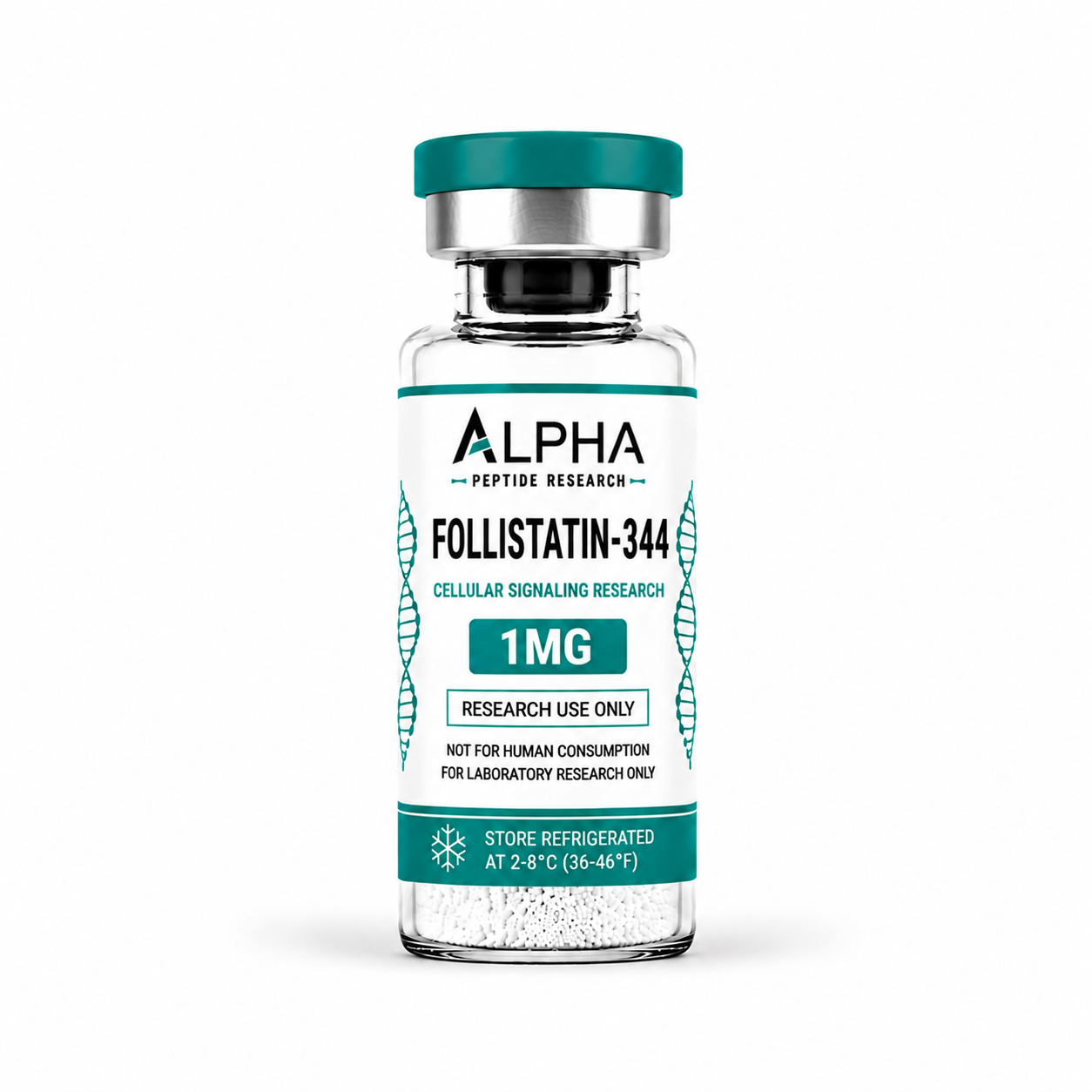
Follistatin-344 1mg
Follistatin-344 1mg, also known as FST-344, is a research material from Alpha Peptide Research intended for controlled laboratory investigation. Follistatin is an activin-binding glycoprotein studied in areas involving TGF-β superfamily signaling, cellular communication, tissue biology, and muscle-related experimental models. Research Use Only. Not for human consumption.
$150.00
✓
Research Use Only
✓
High Purity Standards
✓
Laboratory Tested
✓
Secure Checkout
✓
Fast & Secure Shipping
Research Use Only
Products offered by Alpha Peptide Research are intended exclusively for laboratory and scientific research. They are not intended for human consumption, therapeutic use, veterinary use, or diagnostic purposes.
Follistatin-344 1mg introduces a distinct signaling-related research material to the Alpha Peptide Research Healing Peptides collection.
Follistatin is a naturally occurring glycoprotein known primarily for its ability to bind activins. Activins belong to the transforming growth factor-beta (TGF-β) superfamily, a large group of signaling proteins involved in many biological processes.
Scientists study follistatin because its interaction with activins provides a useful system for investigating cellular communication and signaling regulation.
In addition, follistatin research extends into tissue biology, developmental biology, reproductive research, and muscle-related experimental models.
Follistatin-344 is commonly abbreviated FST-344. However, Alpha Peptide Research supplies the 1mg presentation exclusively as a laboratory research material rather than a therapeutic or performance-enhancing product.
What Is Follistatin-344?
Follistatin is a glycoprotein that interacts with several members of the TGF-β superfamily.
Researchers originally identified follistatin through its relationship with follicle-stimulating hormone (FSH) regulation. Further investigation revealed a much broader biological research profile.
One of follistatin’s best-known properties involves its ability to bind activin.
As a result, scientists have used follistatin extensively when studying activin-associated signaling and related molecular pathways.
The term Follistatin-344 refers to a particular precursor form associated with follistatin research. Researchers should distinguish the exact material supplied from other follistatin forms and fragments through appropriate analytical documentation.
Why Do Scientists Study Follistatin?
Cellular communication depends on signaling molecules that transmit information between and within cells.
Activins represent one group of these molecules. Their biological activity connects with multiple cellular and developmental processes.
Follistatin can interact with activins and influence their availability within experimental systems. Therefore, researchers study the relationship between follistatin and activin to better understand these signaling networks.
Furthermore, scientific research has explored follistatin in connection with other TGF-β superfamily members.
These interactions have contributed to research involving cellular signaling, developmental biology, tissue processes, and muscle-related experimental models.
Follistatin and Activin Research
Activin biology represents one of the most established areas of follistatin research.
Activins are signaling proteins within the TGF-β superfamily. They participate in complex molecular networks and interact with receptors that can influence downstream cellular pathways.
Follistatin can bind activin with high affinity. Consequently, researchers can use follistatin-containing experimental systems to investigate activin availability and signaling behavior.
Scientists may examine molecular markers, receptor-associated pathways, gene expression, or cellular responses depending on the research model.
Moreover, comparing treated models with appropriate controls can help researchers determine how changes in activin signaling affect selected endpoints.
TGF-β Superfamily Research
The TGF-β superfamily contains numerous signaling proteins with diverse biological roles.
Members include activins, inhibins, bone morphogenetic proteins, growth differentiation factors, and related molecules.
Because follistatin interacts with selected members of this family, it provides an important research subject for studying these signaling systems.
For example, scientists may investigate how follistatin binding changes the availability or activity of particular signaling molecules.
Researchers can then measure downstream cellular responses under controlled conditions.
Therefore, Follistatin-344 provides a useful material for investigating signaling networks rather than simply one isolated biological process.
Follistatin and Cellular Signaling Research
Cells rely on signaling networks to coordinate growth, differentiation, communication, and responses to environmental conditions.
Researchers study follistatin because it can influence experimental signaling environments through its interactions with specific proteins.
In particular, activin-associated pathways provide an important focus for this research.
Laboratories may examine receptor activity, intracellular signaling, gene-expression changes, or other measurable biological endpoints.
Furthermore, scientists can vary experimental conditions to investigate how different concentrations or biological environments influence observed responses.
These approaches help researchers build a clearer picture of follistatin-associated biology.
Muscle Biology Research
Follistatin frequently appears in research involving skeletal muscle biology.
This interest partly relates to interactions between follistatin and selected TGF-β superfamily signaling molecules associated with muscle biology.
As a result, preclinical studies have examined follistatin-associated mechanisms in muscle cells and other experimental models.
Scientists may measure cellular differentiation, signaling markers, protein expression, or other research endpoints.
However, these findings do not establish Follistatin-344 1mg as a bodybuilding product, muscle-growth supplement, or performance enhancer.
Alpha Peptide Research should keep all product information focused on legitimate laboratory investigation.
Tissue Biology Research
Tissues depend on coordinated communication among cells, extracellular structures, proteins, and signaling molecules.
Follistatin-related signaling can therefore become relevant in several experimental tissue models.
For instance, researchers may examine how activin-associated pathways behave when follistatin is present within a controlled system.
Other studies may investigate cellular differentiation or changes in selected molecular markers.
In addition, researchers can compare different tissue models to determine whether biological responses vary according to cellular context.
Such research contributes to the broader understanding of signaling biology.
Developmental Biology Research
Signaling molecules within the TGF-β superfamily play important roles in developmental biology.
Researchers study these pathways to understand how cells communicate during differentiation and other biological processes.
Because follistatin can interact with activins and selected related proteins, it has become an important research subject within this field.
Consequently, experimental models may use follistatin to explore how changes in signaling influence developmental processes.
Scientists should interpret each result according to the model, methodology, and experimental conditions.
Follistatin-344 vs. Myostatin
Follistatin and myostatin often appear together in research discussions, but they are not the same molecule.
Myostatin, also known as GDF-8, is a signaling protein belonging to the TGF-β superfamily.
Follistatin, meanwhile, is a binding glycoprotein capable of interacting with selected TGF-β superfamily members.
Research has explored relationships between follistatin and pathways involving myostatin. However, this does not mean the two molecules are interchangeable.
Understanding this distinction helps researchers interpret experiments more accurately.
Follistatin-344 vs. Follistatin-315
Researchers may encounter several numbers associated with follistatin.
Follistatin precursor forms and mature isoforms require careful distinction. Therefore, a product labeled Follistatin-344 should have analytical documentation that confirms the identity of the actual material supplied.
This distinction matters because different follistatin forms may have different molecular characteristics.
For an e-commerce research catalog, the product page should avoid treating FST-344, FST-315, and other forms as interchangeable unless product-specific documentation establishes the relationship.
Why Choose Follistatin-344 1mg?
Follistatin-344 1mg expands the Healing Peptides collection into another area of signaling biology.
Key characteristics include:
- 1mg research presentation
- Follistatin-associated research material
- Commonly abbreviated FST-344
- Activin signaling research
- TGF-β superfamily research
- Cellular signaling research
- Tissue biology research
- Muscle-related experimental research
- Professional laboratory presentation
- Research Use Only labeling
- Not intended for human consumption
Overall, Follistatin-344 adds a different research profile from the shorter peptides already represented in the collection.
Product Specifications
| Specification | Details |
|---|---|
| Product Name | Follistatin-344 |
| Abbreviation | FST-344 |
| Quantity | 1mg |
| Product Class | Follistatin Research Material |
| Molecular Type | Glycoprotein-related research material |
| Category | Healing Peptides |
| Primary Research Area | Activin & Cellular Signaling |
| Additional Research Areas | TGF-β, Tissue & Muscle Biology |
| Presentation | Laboratory Research Vial |
| Intended Use | Laboratory Research Only |
| Human Consumption | Not Intended |
| Brand | Alpha Peptide Research |
| Product Number | Healing Peptides #11 |
Follistatin-344 1mg Research Presentation
The 1mg presentation provides laboratories with a clearly identified quantity of Follistatin-344 research material.
Depending on their objectives, researchers may incorporate appropriately characterized material into biochemical, cellular, analytical, or other controlled experimental systems.
For example, laboratories may investigate activin-associated signaling or selected interactions involving TGF-β superfamily proteins.
Researchers can then evaluate clearly defined molecular or cellular endpoints.
The 1mg specification describes the quantity of research material supplied. It does not represent a human dose, administration recommendation, or performance-enhancement protocol.
Quality and Analytical Documentation
Accurate characterization is particularly important for Follistatin-344.
Researchers should verify the identity and composition of the supplied material using batch-specific analytical documentation.
Relevant records may include product identity, molecular characterization, analytical purity, batch information, quantity, and the analytical methods used.
Furthermore, the product page should only advertise an exact purity percentage when supporting documentation confirms that value for the supplied batch.
Claims such as third-party tested, pharmaceutical grade, or GMP manufactured should also appear only when appropriate records substantiate them.
Ultimately, transparent documentation helps laboratories understand exactly what research material they receive.
Storage and Laboratory Handling
Researchers should follow validated storage requirements for the actual Follistatin-344 1mg formulation.
Keep the vial securely closed and protect the material from unsuitable environmental conditions.
Additionally, laboratories should maintain accurate records for product identity, batch number, inventory, and storage conditions.
Qualified personnel should follow established institutional procedures when handling experimental research materials.
Only print a specific storage temperature on the product label when verified documentation supports that condition for the supplied formulation.
Controlled Laboratory Research
Follistatin-344 1mg supports controlled scientific investigation involving signaling and cellular biology.
Research areas may include activin biology, TGF-β superfamily signaling, tissue processes, cellular communication, developmental biology, and muscle-related experimental models.
For instance, researchers may compare experimental systems containing Follistatin-344 with appropriate controls and evaluate changes in selected signaling markers.
Furthermore, laboratories can combine biochemical and cellular approaches to examine different aspects of the material.
Therefore, strong experimental design remains essential for obtaining meaningful results.
Research Use Only
Alpha Peptide Research supplies Follistatin-344 1mg exclusively for scientific and laboratory research.
This product is not intended for human consumption, self-administration, therapeutic use, diagnosis, bodybuilding, athletic performance enhancement, or veterinary treatment.
The product should not carry claims that it builds muscle, improves athletic performance, treats muscle wasting, accelerates healing, or treats disease.
Importantly, the 1mg designation describes research quantity only and does not provide dosing or administration guidance.
Frequently Asked Questions
What is Follistatin-344 1mg?
Follistatin-344 1mg is a laboratory research presentation containing 1mg of FST-344 research material.
What does FST-344 mean?
FST is an abbreviation for follistatin, while 344 identifies the particular precursor form referenced by the product name.
Is Follistatin-344 a peptide?
Follistatin is more accurately described as a glycoprotein, rather than a simple short peptide such as KPV. Research catalogs may group it with peptide-related materials, but the distinction is scientifically useful.
Why do scientists study follistatin?
Scientists study follistatin primarily because of its interactions with activins and other signaling systems associated with the TGF-β superfamily.
What is activin?
Activins are signaling proteins belonging to the TGF-β superfamily. In particular, activin biology represents an important area of follistatin research.
Is Follistatin-344 related to myostatin research?
Yes. Research has examined follistatin alongside pathways involving myostatin and other TGF-β superfamily members. However, follistatin and myostatin are distinct molecules.
Is Follistatin-344 studied in muscle biology?
Yes. Preclinical research has explored follistatin-associated mechanisms in muscle-related models. Nevertheless, that research does not establish FST-344 1mg as a muscle-building product.
Is Follistatin-344 the same as Follistatin-315?
No. Researchers should distinguish different precursor forms and mature isoforms using appropriate product-specific analytical documentation.
What does 1mg mean?
The 1mg designation identifies the quantity of research material supplied. Importantly, it does not represent a recommended dose.
Is Follistatin-344 1mg intended for human consumption?
No. Alpha Peptide Research supplies this product strictly for controlled laboratory research.
How should researchers store Follistatin-344 1mg?
Follow the validated storage requirements associated with the actual formulation and batch.
Does Follistatin-344 1mg come with a Certificate of Analysis?
Only advertise a Certificate of Analysis when batch-specific documentation is actually available for the supplied material.
Follistatin-344 1mg From Alpha Peptide Research
Follistatin-344 1mg expands the Alpha Peptide Research Healing Peptides collection with a research material associated with activin and TGF-β superfamily signaling.
Its interactions with signaling proteins have contributed to scientific research involving cellular communication, tissue biology, developmental processes, and muscle-related experimental models.
Furthermore, FST-344 offers a substantially different research profile from ARA-290, LL-37, KPV, and the thymosin products already included in the collection.
The 1mg presentation gives laboratories a clearly identified format for appropriately designed scientific investigations.
Overall, accurate identification, suitable analytical documentation, professional packaging, and clear research-use restrictions help create a responsible product presentation.
Follistatin-344 1mg is for laboratory research only and is not intended for human consumption.
Be the first to review “Follistatin-344 1mg”
Related products




Reviews
There are no reviews yet.