

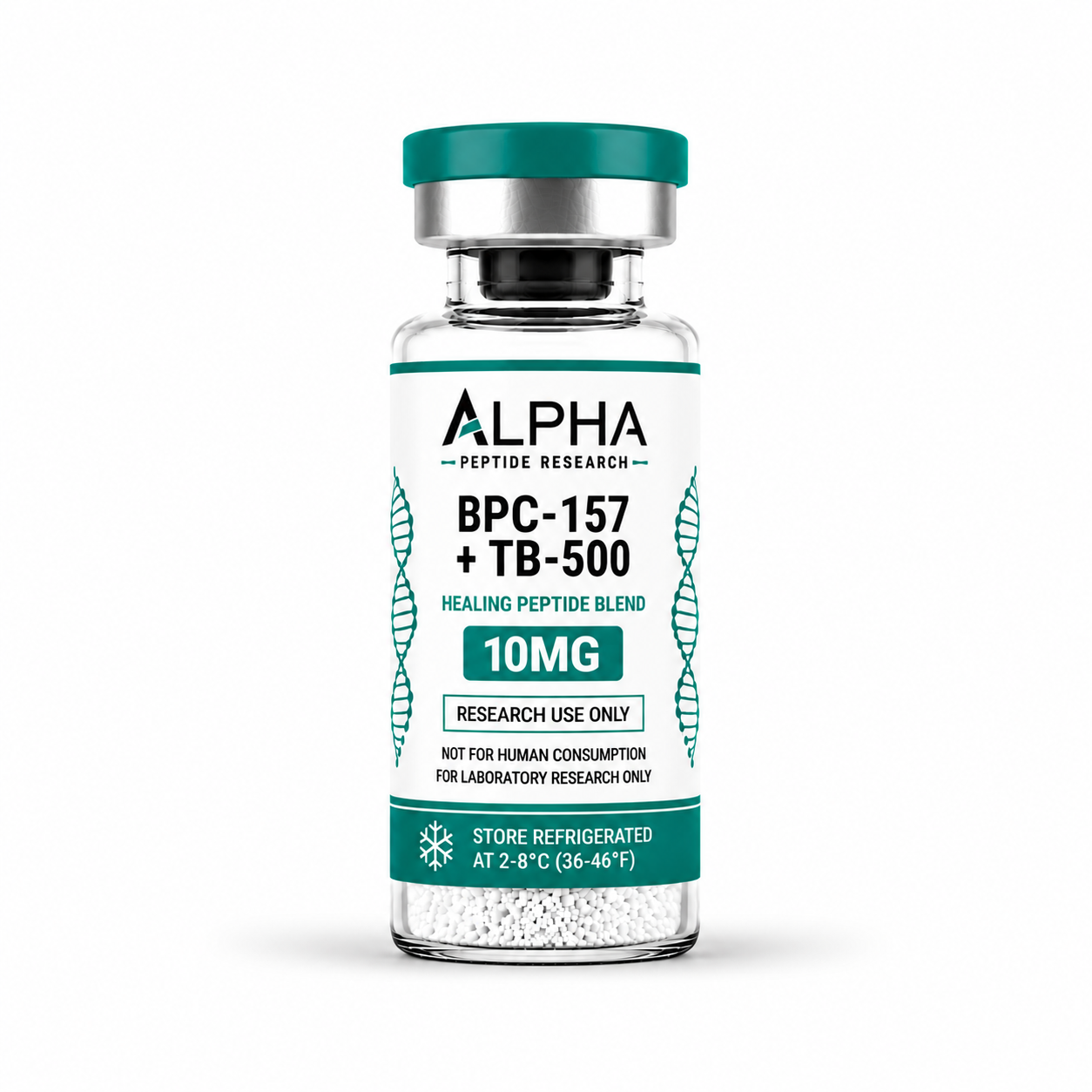
BPC-157 + TB-500 Blend 10mg
BPC-157 + TB-500 Blend 10mg combines two experimental peptide research materials in one laboratory presentation. Alpha Peptide Research offers this blend for controlled studies involving peptide biology, cellular activity, tissue-response mechanisms, and related preclinical research. Research Use Only. Not for human consumption.
$250.00
Research Use Only
Products offered by Alpha Peptide Research are intended exclusively for laboratory and scientific research. They are not intended for human consumption, therapeutic use, veterinary use, or diagnostic purposes.
BPC-157 + TB-500 Blend 10mg brings two widely researched experimental peptide materials together in one laboratory presentation. It forms part of the Alpha Peptide Research Healing Peptides collection and supports controlled scientific studies involving peptide biology, cellular activity, tissue-response mechanisms, and related research areas.
Researchers have studied BPC-157 in preclinical models involving tissue biology, gastrointestinal systems, cellular signaling, and vascular processes. Meanwhile, research associated with TB-500 and thymosin beta-4 has examined areas such as actin biology, cell movement, vascular mechanisms, and cellular responses.
Combining these research materials gives scientists an additional formulation for investigating their behavior within appropriately designed experimental models.
However, the blend remains experimental. Current research does not establish BPC-157 + TB-500 Blend 10mg as an approved treatment for injuries, recovery, or medical conditions.
Alpha Peptide Research offers this product strictly for laboratory research.
What Is BPC-157 + TB-500 Blend 10mg?
BPC-157 + TB-500 Blend 10mg is a combined research presentation containing BPC-157 and a material identified as TB-500.
BPC-157 is a synthetic peptide consisting of 15 amino-acid residues. Scientists have investigated it in several areas of experimental biology, including cellular, gastrointestinal, vascular, and tissue-response research.
TB-500 is a name commonly associated with research involving thymosin beta-4. Researchers have studied thymosin beta-4 because of its relationship with actin and several cellular processes.
The combination creates a single product for researchers who specifically require both materials within one experimental formulation.
The 10mg designation describes the total labeled quantity of the blend. It does not describe a human dose or administration protocol.
Understanding the Blend Ratio
The exact quantity of each component matters when describing a research blend.
A product labeled BPC-157 + TB-500 Blend 10mg does not automatically mean that it contains 5mg of BPC-157 and 5mg of TB-500.
Therefore, Alpha Peptide Research should list the individual quantities only when manufacturing and analytical records confirm the formulation.
For example, if verified documentation confirms a 1:1 formulation containing 5mg of each component, the specifications can state:
BPC-157: 5mg + TB-500: 5mg = 10mg total
Until documentation confirms that ratio, the product page should simply state 10mg total blend quantity.
This approach keeps the listing accurate and avoids making unsupported composition claims.
Why Do Researchers Study BPC-157?
Scientists study BPC-157 to explore several biological mechanisms.
Preclinical research has examined the peptide in models involving tissue responses, gastrointestinal biology, vascular processes, and cellular signaling.
Researchers can use controlled models to measure changes in cells, molecular pathways, or other experimental markers.
These studies help scientists understand how BPC-157 behaves within specific experimental environments.
However, researchers should not treat preclinical observations as proof of clinical effectiveness in humans.
Why Do Researchers Study TB-500?
Scientists commonly discuss TB-500 in connection with thymosin beta-4 research.
Thymosin beta-4 interacts with actin, an important protein involved in cell structure and movement. Consequently, researchers have explored thymosin beta-4 in studies involving cellular movement, actin regulation, vascular biology, and related mechanisms.
TB-500-related materials may provide researchers with tools for investigating similar areas when analytical testing confirms the material’s identity.
Scientists should evaluate the exact composition of TB-500 products rather than assume that every formulation contains the same peptide.
Why Combine BPC-157 and TB-500?
Researchers sometimes investigate multiple compounds within the same experimental model to understand how they behave individually and together.
The BPC-157 + TB-500 Blend 10mg provides a combined formulation for studies specifically designed around both research materials.
Scientists may compare the blend with individual compounds or experimental controls. Such comparisons can help researchers identify measurable differences under standardized conditions.
For example, a study might compare:
- BPC-157 alone
- TB-500-related material alone
- The combined BPC-157 + TB-500 formulation
- An appropriate experimental control
This type of design can help researchers examine compound interactions while controlling other experimental variables.
Importantly, combining two research materials does not prove that they work better together. Researchers need suitable experiments to investigate that question.
Tissue Biology Research
Tissue biology involves complex interactions among cells, proteins, blood vessels, signaling molecules, and structural components.
Researchers study these systems to understand how tissues respond to different experimental conditions.
BPC-157 and thymosin beta-4-related research have both appeared in preclinical investigations involving aspects of tissue biology.
Therefore, the BPC-157 + TB-500 Blend may interest laboratories studying these mechanisms within controlled research environments.
Researchers should use measurable endpoints, suitable controls, and clearly defined methods when conducting these studies.
Cellular Activity and Signaling
Cells rely on signaling networks to communicate and respond to their surroundings.
Scientists can use experimental peptides to examine how particular molecular pathways respond under controlled conditions.
Research involving BPC-157 has explored several cellular and signaling mechanisms. Meanwhile, thymosin beta-4 research has examined cellular processes associated with actin and movement.
A combined formulation allows researchers to investigate both materials within a single experimental system.
However, scientists should interpret any observed response within the limits of the chosen model.
Actin and Cell Movement Research
Actin forms an important part of the cellular structure and contributes to cell movement.
Thymosin beta-4 has a well-established relationship with actin biology, which explains much of the scientific interest surrounding this peptide.
Researchers studying TB-500-related materials may therefore investigate cellular movement and actin-related processes.
Adding BPC-157 to the same experimental formulation creates additional questions about how the two materials behave under identical research conditions.
Controlled laboratory studies can help researchers investigate those questions.
Vascular Biology Research
Vascular biology examines blood vessels and the cells and molecular signals that support them.
Research associated with both BPC-157 and thymosin beta-4 has explored vascular mechanisms in preclinical models.
Researchers may study cellular responses, molecular pathways, endothelial behavior, or other measurable outcomes depending on their experimental objectives.
The combined formulation gives laboratories another material for exploring these research areas.
Still, experimental findings do not establish therapeutic effectiveness in humans.
Blend vs. Individual Research Products
Alpha Peptide Research offers BPC-157 and TB-500 as separate research presentations in addition to this combined product.
The current Healing Peptides range includes BPC-157 5mg, BPC-157 10mg, TB-500 5mg, TB-500 10mg, and BPC-157 + TB-500 Blend 10mg.
Individual products allow researchers to investigate each material separately.
The blend provides a ready combined presentation for research protocols that specifically require both materials together.
Neither option is inherently better. The appropriate product depends on the objectives and design of the experiment.
Why Choose BPC-157 + TB-500 Blend 10mg?
This product expands the Healing Peptides collection beyond single-compound presentations.
Key characteristics include:
- 10mg total blend presentation
- Contains BPC-157 and TB-500 research materials
- Combined experimental formulation
- Clear product identification
- Professional laboratory vial
- Healing Peptides collection branding
- Research Use Only labeling
- Designed for controlled laboratory studies
- Not intended for human consumption
- Consistent Alpha Peptide Research presentation
Researchers should consult batch documentation for the exact quantity and identity of each component.
Product Specifications
| Specification | Details |
|---|---|
| Product Name | BPC-157 + TB-500 Blend |
| Total Quantity | 10mg |
| Components | BPC-157 + TB-500 |
| Component Ratio | Refer to batch-specific documentation |
| Product Type | Experimental Research Peptide Blend |
| Category | Healing Peptides |
| Research Areas | Peptide Biology & Cellular Research |
| Presentation | Laboratory Research Vial |
| Intended Use | Laboratory Research Only |
| Human Consumption | Not Intended |
| Brand | Alpha Peptide Research |
| Product Number | Healing Peptides #5 |
10mg Research Blend Presentation
The 10mg format provides researchers with a combined BPC-157 and TB-500 research presentation.
Laboratories may choose this product when an experimental design specifically calls for both materials in a single formulation.
The 10mg specification identifies the total labeled quantity of the blend.
It does not provide dosing information, administration guidance, or a research protocol.
Scientists should determine material requirements according to their approved experimental procedures.
Quality and Analytical Documentation
Combined formulations require clear analytical documentation because researchers need to understand what each vial contains.
Relevant information may include product identity, total quantity, individual component quantities, blend ratio, lot number, purity results, and molecular characterization.
Researchers should review batch-specific documents before using the blend in an experiment.
This becomes especially important for TB-500 because the term can refer to different research formulations.
Alpha Peptide Research should only publish an exact ratio, sequence, purity percentage, or molecular specification when analytical evidence confirms the information for the actual batch.
Storage and Laboratory Handling
Follow the verified storage requirements for the specific BPC-157 + TB-500 Blend 10mg formulation.
Researchers should keep the vial securely closed and protect the material from unsuitable environmental conditions.
Laboratories should also maintain accurate records for product identity, batch number, inventory, and storage conditions.
Qualified personnel should handle research peptides according to established laboratory procedures.
If validated product documentation specifies 2–8°C (36–46°F) refrigeration, we can display that information on the vial and product page. Otherwise, use the verified conditions for the actual formulation.
Controlled Laboratory Research
BPC-157 + TB-500 Blend 10mg supports controlled scientific investigation.
Depending on their objectives, researchers may explore peptide biology, cellular activity, molecular signaling, actin-related processes, tissue biology, or vascular mechanisms.
Scientists can also compare the combined formulation with the individual components.
Appropriate controls and careful documentation remain essential. Researchers should also interpret results within the limits of their experimental model.
These practices help laboratories produce more reliable and reproducible findings.
Research Use Only
Alpha Peptide Research offers BPC-157 + TB-500 Blend 10mg exclusively for scientific and laboratory research.
This product is not intended for human consumption, self-administration, therapeutic use, diagnosis, or veterinary treatment.
The product does not claim to prevent, treat, or cure disease.
The 10mg label identifies the total research quantity and does not represent a dosing recommendation.
Frequently Asked Questions
What is BPC-157 + TB-500 Blend 10mg?
It is an experimental research formulation that combines BPC-157 and TB-500-related research material in one 10mg total presentation.
Does 10mg mean 5mg BPC-157 plus 5mg TB-500?
Not automatically. The exact component ratio should come from verified manufacturing and analytical documentation.
Why combine BPC-157 and TB-500?
A combined formulation allows scientists to investigate both research materials within the same experimental system.
What is BPC-157?
BPC-157 is a synthetic 15-amino-acid peptide that scientists have investigated in several areas of preclinical biology.
What is TB-500?
TB-500 is a name commonly used for research materials associated with thymosin beta-4 research. Laboratories should use analytical documentation to establish the exact identity of the material.
What research areas relate to this blend?
Research may involve peptide biology, cellular activity, tissue-response mechanisms, actin-related processes, vascular biology, and molecular signaling.
Is the blend better than BPC-157 or TB-500 alone?
Research has not established that the combined formulation is inherently superior. Controlled comparative experiments can investigate differences between individual and combined materials.
Is BPC-157 + TB-500 Blend 10mg intended for human consumption?
No. Alpha Peptide Research offers this product for laboratory research only.
What does 10mg represent?
It describes the total labeled quantity of research material in the blend. It does not provide a dosage recommendation.
How should researchers store the blend?
Follow the validated storage instructions for the actual formulation and batch.
Can researchers purchase the compounds separately?
The Healing Peptides lineup also includes separate BPC-157 and TB-500 research presentations.
Does the product have a Certificate of Analysis?
Only advertise a Certificate of Analysis when batch-specific documentation exists for the product.
BPC-157 + TB-500 Blend 10mg From Alpha Peptide Research
BPC-157 + TB-500 Blend 10mg introduces the first combined formulation within our Healing Peptides lineup.
The product brings BPC-157 and TB-500-related research material together in a single presentation for laboratories investigating peptide biology, cellular mechanisms, tissue responses, actin-related processes, vascular biology, and related research areas.
Researchers can study the blend independently or compare it with the individual BPC-157 and TB-500 products.
Clear composition information, batch-specific analytical documentation, professional packaging, and research-use labeling help laboratories understand and evaluate the material.
BPC-157 + TB-500 Blend 10mg is exclusively for laboratory research and is not intended for human consumption.
Be the first to review “BPC-157 + TB-500 Blend 10mg”
Related products
Reviews
There are no reviews yet.