

Muscle Growth & Recovery
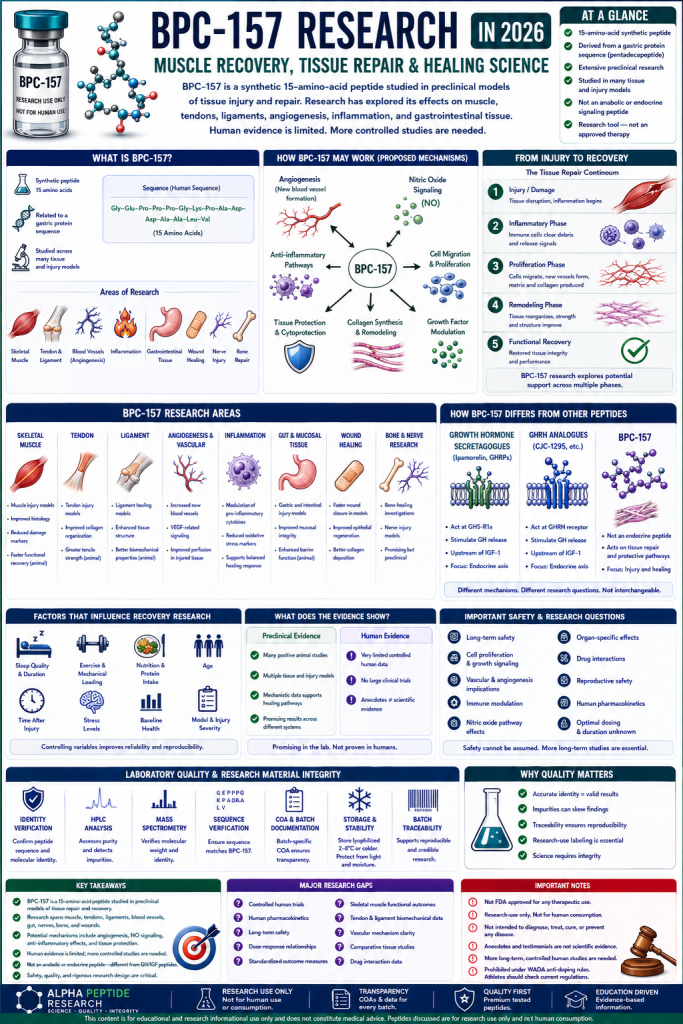
BPC-157 Research in 2026: Muscle Recovery, Tissue Repair and Healing Science
Jul
BPC-157 research has attracted significant interest in experimental tissue repair and recovery science.
Unlike peptides commonly discussed in growth hormone research, BPC-157 does not belong to the growth hormone secretagogue, GHRH analogue, or IGF-1 analogue categories.
Instead, researchers have investigated BPC-157 primarily through preclinical models involving tissue injury, gastrointestinal biology, tendon and ligament responses, skeletal muscle injury, vascular signaling, inflammation, and wound repair.
That distinction matters.
BPC-157 frequently appears online alongside claims involving rapid healing, muscle recovery, tendon repair, and injury rehabilitation. However, mechanistic findings and animal experiments cannot automatically establish those outcomes in humans.
Therefore, researchers need to separate three questions.
What has been observed experimentally?
Which biological mechanisms might explain those findings?
Finally, what remains unproven in humans?
This guide examines BPC-157 research in 2026, including skeletal muscle recovery, tendon and ligament biology, angiogenesis, inflammation, nitric oxide signaling, gastrointestinal research, current evidence limitations, safety questions, and laboratory quality.
What Is BPC-157?
BPC-157 is a synthetic peptide consisting of 15 amino acids.
Researchers have described it in experimental literature as a peptide related to a gastric protein-derived sequence.
The compound has appeared in numerous preclinical investigations involving tissue responses and injury models.
Major areas of BPC-157 research include:
Skeletal muscle injury
Tendon biology
Ligament research
Wound healing
Gastrointestinal tissue
Vascular responses
Angiogenesis-related signaling
Inflammatory pathways
Nitric oxide biology
Nerve injury models
Bone-related research
However, evidence varies considerably among these areas.
Moreover, much of the literature remains preclinical.
Why Is BPC-157 Studied?
Researchers became interested in BPC-157 because experimental studies reported biological responses across several injury and tissue models.
Those observations generated hypotheses involving tissue protection and repair.
For example, researchers have investigated whether BPC-157 affects vascular responses near damaged tissue.
Other studies have explored cellular migration, inflammatory processes, tendon-related responses, and gastrointestinal tissue models.
Consequently, BPC-157 has become a broad experimental research topic.
However, broad research interest does not establish broad clinical efficacy.
Each proposed effect requires separate evidence.
BPC-157 and Muscle Recovery Research
Skeletal muscle can experience mechanical damage through trauma, intense loading, or experimental injury.
After injury, the tissue enters a complex biological process involving inflammation, cellular signaling, vascular responses, remodeling, and restoration of function.
Researchers have used preclinical models to examine whether BPC-157 influences components of this process.
Potential research endpoints include:
Muscle tissue organization
Functional recovery
Inflammatory markers
Vascular responses
Cellular signaling
Histological changes
Strength restoration
Tissue remodeling
Nevertheless, scientists should distinguish changes in laboratory markers from complete functional recovery.
What Does Muscle Recovery Mean?
“Recovery” can describe several different outcomes.
A researcher might mean restoration of force production.
Another study might measure tissue appearance under microscopy.
Meanwhile, another experiment could focus on inflammatory markers or molecular signaling.
Therefore, scientists need precise definitions.
Useful recovery endpoints can include:
Muscle force
Range of motion
Functional performance
Histology
Biochemical markers
Inflammatory markers
Tissue integrity
Time to functional restoration
Clear endpoints make studies easier to interpret.
Muscle Injury and Repair
Muscle repair occurs through multiple overlapping phases.
Initially, damaged tissue triggers biological responses associated with injury and inflammation.
Next, cellular processes contribute to cleanup and repair.
Regenerative mechanisms then help rebuild tissue.
Finally, remodeling can continue as the tissue adapts.
Blood supply, mechanical loading, nutrition, cellular signaling, and the severity of injury all influence the process.
Therefore, no single signaling pathway completely explains muscle recovery.
BPC-157 research needs to account for this complexity.
Does BPC-157 Build Muscle?
BPC-157 should not be confused with compounds studied primarily for anabolic signaling.
Research involving injury recovery does not automatically establish muscle hypertrophy.
Muscle growth requires direct evidence of increased muscle tissue.
Scientists would need to measure outcomes such as muscle cross-sectional area, fiber characteristics, lean mass, strength, or protein metabolism.
Therefore, evidence involving tissue repair should not become a claim that BPC-157 directly builds muscle.
Recovery and hypertrophy are different research questions.
BPC-157 vs IGF-1 LR3 Research
IGF-1 LR3 research focuses heavily on IGF-related receptor signaling.
That field intersects with cellular growth, metabolism, skeletal muscle signaling, and protein regulation.
BPC-157 research follows a different path.
Researchers have investigated it primarily through tissue injury, vascular, inflammatory, gastrointestinal, and repair-related models.
Consequently, the two peptides should not be grouped together simply because both appear in muscle-related discussions.
Their research mechanisms and evidence bases differ.
BPC-157 vs CJC-1295
CJC-1295-related research involves the growth hormone-releasing hormone pathway.
GHRH signaling can influence pituitary growth hormone secretion and downstream IGF-1 biology.
BPC-157 does not belong to that research category.
Therefore, researchers studying BPC-157 generally focus on different mechanisms and endpoints.
This distinction helps prevent the entire peptide field from becoming one scientifically inaccurate category.
BPC-157 vs Ipamorelin
Ipamorelin belongs to growth hormone secretagogue research and interacts with GHS-R1a.
Researchers study that pathway in relation to pituitary growth hormone release.
BPC-157 research, by comparison, has focused heavily on tissue injury and repair models.
Therefore, direct comparisons based only on “recovery” terminology can be misleading.
Scientists should compare mechanisms, evidence quality, and direct outcomes instead.
BPC-157 and Tendon Research
Tendons connect muscle to bone.
Their structure differs substantially from skeletal muscle.
Collagen-rich extracellular matrix contributes to tendon strength and mechanical function.
However, tendon injuries can recover slowly.
Blood supply, injury severity, mechanical loading, age, and other factors influence healing.
Consequently, tendon biology has become one of the prominent areas associated with BPC-157 research.
Preclinical experiments have investigated structural and functional outcomes following tendon injury.
Still, animal evidence cannot establish clinical effectiveness in people.
How Tendon Healing Works
Tendon healing involves several overlapping processes.
Inflammatory signaling occurs early after injury.
Cells then contribute to matrix production and repair.
Collagen organization changes over time.
Eventually, remodeling can improve tissue structure and mechanical properties.
However, repaired tendon may not immediately match the characteristics of uninjured tissue.
Therefore, researchers can examine multiple endpoints.
Histology alone may not reveal whether a tendon has regained normal mechanical function.
Measuring Tendon Recovery
Strong tendon research may evaluate:
Tensile strength
Stiffness
Collagen organization
Histological structure
Cellular activity
Inflammatory markers
Vascular changes
Functional outcomes
Mechanical properties
Using several measurements can provide a more complete picture.
For example, tissue may appear improved under microscopy while still showing altered mechanical strength.
Therefore, scientists need both structural and functional evidence.
BPC-157 and Ligament Research
Ligaments connect bone to bone and help stabilize joints.
Like tendons, ligaments contain collagen-rich connective tissue.
Researchers have explored BPC-157 in experimental ligament injury models.
These investigations can help scientists study tissue organization, mechanical recovery, vascular responses, and other aspects of repair.
However, tendon and ligament findings should not automatically be treated as identical.
Different tissues can respond differently to injury and experimental interventions.
BPC-157 and Connective Tissue
Connective tissue includes several structures, such as tendons, ligaments, fascia, cartilage, and extracellular matrix components.
Therefore, the phrase “connective tissue healing” covers a broad set of biological processes.
Researchers should specify which tissue they are studying.
A result involving tendon tissue cannot automatically establish an effect in cartilage.
Likewise, findings from a ligament model may not translate directly to skeletal muscle.
Specific terminology improves scientific accuracy.
BPC-157 and Angiogenesis Research
Angiogenesis describes the formation of new blood vessels from existing vascular structures.
This process plays important roles in development, tissue maintenance, and wound repair.
Damaged tissue often requires adequate blood supply to support biological recovery.
Therefore, vascular signaling represents an important research area in tissue healing.
BPC-157 studies have generated interest in angiogenesis-related mechanisms.
However, angiogenesis is a complex process involving multiple signaling pathways.
Researchers need direct measurements to characterize any effect accurately.
Why Blood Vessels Matter in Tissue Repair
Blood vessels deliver oxygen and nutrients to tissues.
They also support the movement of cells and signaling molecules involved in biological responses.
Consequently, vascular integrity can influence tissue recovery.
After injury, local blood supply may become disrupted.
Researchers can therefore investigate whether experimental interventions alter vascular responses.
However, improved vascular signaling does not automatically prove complete tissue healing.
Scientists still need structural and functional outcome measurements.
VEGF and Angiogenesis
Vascular endothelial growth factor, commonly abbreviated VEGF, plays an important role in blood-vessel biology.
Researchers frequently study VEGF-related pathways during angiogenesis experiments.
Therefore, BPC-157 research may examine how experimental effects intersect with vascular signaling.
Nevertheless, VEGF represents only one component of a broader network.
Other signals also regulate endothelial cells, vascular remodeling, and tissue perfusion.
Consequently, scientists should avoid explaining angiogenesis through one biomarker alone.
Endothelial Cells
Endothelial cells line blood vessels.
They participate in vascular function, permeability, signaling, and angiogenesis.
During tissue-repair research, scientists may investigate endothelial-cell migration or other cellular responses.
Cell studies can provide valuable mechanistic information.
However, they represent only one level of evidence.
A response in cultured endothelial cells does not automatically establish improved injury recovery in humans.
BPC-157 and Nitric Oxide Research
Nitric oxide plays an important role in vascular physiology.
The molecule contributes to signaling involved in blood-vessel tone and several other biological processes.
Researchers have explored relationships between BPC-157 and nitric oxide-related systems in experimental models.
This area may help scientists understand some reported vascular responses.
However, nitric oxide biology is highly regulated.
Therefore, researchers need carefully designed experiments before drawing broad conclusions.
Nitric Oxide Synthase
Nitric oxide synthase enzymes produce nitric oxide from biological substrates.
Different forms of nitric oxide synthase participate in different physiological contexts.
Consequently, researchers studying vascular or inflammatory pathways may examine nitric oxide synthase activity or expression.
Such measurements can help characterize mechanisms.
Still, enzyme-related changes do not independently establish tissue recovery.
Direct outcome measurements remain essential.
BPC-157 and Inflammation Research
Inflammation forms part of the normal response to injury.
Immune cells and signaling molecules help coordinate tissue responses.
However, inflammation is not simply “good” or “bad.”
An appropriate inflammatory response can contribute to repair.
Meanwhile, excessive or prolonged inflammation may interfere with normal tissue function.
Therefore, researchers should avoid framing tissue recovery as merely reducing inflammation.
BPC-157 research may instead investigate how experimental exposure influences specific inflammatory pathways.
Cytokines and Tissue Research
Cytokines are signaling proteins involved in immune and inflammatory communication.
Researchers may measure cytokines during injury experiments to characterize biological responses.
However, one cytokine cannot describe the entire inflammatory environment.
Timing also matters.
A marker may rise during one phase of injury and fall during another.
Therefore, longitudinal measurements can provide more useful information than isolated readings.
BPC-157 and Wound Healing Research
Wound healing involves several coordinated biological processes.
These include inflammation, cell migration, extracellular matrix production, vascular responses, and tissue remodeling.
Researchers have investigated BPC-157 in experimental wound models.
Such studies can provide mechanistic information about tissue responses.
Nevertheless, different wounds have different biological characteristics.
Skin wounds, muscle injuries, tendon damage, and gastrointestinal lesions should not be treated as the same model.
Collagen and Tissue Repair
Collagen provides structural support across many connective tissues.
During repair, collagen production and organization can change.
Researchers may therefore examine collagen-related endpoints.
However, more collagen does not necessarily mean better healing.
Organization, cross-linking, orientation, and mechanical properties also matter.
Consequently, scientists should evaluate tissue quality rather than one structural marker alone.
Fibroblasts in Repair Research
Fibroblasts contribute to extracellular matrix production and tissue remodeling.
They play important roles in connective tissue and wound biology.
Researchers can study fibroblast migration, proliferation, signaling, and matrix production.
These experiments can help scientists investigate potential mechanisms associated with BPC-157.
However, cell-culture evidence remains mechanistic.
Whole-tissue outcomes require additional research.
BPC-157 and Gastrointestinal Research
BPC-157 has a substantial association with gastrointestinal research in the experimental literature.
Researchers have studied gastric and intestinal injury models, mucosal responses, and related biological mechanisms.
This background partly explains why BPC-157 differs from peptides primarily developed around endocrine signaling.
Gastrointestinal research may also provide insights into vascular and tissue-protective mechanisms.
However, findings from animal gastrointestinal models should not become unsupported human treatment claims.
The Gut and Tissue Protection
The gastrointestinal tract experiences constant exposure to mechanical, chemical, microbial, and dietary factors.
Its tissues therefore rely on complex protective and repair systems.
Blood flow, mucus, epithelial integrity, immune responses, and cellular signaling all contribute.
Researchers can use experimental injury models to examine these processes.
BPC-157 has appeared in this research context.
Nevertheless, translating these findings to human disease requires controlled clinical evidence.
BPC-157 and Bone Research
Bone healing involves inflammation, vascularization, cellular differentiation, matrix formation, mineralization, and remodeling.
Because vascular and tissue-repair mechanisms overlap with other research areas, scientists have also explored BPC-157 in experimental bone-related contexts.
However, bone differs substantially from muscle, tendon, and skin.
Therefore, researchers need tissue-specific evidence.
A result from one injury model cannot establish universal healing effects.
BPC-157 and Nerve Research
Peripheral nerve injury research represents another experimental area associated with BPC-157.
Nerve repair involves biological processes that differ from muscle or tendon healing.
Axonal responses, Schwann cells, inflammation, blood supply, and target-tissue connections may all matter.
Preclinical models can help scientists explore these mechanisms.
However, human neurological outcomes require separate evidence.
Why Preclinical Evidence Matters
Preclinical research plays an important role in biomedical science.
Cell studies can identify mechanisms.
Animal models allow researchers to investigate whole-organism responses under controlled conditions.
These studies can reveal promising biological effects and guide future research.
However, preclinical evidence has limits.
Animal physiology differs from human physiology.
Experimental injuries may also differ from real-world clinical conditions.
Therefore, preclinical findings should generate hypotheses rather than definitive human claims.
What Does Human Evidence Show?
Human evidence for BPC-157 remains limited compared with the volume of claims surrounding the peptide online.
That gap is important.
Animal studies can provide biologically interesting findings.
However, researchers still need robust human data to establish efficacy, safety, appropriate clinical contexts, and long-term outcomes.
Consequently, phrases such as “proven healing peptide” go beyond the evidence.
A more accurate description is an experimental peptide with substantial preclinical research interest and important unanswered human questions.
Anecdotes vs Scientific Evidence
Online discussions frequently include personal reports about BPC-157.
Anecdotes can generate research questions.
However, they cannot establish cause and effect.
Injury severity may differ between individuals.
Rehabilitation programs vary.
Rest, nutrition, time, physical therapy, and other interventions can influence recovery.
Additionally, placebo effects and reporting bias can affect perceptions.
Therefore, controlled research provides much stronger evidence than testimonials.
BPC-157 and Sports Recovery
Interest in BPC-157 often overlaps with sports and exercise discussions.
Athletes commonly experience muscle strains, tendon problems, ligament injuries, and other musculoskeletal conditions.
Therefore, tissue-repair research naturally attracts attention in this area.
However, research interest does not establish safe or effective use for athletes.
Furthermore, sport-specific regulatory rules may apply independently of medical or research status.
Researchers should distinguish laboratory evidence from athletic-performance claims.
BPC-157 and Anti-Doping Rules
Competitive sport involves separate regulatory considerations.
The World Anti-Doping Agency has prohibited BPC-157 under its rules.
Therefore, athletes and researchers working in sport-related environments should understand that experimental status does not remove anti-doping implications.
Regulatory status can also change over time.
Consequently, current official rules should always be checked directly when sport eligibility matters.
Is BPC-157 FDA Approved?
BPC-157 is not an FDA-approved medication.
Research interest does not equal regulatory approval.
Therefore, it should not be presented as an approved treatment for muscle injuries, tendon damage, ligament injuries, gastrointestinal disease, wound healing, or other medical conditions.
Accurate regulatory language matters.
Research-use materials should also remain clearly distinguished from approved medicines.
Safety Research
Safety represents one of the most important gaps in BPC-157 research.
A compound can produce interesting effects in animal models while still requiring extensive safety evaluation.
Researchers need stronger information involving:
Long-term exposure
Tissue-specific effects
Cardiovascular responses
Immune effects
Vascular signaling
Cell proliferation
Drug interactions
Organ-specific effects
Reproductive safety
Individual variability
Human pharmacology
Without adequate data, scientists should avoid assuming safety from mechanism or anecdote.
Angiogenesis and Safety Questions
Angiogenesis can support tissue repair.
However, vascular growth is also relevant to other biological processes.
Therefore, researchers need to understand whether angiogenesis-related effects occur selectively, temporarily, or across multiple tissues.
This question becomes especially important during long-term safety research.
A pathway that appears useful in one injury model may have different implications in another biological context.
Consequently, tissue-specific research remains necessary.
Cell Proliferation and Safety
Tissue repair often requires cellular activity.
However, scientists need to characterize how experimental compounds influence different cell types.
A response that supports repair in one tissue may not have identical implications elsewhere.
Therefore, researchers should investigate cell proliferation, migration, differentiation, and signaling carefully.
Long-term studies can provide information that short experiments may miss.
Acute vs Long-Term Research
Acute experiments examine relatively short biological responses.
They can help scientists identify mechanisms, timing, and immediate tissue effects.
Long-term research answers different questions.
Researchers can examine:
Durability of tissue changes
Remodeling
Functional recovery
Safety
Organ effects
Vascular responses
Immune adaptation
Potential unintended effects
Therefore, short-term injury findings cannot establish long-term safety.
Research Design Matters
Strong BPC-157 research requires clearly defined models and endpoints.
Scientists should specify the tissue being studied.
Next, they should define the type and severity of injury.
Appropriate controls are also essential.
Researchers may then evaluate structural, molecular, and functional outcomes.
For example, a tendon study could combine histology with tensile testing.
A muscle study could combine tissue analysis with force measurements.
This approach produces stronger evidence than relying on one biomarker.
Variables That Influence Recovery Research
Many variables can influence tissue recovery.
Researchers may need to account for:
Age
Nutrition
Physical activity
Injury severity
Tissue type
Time after injury
Inflammatory status
Mechanical loading
Baseline health
Experimental model
Measurement method
These variables can produce substantial differences in outcomes.
Therefore, careful controls improve reproducibility.
Mechanical Loading and Tissue Recovery
Tissues respond to mechanical forces.
Muscle adapts to contraction.
Tendons respond to loading.
Bone remodels according to mechanical stress.
Consequently, recovery studies need to consider activity levels.
Two groups exposed to different loading conditions may heal differently even without another experimental variable.
Therefore, researchers should standardize or document mechanical loading when relevant.
Nutrition and Tissue Repair
Tissue recovery requires biological resources.
Protein, energy, vitamins, minerals, and other nutritional factors can influence repair processes.
Therefore, nutritional differences may affect experimental outcomes.
Researchers should control relevant dietary variables when possible.
This consideration becomes especially important in long-term recovery studies.
Age and Tissue Healing
Age can influence tissue repair.
Cellular responses, vascular function, collagen characteristics, endocrine physiology, and recovery capacity can change across the lifespan.
Therefore, results from young experimental models may not translate directly to older populations.
Age-specific research can help clarify these differences.
Why Tissue Type Matters
Muscle, tendon, ligament, bone, skin, nerves, and gastrointestinal tissue have different structures and biological functions.
Consequently, they also heal differently.
Researchers should avoid treating “healing” as one universal process.
BPC-157 research becomes more useful when scientists identify the exact tissue and endpoint.
Specificity strengthens interpretation.
Laboratory Quality and BPC-157 Research
Reliable research requires well-characterized experimental material.
Researchers need confidence that a sample actually contains the intended peptide.
Important quality considerations include:
Peptide identity
Amino-acid sequence
Molecular mass
Purity
Batch number
Analytical methods
COA documentation
Storage information
Stability
Traceability
Research-use labeling
These factors help laboratories produce reproducible experiments.
HPLC Analysis
High-performance liquid chromatography can help characterize peptide purity.
The method separates components within a sample.
Researchers can then evaluate chromatographic profiles and potential impurities.
However, HPLC does not independently prove molecular identity.
Therefore, scientists should combine purity analysis with appropriate identity testing.
Mass Spectrometry
Mass spectrometry provides information about molecular mass.
Researchers can compare measured characteristics with the expected BPC-157 molecule.
Therefore, mass analysis can support identity verification.
Combined with chromatography, it provides complementary information.
HPLC helps characterize purity, while mass spectrometry helps evaluate molecular identity.
Sequence Verification
BPC-157 is defined by a specific peptide sequence.
Therefore, sequence information matters.
Researchers should confirm that analytical documentation corresponds with the intended molecule.
This step becomes particularly important when sourcing research materials from different suppliers.
Accurate sequence information supports experimental consistency.
Certificates of Analysis
A Certificate of Analysis can summarize testing information for a specific research batch.
Useful information may include:
Compound name
Sequence
Batch number
Purity
HPLC data
Mass data
Testing date
Specifications
Storage conditions
Laboratory information
Researchers should verify that the documentation matches the exact batch they receive.
Batch Traceability
Traceability connects experimental results to specific research material.
If scientists observe unusual findings, they can examine the batch’s analytical documentation and handling history.
Furthermore, researchers can compare batches across experiments.
Therefore, batch traceability contributes directly to reproducibility.
Storage and Stability
Peptide stability can depend on temperature, moisture, light, formulation, and time.
Consequently, laboratories should follow validated storage information for the specific research material.
Researchers should also document handling conditions.
Poor storage can change experimental material and introduce unwanted variability.
Therefore, storage forms part of research quality.
Why Purity Alone Is Not Enough
A high purity percentage can look impressive.
However, purity answers only one question.
Researchers also need to know whether the dominant material is actually BPC-157.
Therefore, laboratories should evaluate identity as well as purity.
Mass spectrometry, sequence information, chromatography, and other appropriate methods can provide complementary evidence.
Evaluating BPC-157 Research Material
Researchers should begin with molecular identity.
The peptide sequence should match the intended research compound.
Next, analytical documentation should support purity and mass.
Batch-specific COAs improve traceability.
Storage documentation also matters.
Finally, researchers should ensure that the material is appropriately labeled for its research context.
This process creates a stronger foundation for reproducible science.
Major BPC-157 Research Gaps in 2026
Important questions remain.
Future research needs stronger evidence involving:
Human pharmacokinetics
Human safety
Long-term exposure
Skeletal muscle recovery
Tendon outcomes
Ligament outcomes
Vascular mechanisms
Angiogenesis
Inflammatory pathways
Nitric oxide signaling
Gastrointestinal effects
Neurological models
Bone healing
Drug interactions
Tissue-specific responses
Controlled human studies
These gaps should remain visible when interpreting current claims.
Future of BPC-157 Research
The next stage of BPC-157 research should move beyond broad descriptions of “healing.”
Scientists can instead focus on specific tissues, mechanisms, and measurable outcomes.
For skeletal muscle, researchers could examine functional restoration alongside tissue markers.
Tendon studies could combine histology with mechanical testing.
Vascular research could characterize specific signaling pathways.
Meanwhile, carefully designed human research would be necessary to determine whether preclinical findings translate to people.
Long-term safety research remains equally important.
Why BPC-157 Research Matters
BPC-157 presents an interesting scientific case because its research history differs from many peptides associated with muscle and recovery discussions.
CJC-1295 and Ipamorelin connect strongly with growth hormone regulation.
IGF-1 LR3 connects with growth-factor receptor signaling.
BPC-157, by contrast, has generated research questions around tissue injury, vascular responses, inflammation, gastrointestinal biology, and repair.
Therefore, it broadens the scientific scope of muscle recovery research.
However, the evidence needs careful interpretation.
Promising preclinical findings should encourage better studies rather than stronger marketing claims.
Frequently Asked Questions
What is BPC-157?
BPC-157 is a synthetic 15-amino-acid peptide studied experimentally in several preclinical tissue and injury models.
What does BPC-157 research focus on?
Research has examined skeletal muscle injury, tendons, ligaments, gastrointestinal tissue, vascular signaling, wound healing, inflammation, and other experimental areas.
Is BPC-157 researched for muscle recovery?
Yes. Preclinical studies have explored BPC-157 in muscle injury and recovery-related models. However, strong human evidence remains limited.
Does BPC-157 build muscle?
Research involving tissue repair does not establish BPC-157 as a proven muscle-building treatment. Muscle hypertrophy requires direct evidence.
Is BPC-157 studied for tendon repair?
Tendon injury represents an important area of preclinical BPC-157 research, although animal findings cannot automatically establish human efficacy.
Is BPC-157 studied for ligaments?
Researchers have investigated BPC-157 in experimental ligament-related models. Human evidence remains an important research gap.
What is angiogenesis?
Angiogenesis is the formation of new blood vessels from existing vascular structures. It plays roles in tissue repair and several other biological processes.
Why is angiogenesis relevant to BPC-157?
Some experimental research has generated hypotheses involving vascular and angiogenesis-related responses, although the mechanisms require further study.
Does BPC-157 affect nitric oxide signaling?
Experimental research has explored interactions between BPC-157 and nitric oxide-related pathways. The biological significance and human relevance require further investigation.
Is BPC-157 the same as Ipamorelin?
No. Ipamorelin belongs to growth hormone secretagogue research, whereas BPC-157 has primarily been studied in tissue injury and repair-related models.
Is BPC-157 the same as CJC-1295?
No. CJC-1295-related research involves GHRH and growth hormone signaling. BPC-157 belongs to a different research area.
Is BPC-157 the same as IGF-1 LR3?
No. IGF-1 LR3 is a modified IGF-1 analogue associated with IGF receptor research. BPC-157 is a different peptide with a different experimental literature.
Is BPC-157 FDA approved?
No. BPC-157 is not an FDA-approved medication and should not be represented as an approved treatment for injury or disease.
Is BPC-157 prohibited in competitive sport?
BPC-157 is prohibited under WADA anti-doping rules. Athletes should consult the current official prohibited list because rules can change.
What laboratory testing matters for BPC-157 research?
Researchers may evaluate sequence, identity, HPLC purity, mass spectrometry, batch-specific COAs, traceability, storage documentation, and stability information.
Conclusion
BPC-157 research has generated significant scientific interest because experimental studies have explored the peptide across several tissue and injury models.
Skeletal muscle recovery represents one important area.
However, researchers have also investigated tendon, ligament, gastrointestinal, vascular, inflammatory, wound, bone, and nerve-related models.
This breadth makes BPC-157 scientifically interesting.
At the same time, it makes careful interpretation essential.
An experimental effect in one tissue cannot automatically establish the same response in another.
Likewise, animal research cannot prove human clinical efficacy.
Researchers should therefore distinguish mechanistic findings, preclinical outcomes, and human evidence.
Muscle recovery also requires precise definitions.
Functional restoration, histological improvement, inflammatory markers, tissue integrity, and mechanical performance represent different outcomes.
The strongest studies combine relevant measurements rather than relying on a single marker.
Safety remains another major research gap.
Scientists need better information involving long-term exposure, vascular signaling, cell proliferation, tissue-specific responses, interactions, and human pharmacology.
Finally, laboratory quality matters.
Researchers need accurate peptide identity, sequence verification, HPLC analysis, mass spectrometry, batch-specific COAs, traceability, and appropriate storage documentation.
Ultimately, BPC-157 should remain a research question rather than a predetermined conclusion.
Better controlled studies will determine whether promising preclinical observations translate into reproducible biological outcomes and, importantly, whether those effects have meaningful relevance to human tissue recovery.
Alpha Peptide Research provides research-focused educational information about emerging peptide science, laboratory standards, and developments shaping modern biotechnology.
Research Disclaimer: This article provides educational and scientific research information only. BPC-157 is discussed as an experimental research peptide. The content does not provide dosing, administration, treatment, injury-management, bodybuilding, or performance-enhancement instructions and does not establish safety, efficacy, or suitability for human use. Research-use materials are not intended for human consumption.
