

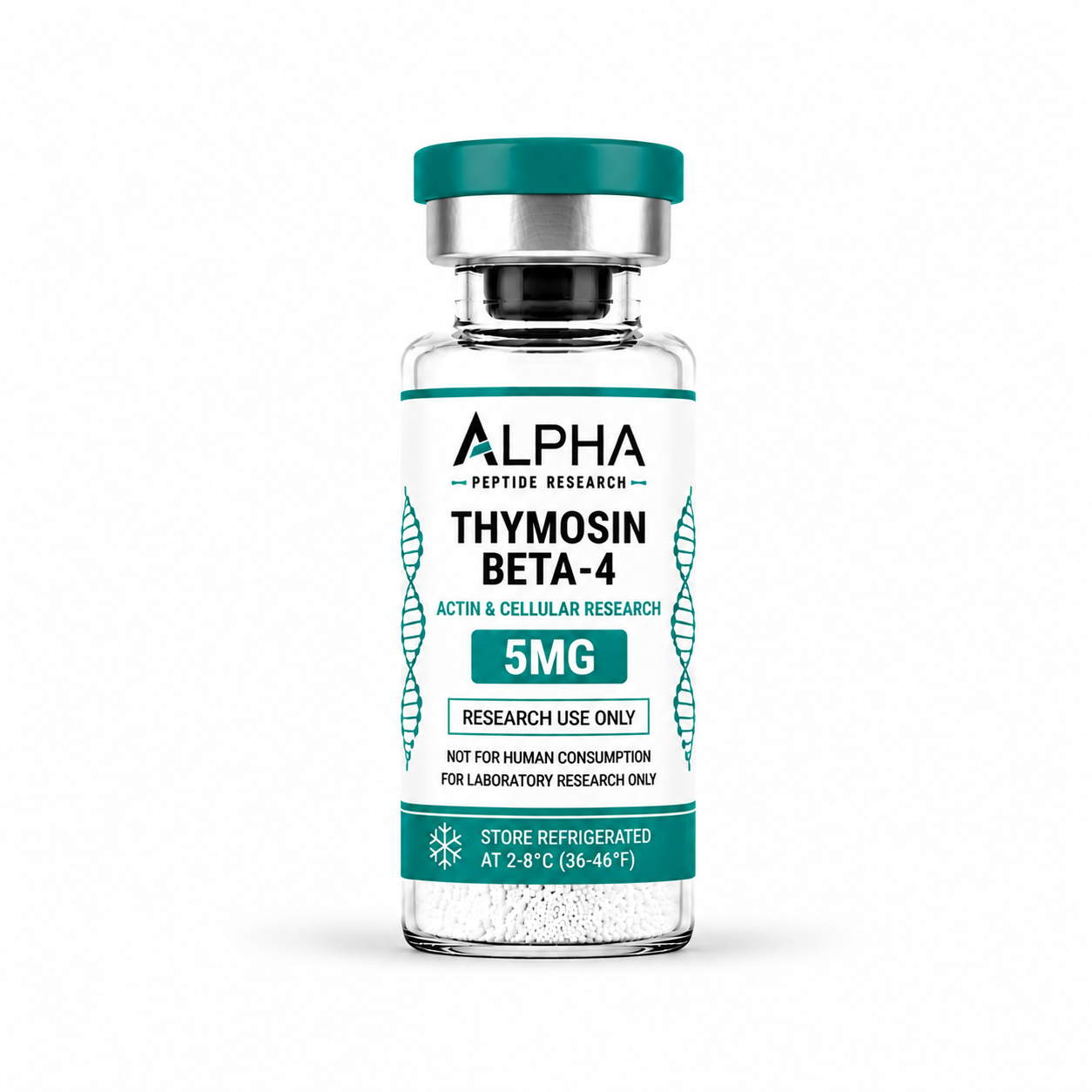
Thymosin Beta-4 5mg
Thymosin Beta-4 5mg is a 43-amino-acid research peptide from Alpha Peptide Research. Commonly abbreviated Tβ4 or TB4, thymosin beta-4 has been investigated in research involving actin regulation, cellular movement, cytoskeletal biology, vascular processes, and tissue-response mechanisms. The 5mg presentation supports controlled scientific investigation. Research Use Only. Not for human consumption.
$200.00
Research Use Only
Products offered by Alpha Peptide Research are intended exclusively for laboratory and scientific research. They are not intended for human consumption, therapeutic use, veterinary use, or diagnostic purposes.
Thymosin Beta-4 5mg adds a defined 43-amino-acid peptide to the Alpha Peptide Research Healing Peptides collection.
Commonly abbreviated Tβ4 or TB4, thymosin beta-4 occurs naturally in many mammalian tissues and cell types. Researchers have studied the peptide extensively because of its relationship with actin, a protein that plays a central role in cellular structure and movement.
In addition, scientific studies have explored thymosin beta-4 in areas involving cellular migration, cytoskeletal organization, vascular biology, and tissue-response mechanisms.
Its broad research history makes Tβ4 relevant to laboratories investigating fundamental cellular processes. However, Alpha Peptide Research supplies Thymosin Beta-4 5mg strictly as a laboratory research material.
What Is Thymosin Beta-4?
Thymosin beta-4 is a naturally occurring peptide containing 43 amino-acid residues.
Scientists originally identified thymosin peptides through research involving the thymus. Further investigation showed that thymosin beta-4 occurs widely throughout the body rather than functioning solely as a thymic peptide.
One of its best-known biochemical characteristics involves its interaction with G-actin, the globular form of actin.
As a result, researchers have investigated Tβ4 extensively in studies involving actin dynamics and cytoskeletal biology.
The peptide’s research profile also extends to cell movement and several tissue-related biological mechanisms.
Why Do Researchers Study Thymosin Beta-4?
Cells depend on highly organized molecular systems to maintain their structure, move, divide, and respond to environmental changes.
Actin plays an important role in many of these processes. Thymosin beta-4 has attracted scientific attention because of its ability to interact with actin.
Therefore, laboratories may investigate Tβ4 when studying cytoskeletal organization, cell movement, and related molecular mechanisms.
Furthermore, research has explored thymosin beta-4 in experimental models involving vascular and tissue biology.
Scientists should interpret these observations within the limits of each model. Experimental findings do not establish Thymosin Beta-4 5mg as an approved therapeutic product.
Thymosin Beta-4 and Actin Research
Actin is one of the most abundant proteins in many eukaryotic cells.
It can exist as individual globular units known as G-actin. These units can also assemble into filamentous structures known as F-actin.
Thymosin beta-4 can bind monomeric actin. Consequently, researchers have studied the peptide’s role in actin availability and cytoskeletal dynamics.
This interaction provides scientists with an important research area for investigating how cells control structural changes.
Moreover, actin-related mechanisms connect with many other cellular processes, including movement and changes in cell shape.
Cytoskeletal Biology Research
The cytoskeleton provides cells with internal structural organization.
Actin filaments form one major part of this system. Other components work alongside them to help cells maintain shape and respond to their surroundings.
Researchers study thymosin beta-4 to explore how actin regulation contributes to cytoskeletal behavior.
For example, laboratories may examine changes in cell morphology, molecular interactions, or actin-associated processes under controlled conditions.
These studies can help scientists understand fundamental cellular mechanisms.
Cellular Movement Research
Cells move during many normal biological processes.
To accomplish this movement, cells must reorganize parts of their cytoskeleton. Actin dynamics play an important role in that process.
Because thymosin beta-4 interacts with actin, researchers have investigated it in experimental models involving cellular migration.
Scientists may compare peptide-exposed models with appropriate controls and measure changes in cellular behavior.
In this way, researchers can examine specific mechanisms while controlling other experimental variables.
Tissue Biology Research
Tissues contain cells, extracellular structures, signaling molecules, and vascular components that interact continuously.
Researchers use controlled models to understand how these systems respond to different biological conditions.
Thymosin beta-4 has appeared in preclinical research involving several aspects of tissue biology.
For instance, studies may investigate cellular migration, molecular signaling, vascular processes, or cytoskeletal changes.
Such research helps scientists understand biological mechanisms. Nevertheless, preclinical observations should not become claims that Thymosin Beta-4 5mg heals injuries or repairs human tissue.
Vascular Biology Research
Blood vessels depend on coordinated activity among endothelial cells, structural proteins, signaling molecules, and other biological components.
Scientists investigate these systems to better understand vascular biology.
Thymosin beta-4 has attracted research interest in this area. In particular, experimental studies have explored cellular and molecular mechanisms associated with vascular responses.
Researchers may measure cellular movement, molecular markers, signaling activity, or other defined endpoints.
However, results depend on the model and experimental conditions. Researchers should therefore avoid extending findings beyond the available evidence.
Thymosin Beta-4 vs. TB-500
Thymosin Beta-4 and TB-500 are often discussed together, but the names should not automatically be treated as interchangeable.
Thymosin Beta-4 refers to a defined naturally occurring peptide containing 43 amino-acid residues.
TB-500, meanwhile, is a name used commercially for research products associated with thymosin beta-4 research. The precise composition of a TB-500 product should come from its product-specific analytical documentation.
Therefore, Thymosin Beta-4 5mg provides a clearly identified Tβ4 research presentation, while our TB-500 products remain separate catalog entries.
This distinction improves product clarity and gives researchers more accurate information about the material they are purchasing.
Thymosin Beta-4 vs. Thymosin Alpha-1
Although both peptides carry the thymosin name, Thymosin Beta-4 and Thymosin Alpha-1 are different molecules.
Thymosin Beta-4 contains 43 amino-acid residues and has a strong research connection with actin, cytoskeletal biology, and cellular movement.
Thymosin Alpha-1 contains 28 amino-acid residues and has been studied primarily in immune and cellular signaling research.
Consequently, each peptide supports different experimental questions.
Including both in the Healing Peptides collection gives researchers access to two distinct thymosin research materials.
Why Choose Thymosin Beta-4 5mg?
Thymosin Beta-4 5mg provides a defined peptide presentation for laboratories investigating cellular and actin-related biology.
Its main product characteristics include:
- 5mg research presentation
- Defined thymosin beta-4 peptide
- 43 amino-acid residues
- Commonly abbreviated Tβ4 or TB4
- Actin-related research applications
- Cytoskeletal biology research
- Cellular movement research
- Professional laboratory vial
- Research Use Only labeling
- Not intended for human consumption
- Consistent Alpha Peptide Research presentation
Overall, Tβ4 adds another distinct research direction to our Healing Peptides collection.
Product Specifications
| Specification | Details |
|---|---|
| Product Name | Thymosin Beta-4 |
| Common Abbreviations | Tβ4, TB4 |
| Quantity | 5mg |
| Peptide Length | 43 amino-acid residues |
| Product Type | Research Peptide |
| Category | Healing Peptides |
| Primary Research Area | Actin & Cellular Biology |
| Additional Research Areas | Cytoskeletal, Cellular Movement & Vascular Biology |
| Presentation | Laboratory Research Vial |
| Intended Use | Laboratory Research Only |
| Human Consumption | Not Intended |
| Brand | Alpha Peptide Research |
| Product Number | Healing Peptides #9 |
Thymosin Beta-4 5mg Research Presentation
The 5mg presentation provides laboratories with a clearly identified quantity of Thymosin Beta-4 research material.
Researchers may incorporate appropriately characterized Tβ4 into biochemical, analytical, cellular, or other controlled experimental models.
Depending on the study, laboratories may investigate peptide-actin interactions, cytoskeletal processes, cell movement, or related mechanisms.
The 5mg specification describes the quantity of research material supplied in the vial. It does not represent a human dose, veterinary dose, or administration recommendation.
Instead, researchers should determine material requirements according to their experimental protocols.
Quality and Analytical Documentation
Reliable research begins with well-characterized materials.
For this reason, laboratories should review batch-specific analytical documentation before using Thymosin Beta-4 5mg in an experiment.
Relevant records may include identity confirmation, sequence verification, analytical purity results, molecular characterization, batch number, and quantity.
Furthermore, accurate identity information is especially useful when distinguishing Tβ4 from products marketed under the TB-500 name.
Alpha Peptide Research should only publish specific purity percentages or testing claims when supporting documentation exists for the supplied batch.
Storage and Laboratory Handling
Researchers should follow the validated storage conditions for the specific Thymosin Beta-4 5mg formulation and batch.
Keep the vial securely closed and protect the material from unsuitable environmental conditions. Additionally, laboratories should maintain records of batch numbers, inventory, and storage conditions.
Qualified personnel should follow established laboratory procedures when handling research peptides.
Any storage temperature displayed on the vial or product page should match verified documentation for the actual formulation.
Controlled Laboratory Research
Thymosin Beta-4 5mg supports controlled scientific studies involving peptide and cellular biology.
Research areas may include actin regulation, cytoskeletal processes, cellular movement, vascular biology, and tissue-response mechanisms.
For example, scientists can compare experimental systems exposed to Tβ4 with suitable controls and evaluate clearly defined cellular endpoints.
Moreover, multiple analytical approaches can help researchers examine different aspects of peptide behavior.
Ultimately, strong experimental design and careful documentation support more reliable interpretation.
Research Use Only
Alpha Peptide Research supplies Thymosin Beta-4 5mg exclusively for scientific and laboratory research.
The product is not intended for human consumption, self-administration, diagnosis, therapeutic use, or veterinary treatment.
Furthermore, it should not be presented as a product that heals injuries, accelerates recovery, or treats disease.
The 5mg designation identifies research quantity only and does not provide dosing or administration guidance.
Frequently Asked Questions
What is Thymosin Beta-4 5mg?
Thymosin Beta-4 5mg is a laboratory research presentation containing 5mg of the peptide thymosin beta-4.
What is Tβ4?
Tβ4 is a common abbreviation for thymosin beta-4.
How many amino acids does Thymosin Beta-4 contain?
Thymosin beta-4 contains 43 amino-acid residues.
Why do scientists study Thymosin Beta-4?
Researchers study Tβ4 in areas involving actin regulation, cytoskeletal biology, cellular movement, vascular processes, and other cellular mechanisms.
What is the relationship between Thymosin Beta-4 and actin?
Thymosin beta-4 can interact with monomeric G-actin. Therefore, actin regulation represents an important area of Tβ4 research.
Is Thymosin Beta-4 the same as TB-500?
Researchers should not automatically treat the terms as identical. Thymosin Beta-4 refers to a defined 43-amino-acid peptide, while the exact composition of a product marketed as TB-500 should be verified from its analytical documentation.
Is Thymosin Beta-4 the same as Thymosin Alpha-1?
No. Although both carry the thymosin name, they have different structures and research profiles.
Is Thymosin Beta-4 studied in cellular movement?
Yes. Its relationship with actin has contributed to research involving cellular migration and cytoskeletal dynamics.
Does Thymosin Beta-4 5mg heal injuries?
No such claim should be made. Preclinical research involving tissue-related mechanisms does not establish this laboratory product as a treatment for injuries.
What does 5mg mean?
The 5mg label identifies the quantity of research material supplied. Importantly, it does not represent a recommended dose.
Is Thymosin Beta-4 5mg intended for human consumption?
No. Alpha Peptide Research supplies the product exclusively for controlled laboratory research.
How should researchers store Thymosin Beta-4 5mg?
Follow the validated storage requirements associated with the actual formulation and batch.
Thymosin Beta-4 5mg From Alpha Peptide Research
Thymosin Beta-4 5mg introduces a clearly defined 43-amino-acid Tβ4 presentation into the Alpha Peptide Research Healing Peptides collection.
Its interaction with actin has contributed to scientific interest in cytoskeletal organization, cellular movement, vascular biology, and related cellular mechanisms.
In addition, keeping Tβ4 separate from our TB-500 products makes the catalog clearer about the identity of each research material.
The 5mg presentation provides laboratories with a dedicated format for appropriately designed experiments, while professional labeling and analytical documentation support accurate identification.
Overall, Thymosin Beta-4 5mg expands the collection with an important peptide for actin and cellular biology research.
Thymosin Beta-4 5mg is for laboratory research only and is not intended for human consumption.
Be the first to review “Thymosin Beta-4 5mg”
Related products
Reviews
There are no reviews yet.